
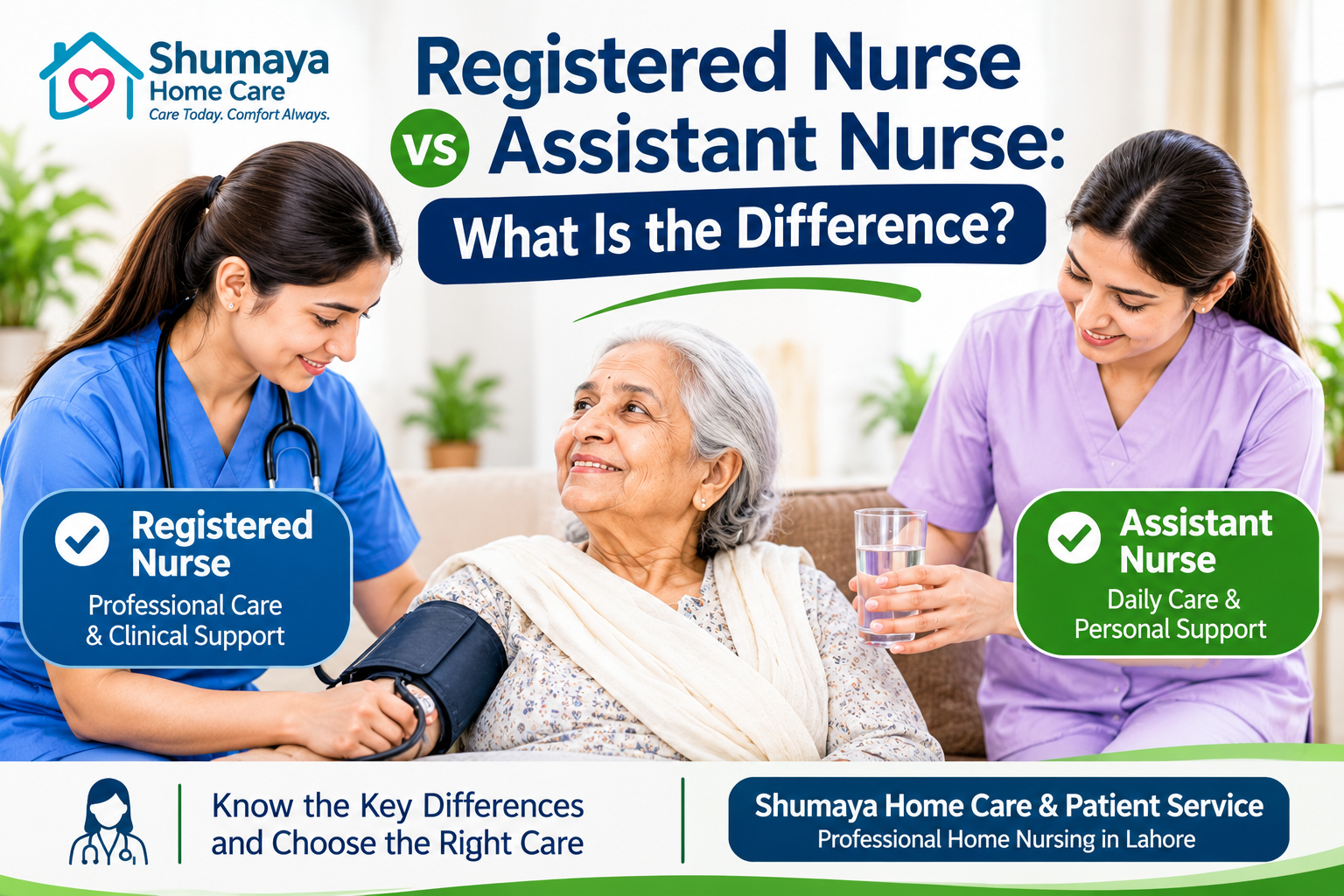
When arranging professional care for a patient at home, families often ask whether they need a registered nurse or an assistant nurse. Although both may support patients, their qualifications, clinical responsibilities and level of professional accountability can be different.
Choosing the right healthcare professional is particularly important for elderly patients, bedridden individuals, people recovering from surgery and patients living with long-term medical conditions.
Understanding the difference between a registered nurse and an assistant nurse can help families make a safer and more informed decision.
At Shumaya Home Care & Patient Service, we understand that every patient has different care requirements. Some need professional nursing services, while others may benefit from trained assistance with daily activities and personal care.
Quick Answer: Registered Nurse vs Assistant Nurse
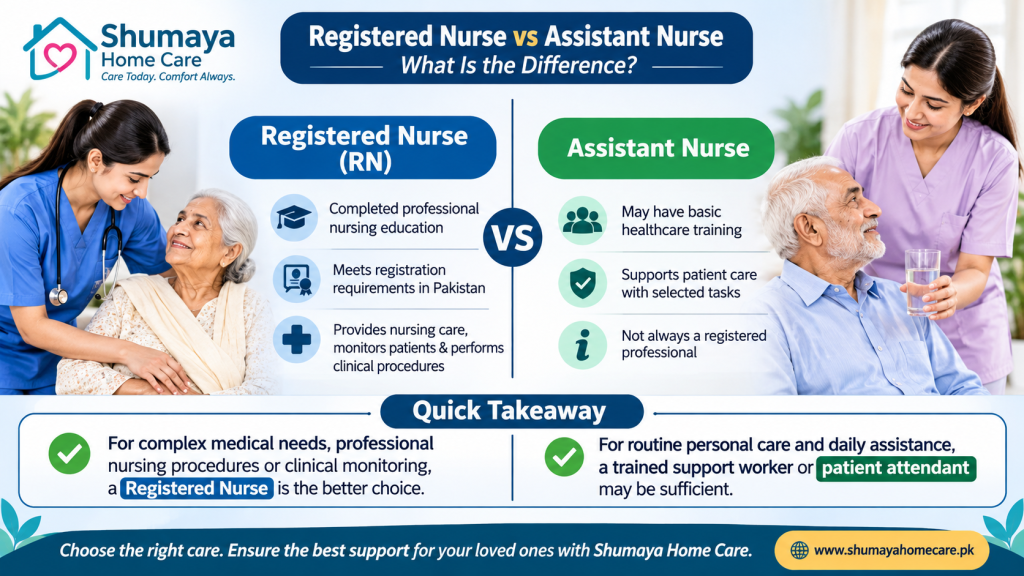
The main difference between a registered nurse and an assistant nurse is their professional qualification, registration status and scope of responsibilities.
A Registered Nurse (RN) has completed the required nursing education and meets the applicable professional registration requirements in Pakistan. Registered nurses are trained to provide nursing care, monitor patients, assess clinical needs within their professional scope and perform appropriate nursing procedures.
An assistant nurse is a job title that may describe someone trained to support patients with basic care activities and selected healthcare tasks. However, the title is not enough to establish a person’s exact qualification, registration status or authority to perform clinical procedures.
For patients with complex medical needs, professional nursing procedures or clinical monitoring requirements, a suitably qualified registered nurse is generally the more appropriate choice. For routine personal care and daily assistance, a trained support worker or patient attendant may be sufficient.
What Is a Registered Nurse?
A registered nurse is a qualified nursing professional who has completed an approved nursing education programme and fulfils the applicable registration requirements of the Pakistan Nursing and Midwifery Council (PNMC).
Registered nurses receive professional training in patient assessment, nursing procedures, infection prevention, medication safety, clinical monitoring and patient education.
Their responsibilities depend on their qualifications, experience, clinical competence, applicable professional requirements and the patient’s care plan.
Qualifications of a Registered Nurse in Pakistan
In Pakistan, nursing education and professional registration are regulated through the Pakistan Nursing and Midwifery Council.
When hiring a registered nurse for home care, families should consider:
Completion of an approved nursing education programme.
Valid professional registration with the relevant regulatory body.
Relevant clinical experience.
Training related to the patient’s medical condition.
Experience with the required nursing procedures.
Ability to communicate with patients, families and healthcare professionals.
Families should verify the nurse’s current registration and credentials rather than relying only on a job title or verbal assurance.
Main Responsibilities of a Registered Nurse
Depending on their training, competence and assigned care plan, a registered nurse may provide:
1. Patient Assessment and Monitoring
A registered nurse can assess a patient’s nursing needs, monitor relevant health observations and identify changes that may require medical attention.
2. Medication Administration
A nurse may administer prescribed medication within their professional scope and applicable requirements. Medication should always follow the treating doctor’s prescription and instructions.
3. Wound Care and Dressing
Registered nurses with appropriate training may provide wound assessment and dressing care, including monitoring for signs of infection and reporting concerns.
4. Nursing Procedures
Depending on the nurse’s competence, authorization and the patient’s care plan, nursing procedures may include injections, catheter-related care and other prescribed interventions.
5. Post-Surgical Nursing Care
Patients recovering from surgery may require wound monitoring, medication support, mobility guidance and observation for complications. A suitably qualified nurse can provide nursing care according to the discharge instructions and treatment plan.
6. Patient and Family Education
Registered nurses can explain relevant care instructions, help families understand the patient’s nursing needs and communicate concerns to the treating healthcare team.
What Is an Assistant Nurse?
The term assistant nurse is commonly used by healthcare providers to describe a person who supports patients and nursing teams with selected care activities.
However, the title does not always represent the same qualification or professional category. Training, certification and responsibilities can differ between institutions and service providers.
An assistant nurse may have training in basic patient care, hygiene, mobility assistance, observation and other support activities. Some individuals may have additional healthcare training, but this should be verified rather than assumed.
Families should ask about the person’s actual qualification, practical training, experience and the duties they are permitted to perform.
Qualifications and Training of an Assistant Nurse
Before hiring an assistant nurse, check:
What training or certificate has the person completed?
Which institution provided the training?
Does the person have practical patient-care experience?
Have they received training in hygiene and infection prevention?
Can they safely assist with mobility, feeding and personal care?
Are they trained to recognize and report changes in a patient’s condition?
What responsibilities will they perform under the care plan?
A person should not be considered qualified to perform a clinical procedure simply because their job title includes the word “nurse.”
Main Responsibilities of an Assistant Nurse
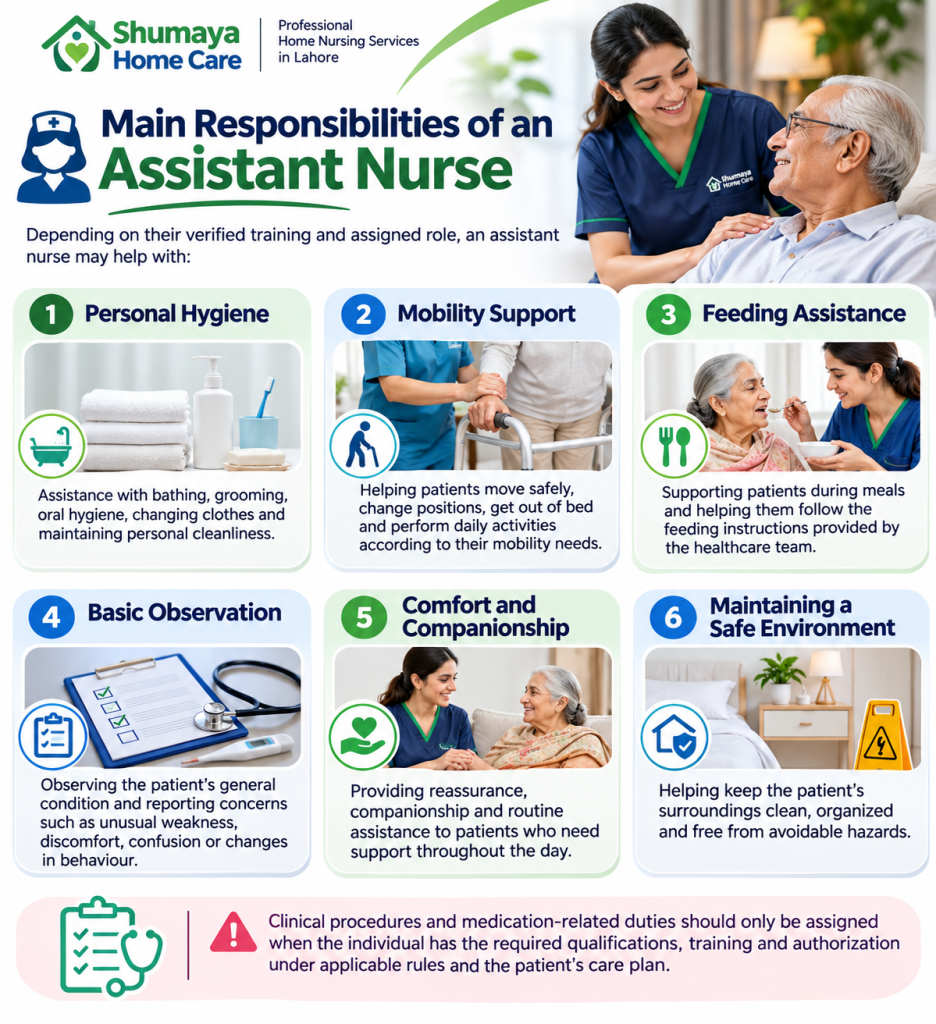
Depending on their verified training and assigned role, an assistant nurse may help with:
1. Personal Hygiene
Assistance with bathing, grooming, oral hygiene, changing clothes and maintaining personal cleanliness.
2. Mobility Support
Helping patients move safely, change positions, get out of bed and perform daily activities according to their mobility needs.
3. Feeding Assistance
Supporting patients during meals and helping them follow the feeding instructions provided by the healthcare team.
4. Basic Observation
Observing the patient’s general condition and reporting concerns such as unusual weakness, discomfort, confusion or changes in behaviour.
5. Comfort and Companionship
Providing reassurance, companionship and routine assistance to patients who need support throughout the day.
6. Maintaining a Safe Environment
Helping keep the patient’s surroundings clean, organized and free from avoidable hazards.
Clinical procedures and medication-related duties should only be assigned when the individual has the required qualifications, training and authorization under applicable rules and the patient’s care plan.
Registered Nurse vs Assistant Nurse: Main Differences
The following table explains the general differences. Actual responsibilities depend on verified qualifications, professional requirements and the assigned care plan.
| Comparison | Registered Nurse | Assistant Nurse |
|---|---|---|
| Professional qualification | Approved nursing education | Varies by training and job designation |
| Professional registration | Meets applicable registration requirements | Must be verified; title alone does not establish registration |
| Patient assessment | Within professional nursing scope | Generally supports observation and reporting |
| Clinical monitoring | Can monitor and assess nursing needs within competence | May assist with basic observations if trained and permitted |
| Medication responsibilities | May administer prescribed medication within scope | Depends on verified qualification and authorization |
| Injections | Only when trained, competent and permitted | Do not assume authorization from job title |
| Wound care | May provide appropriate nursing wound care | Only if specifically trained and permitted |
| Personal care | Can provide or supervise appropriate care | Often supports daily personal care |
| Mobility assistance | Can assess nursing-related mobility needs | May assist with routine mobility |
| Clinical decision-making | Within professional scope | Does not replace registered nursing judgment |
| Complex patient care | More appropriate when professional nursing care is required | Suitable only for duties within the person’s competence |
Important: This is a general comparison, not a legal definition of every job title used in Pakistan. Families should confirm the exact qualification and permitted scope of each healthcare worker.
Which Professional Is Better for Home Patient Care?
The right choice depends on the patient’s medical condition, level of dependency and type of care required.
Some patients need clinical nursing support, while others mainly need help with personal activities and daily routines.
When Should You Hire a Registered Nurse at Home?
A registered nurse may be needed when a patient:
Has recently undergone major surgery.
Requires prescribed nursing procedures.
Needs professional wound assessment or dressing care.
Has a medical condition requiring regular clinical monitoring.
Requires nursing support after hospital discharge.
Has complex care needs that require professional nursing judgment.
Needs care that must be provided by a qualified nursing professional.
For these situations, families should discuss the patient’s requirements with the treating doctor and arrange a nurse with suitable experience.
Shumaya provides home nursing services in Lahore for patients who require professional nursing support at home.
When Is an Assistant Nurse or Patient Attendant Enough?
A trained assistant nurse or patient attendant may be suitable when the patient mainly needs help with everyday activities, such as:
Bathing and grooming.
Changing clothes.
Feeding assistance.
Toileting and personal hygiene.
Routine mobility assistance.
Repositioning and comfort support.
Companionship and daily supervision.
Reporting changes in the patient’s general condition.
However, if the patient’s condition changes or clinical needs increase, the family should arrange an appropriate nursing assessment rather than expecting a support worker to manage responsibilities outside their training.
Registered Nurse vs Assistant Nurse for Elderly Patients
Older adults may experience reduced mobility, weakness, memory problems and long-term medical conditions. Their care requirements can range from routine daily assistance to complex nursing support.
The appropriate professional depends on the patient’s health and independence.
When an Elderly Patient Needs a Registered Nurse
A registered nurse may be appropriate for an elderly patient who:
Has multiple medical conditions requiring nursing oversight.
Has recently returned home after hospitalization.
Needs prescribed wound care.
Requires nursing procedures.
Has a condition that requires professional clinical monitoring.
Needs nursing support as part of a doctor-directed care plan.
When an Elderly Patient Needs Daily Care Assistance
A trained assistant or patient attendant may be appropriate when the main requirements include:
Help with bathing and dressing.
Assistance with meals.
Support with walking and movement.
Personal hygiene and toileting.
Companionship and routine supervision.
Assistance with daily activities.
Families arranging elderly patient care at home in Lahore, Pakistan should assess the older person’s medical needs and daily living requirements before choosing a caregiver.
For patients who need both nursing and daily personal care, a coordinated care arrangement may be more suitable.
Assistant Nurse vs Patient Attendant: Are They the Same?
The terms assistant nurse and patient attendant are sometimes used interchangeably, but they should not automatically be treated as identical.
A patient attendant generally focuses on non-clinical daily assistance, personal hygiene, feeding, mobility, comfort and companionship.
An assistant nurse may have additional healthcare-related training, depending on the person’s actual qualification and the provider’s job description.
The most important point is to verify what the individual is trained and permitted to do.
For example:
A patient attendant may help an elderly person with bathing and dressing.
A trained assistant may support basic patient observations if this is within their training and assigned role.
A registered nurse may provide professional nursing assessment and appropriate clinical care within their scope.
Families should never rely on job titles alone when assigning clinical responsibilities.
How to Verify a Registered Nurse’s Qualifications in Pakistan
Before hiring a nurse for home patient care, take time to verify their professional background.
1. Check Nursing Education
Ask which nursing programme the individual completed and which institution provided the qualification.
2. Verify PNMC Registration
Ask for the nurse’s registration details and verify their current professional status through the relevant PNMC verification process.
3. Ask About Clinical Experience
Experience matters, particularly when caring for elderly, bedridden, post-surgical or critically ill patients.
Ask whether the nurse has previously managed patients with similar care requirements.
4. Confirm Relevant Training
A nurse caring for a patient with complex needs should have suitable training and experience related to those needs.
5. Discuss the Care Plan
Clearly explain the patient’s medical condition, prescribed treatment, mobility limitations and daily care requirements.
The family and healthcare provider should agree on the duties, working hours, reporting arrangements and escalation process.
Male or Female Registered Nurse: Which Should You Choose?
The choice between a male and female nurse depends on the patient’s comfort, personal preference and care requirements.
Some patients may feel more comfortable receiving personal care from a caregiver of the same gender. Others may prioritize specific nursing experience or availability.
When arranging a nurse, consider:
The patient’s preference.
The type of personal care required.
The nurse’s qualifications and experience.
The patient’s medical condition.
The availability of suitable staff.
Shumaya Home Care & Patient Service provides gender-specific staff nurse and patient attendant services according to patient requirements and staff availability.
How to Choose the Right Home Nursing Professional in Lahore
Finding a suitable healthcare professional requires more than comparing job titles or service prices.
Before making a decision, consider these factors:
Understand the patient’s needs: Identify whether the patient needs clinical nursing care, personal assistance or both.
Check qualifications: Verify professional registration where applicable and ask for evidence of relevant training.
Review experience: Choose someone with experience related to the patient’s condition and care requirements.
Clarify responsibilities: Discuss exactly which tasks the professional will perform and which tasks require a registered nurse or doctor.
Confirm availability: Ask about working hours, replacement arrangements and supervision.
Maintain communication: Ensure the family can receive updates and report concerns to the service provider.
If you are looking for professional home patient services in Lahore, Pakistan, selecting the right level of care can help support patient comfort, safety and continuity of care.
Frequently Asked Questions
1. What is the main difference between a registered nurse and an assistant nurse?
A registered nurse has completed the required nursing education and meets applicable professional registration requirements. An assistant nurse is a job title that may describe a healthcare support role, but the person’s actual training and responsibilities must be verified.
2. Is an assistant nurse qualified to give injections?
Not necessarily. The job title alone does not establish authorization to administer injections. The individual’s qualification, practical competence and applicable professional requirements must be checked. Prescribed injections should be administered by an appropriately qualified and authorized healthcare professional.
3. Can an assistant nurse work independently at home?
This depends on the person’s verified qualifications and assigned responsibilities. A support worker may provide routine assistance within their training, but should not independently take on clinical responsibilities that require a qualified nursing professional.
4. What qualifications should a home nurse have in Pakistan?
A professional registered nurse should have completed an approved nursing education programme and meet applicable PNMC registration requirements. Families should verify current registration, experience and relevant clinical training.
5. Does an elderly patient need a registered nurse?
Not every elderly patient needs a registered nurse. Some older adults mainly require help with daily activities, while others need professional nursing care because of medical conditions, recent hospitalization or prescribed procedures.
6. Is an assistant nurse the same as a patient attendant?
No. A patient attendant generally provides daily personal care and non-clinical assistance. An assistant nurse may have additional healthcare training, but the exact role depends on the individual’s qualification and assigned duties.
7. How do I choose between a registered nurse and an assistant nurse for a bedridden patient?
Consider the patient’s medical condition and care plan. If professional nursing procedures, clinical assessment or complex monitoring are required, arrange a suitably qualified registered nurse. If the patient mainly needs help with hygiene, feeding, repositioning and mobility, a trained attendant may be appropriate. Some patients need both.
8. Can I hire a male or female nurse in Lahore?
Yes, subject to staff availability and the patient’s requirements. Families can discuss gender preferences, qualifications, experience and the type of care needed with the home-care provider.
9. How much does a home nurse cost in Lahore?
The cost depends on the nurse’s qualifications, experience, working hours, patient’s medical condition and level of care required. Day shifts, night shifts and 24-hour arrangements may have different charges. Request a quotation based on the patient’s actual needs.
Arrange Professional Home Nursing and Patient Care in Lahore
Choosing between a registered nurse and an assistant nurse is an important decision for any family arranging healthcare at home.
A registered nurse is generally more appropriate when a patient requires professional nursing assessment, prescribed clinical procedures or complex nursing support. A trained assistant or patient attendant may be suitable for daily personal care, mobility assistance and routine support.
At Shumaya Home Care & Patient Service, we provide home nursing and patient-care support in Lahore, including professional nursing staff and patient attendants according to individual care requirements.
Whether your family needs a registered nurse, assistant nurse or patient attendant, the first step is to understand the patient’s condition and arrange an appropriate level of care.
Contact Shumaya Home Care & Patient Service to discuss your home nursing and patient-care requirements in Lahore.
Website: https://www.shumayahomecare.pk/
Home Nursing Services: https://www.shumayahomecare.pk/nursing-services-in-lahore/
Assistant Nurse Services: https://www.shumayahomecare.pk/assistant-nurse/