

Caring for a patient with a urinary catheter at home requires proper hygiene, careful handling, and regular observation. A urinary catheter helps drain urine from the bladder when a person cannot pass urine normally or needs bladder drainage for a medical reason.
Although catheter care may become part of a patient’s daily routine, incorrect handling can increase the risk of infection, blockage, leakage, and discomfort. Family caregivers should understand the basic precautions and know when to contact a healthcare professional.
This guide explains how to manage a urinary catheter at home, maintain hygiene, reduce the risk of catheter-associated urinary tract infections (CAUTIs), and recognize common warning signs.
What Is a Urinary Catheter?
A urinary catheter is a thin, flexible tube inserted into the bladder to drain urine into a collection bag or container.
A doctor may recommend catheterization for patients who:
Cannot empty their bladder properly.
Have urinary retention.
Need bladder drainage after certain surgeries.
Have specific neurological conditions affecting bladder function.
Require accurate urine output monitoring during medical care.
Need assistance with bladder drainage because of certain medical conditions.
A catheter should only be used when medically necessary. The healthcare team should review its continued need regularly because unnecessary catheter use increases the risk of infection and other complications.
Types of Urinary Catheters
Different types of catheters are used depending on the patient’s medical condition and treatment plan.
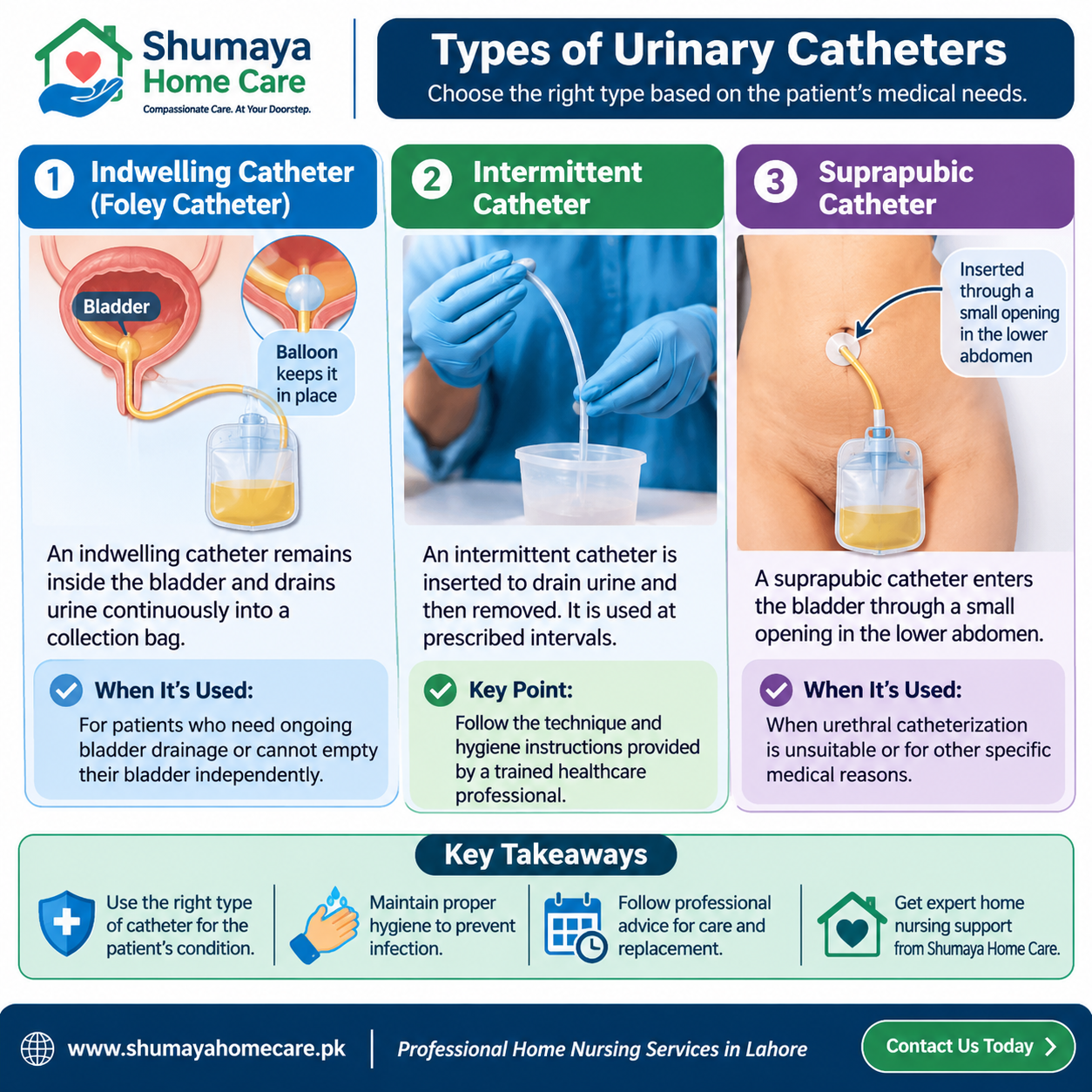
1. Indwelling Catheter (Foley Catheter)
An indwelling catheter remains inside the bladder and drains urine continuously into a collection bag. A small balloon helps keep it in place.
It may be used for patients who require ongoing bladder drainage or cannot empty their bladder independently.
2. Intermittent Catheter
An intermittent catheter is inserted to drain urine and then removed. It is used at prescribed intervals rather than remaining inside the bladder continuously.
Patients or caregivers should follow the technique and hygiene instructions provided by a trained healthcare professional.
3. Suprapubic Catheter
A suprapubic catheter enters the bladder through a small opening in the lower abdomen. It may be recommended when urethral catheterization is unsuitable or for other specific medical reasons.
The insertion site requires appropriate care according to the clinician’s instructions.
Daily Urinary Catheter Care at Home
Daily catheter care helps maintain hygiene, reduce irritation, and support proper urine drainage.
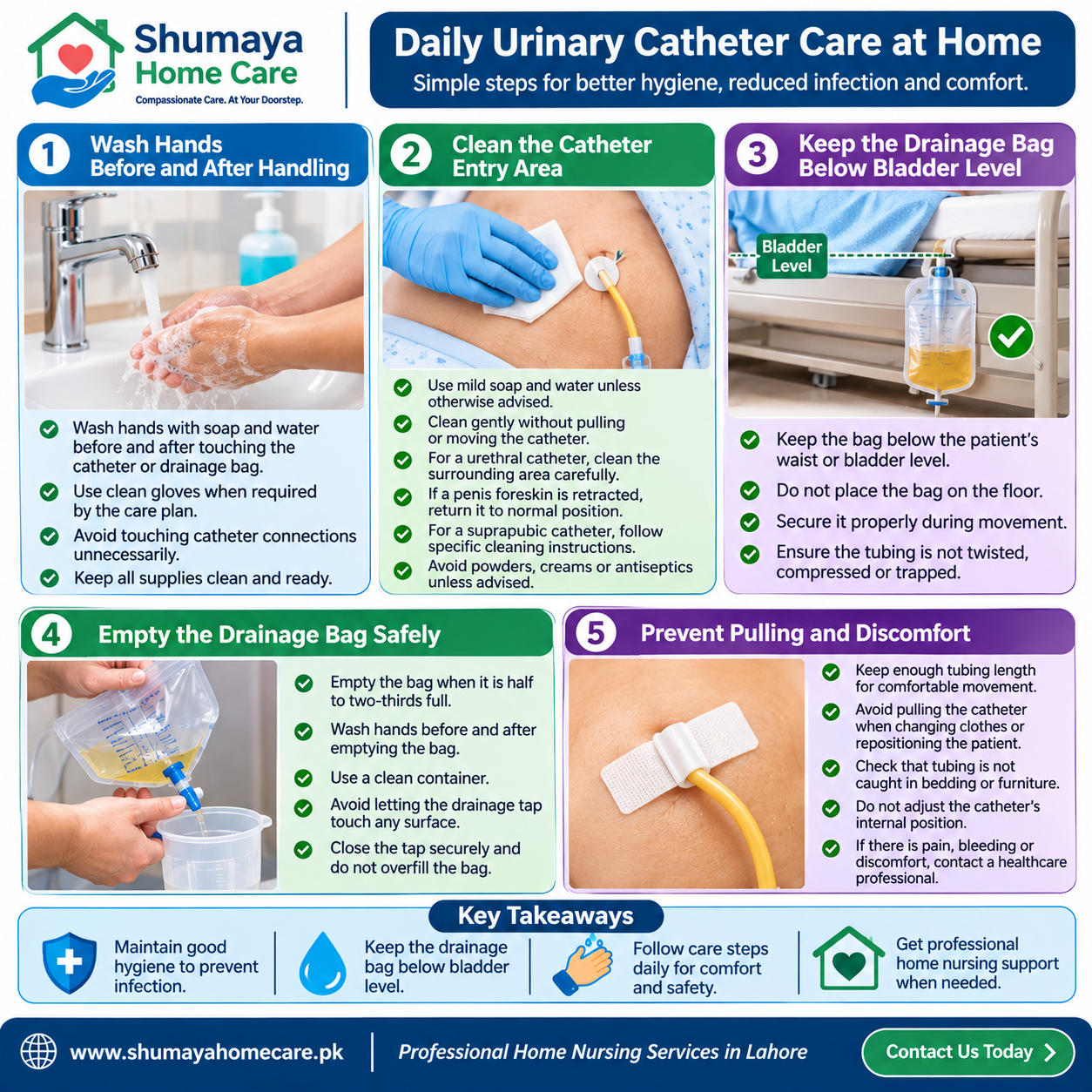
1. Wash Hands Before and After Handling
Hand hygiene is one of the most important precautions.
Wash hands with soap and water before and after touching the catheter or drainage bag.
Use clean gloves when required by the care plan.
Avoid touching the catheter connections unnecessarily.
Keep all supplies clean and ready before providing care.
2. Clean the Catheter Entry Area
Clean the area where the catheter enters the body every day and after bowel movements or soiling.
Use mild soap and water unless the healthcare professional recommends otherwise.
Clean gently without pulling or moving the catheter.
For a patient with a urethral catheter, clean the surrounding genital area carefully.
If the patient has a penis and the foreskin is retracted for cleaning, return it to its normal position afterward.
For a suprapubic catheter, follow the specific instructions for cleaning the abdominal insertion site.
Avoid applying powders, creams, antiseptics, or other products around the catheter unless specifically advised by a healthcare professional.
3. Keep the Drainage Bag Below Bladder Level
The urine collection bag should remain below the level of the bladder. This helps prevent urine from flowing backward.
Keep the bag below the patient’s waist or bladder level.
Do not place the bag directly on the floor.
Secure it properly during walking or movement.
Make sure the tubing is not twisted, compressed, or trapped under the patient’s body.
4. Empty the Drainage Bag Safely
Empty the drainage bag when it is around half to two-thirds full, or according to the manufacturer’s and healthcare professional’s instructions.
Wash your hands before and after emptying the bag.
Use a clean, designated container if needed.
Avoid allowing the drainage tap to touch the container or any other surface.
Close the drainage tap securely afterward.
Do not let the bag become excessively full.
5. Prevent Pulling and Discomfort
The catheter should be secured to reduce unnecessary movement and pulling.
Keep enough tubing length for comfortable movement.
Avoid pulling the catheter when changing clothes or repositioning the patient.
Check that the tubing is not caught in bedding or furniture.
Do not attempt to adjust the catheter’s internal position.
If the catheter causes persistent pain, bleeding, or discomfort, contact the healthcare professional responsible for the patient’s care.
How to Reduce the Risk of Catheter-Associated Infection
A urinary tract infection can develop in a patient with a urinary catheter. This is commonly called a catheter-associated urinary tract infection (CAUTI).
The following precautions can help reduce the risk:
Maintain hand hygiene before and after catheter handling.
Keep the drainage system closed and avoid unnecessary disconnection.
Keep the collection bag below bladder level.
Prevent the drainage tubing from becoming kinked or compressed.
Maintain daily hygiene around the catheter entry area.
Empty the collection bag using a clean technique.
Avoid unnecessary handling of catheter connections.
Do not flush or irrigate the catheter unless specifically instructed by a healthcare professional.
Ensure the catheter is reviewed regularly and removed when it is no longer medically needed.
A catheter should not be replaced simply because a fixed number of days has passed unless that schedule is specifically part of the patient’s clinical plan or device instructions. Replacement timing depends on the catheter type, the patient’s condition, and professional guidance.
Catheter Care for Male and Female Patients
The basic principles of catheter care are similar for male and female patients, but hygiene and personal care should respect individual anatomy, comfort, and privacy.
For male patients:
Clean the area around the catheter entry point gently.
If the foreskin is moved during cleaning, return it to its normal position.
Avoid pulling the catheter while changing clothes or providing personal care.
For female patients:
Clean the genital area gently from front to back.
Keep the catheter tubing positioned comfortably to prevent pulling.
Maintain privacy and use a respectful approach during personal care.
Families may also consider the patient’s preference for a male or female caregiver when arranging home nursing support. The caregiver must have the appropriate training and experience for the tasks involved.
Common Urinary Catheter Problems and What to Do
Catheter users may experience leakage, reduced urine flow, discomfort, or other problems. These issues should be handled carefully.
1. Urine Leakage Around the Catheter
Leakage may occur because of bladder spasms, constipation, catheter blockage, or other medical issues.
What to do:
Check whether the tubing is twisted or compressed.
Make sure the drainage bag is below bladder level.
Check whether urine is flowing into the bag.
Contact the healthcare professional if leakage continues or is accompanied by pain or reduced urine output.
Do not try to push the catheter further inside or adjust its internal position.
2. Little or No Urine in the Bag
If urine stops draining, check for simple problems first.
Make sure the bag is below bladder level.
Check for kinks or compression in the tubing.
Make sure the drainage bag is not full.
Check whether the tubing is trapped beneath the patient.
If urine does not start flowing again, contact a healthcare professional promptly. Do not flush, remove, or replace the catheter yourself unless you have been specifically trained and instructed to do so.
Seek urgent medical assessment if the patient has lower abdominal pain, swelling, or a strong urge to pass urine with no drainage.
3. Blood in the Urine
A small amount of blood may sometimes occur after catheter insertion or because of irritation, but visible blood should not be ignored.
Contact the healthcare professional for advice. Seek urgent medical assessment if there are blood clots, heavy bleeding, severe pain, or difficulty draining urine.
4. Unpleasant Smell or Cloudy Urine
Urine may sometimes look cloudy or have a strong smell for reasons other than infection, including changes in hydration or urine concentration.
These signs alone do not confirm a urinary tract infection. Do not start antibiotics without medical assessment and a prescription.
Contact the healthcare professional if these changes occur with other symptoms or if you are concerned about the patient’s condition.
Signs of a Possible Catheter-Associated Urinary Tract Infection
A patient with a urinary catheter should be monitored for symptoms that may indicate infection.
Possible warning signs include:
Fever or chills.
Pain or tenderness in the lower abdomen.
Pain in the back or side.
Feeling unusually unwell or weak.
New or worsening confusion, particularly in older adults.
Blood in the urine.
Other new symptoms that concern the patient’s healthcare team.
Confusion alone does not necessarily mean a urinary tract infection. Older adults can become confused for many different reasons, including dehydration, medication effects, and other illnesses. A healthcare professional should assess the patient rather than assuming the catheter is the cause.
Seek prompt medical advice if infection is suspected. Do not use leftover antibiotics or begin treatment without a clinician’s assessment.
When Should a Urinary Catheter Be Removed?
A urinary catheter should remain in place only for as long as it is medically necessary.
The healthcare team should review the need for the catheter regularly, particularly during long-term use. If the original reason for catheterization has resolved, a clinician may recommend a removal plan or an alternative method of bladder management.
Catheter removal should be performed by a trained and authorized healthcare professional according to the patient’s care plan. Family members and untrained attendants should not remove an indwelling catheter themselves.
When Should You Contact a Doctor or Nurse?
Contact the healthcare professional responsible for the patient’s care if you notice:
Persistent leakage around the catheter.
Reduced or stopped urine drainage.
New pain or discomfort.
Blood in the urine.
Fever, chills, or other possible infection symptoms.
Redness, swelling, discharge, or increasing pain around a suprapubic insertion site.
Accidental pulling or displacement of the catheter.
Repeated blockage or other ongoing catheter problems.
Seek urgent medical care if the patient has severe lower abdominal pain or swelling with no urine drainage, heavy bleeding or blood clots, severe illness, or other rapidly worsening symptoms.
Role of a Professional Home Nurse in Catheter Care
Patients who use urinary catheters may need support with hygiene, mobility, observation, and their wider healthcare routine.
A qualified home nurse can provide catheter-related care when it falls within their training, authorization, and the patient’s clinical care plan.
Professional nursing support may include:
Providing appropriate catheter and insertion-site care.
Monitoring urine drainage and reporting changes.
Observing for possible signs of infection or complications.
Supporting hygiene and patient comfort.
Helping maintain accurate records when required.
Following instructions for prescribed catheter-related procedures.
Informing the responsible clinician about concerning changes.
The exact responsibilities depend on the nurse’s qualifications, local professional requirements, and the patient’s treatment plan.
Professional Nurse vs Patient Attendant for Catheter Care
Families should understand the difference between clinical nursing responsibilities and personal care assistance.
| Responsibility | Professional Nurse | Patient Attendant |
|---|---|---|
| Clinical catheter assessment | Within qualifications and care plan | Not an independent responsibility |
| Prescribed catheter-related procedures | When trained and authorized | Not independently |
| Monitoring urine output | As required by the care plan | May observe and report changes |
| Personal hygiene assistance | Can provide appropriate care | Can assist with daily hygiene |
| Helping with mobility and positioning | Yes | Yes, according to the care plan |
| Reporting unusual symptoms | Yes | Yes, to the responsible nurse or family |
A patient attendant can help with daily comfort, hygiene, mobility, and observation. However, catheter insertion, removal, flushing, replacement, and other clinical procedures should not be assigned to an attendant unless the person is separately qualified, trained, and authorized to perform them.
Catheter Care for Elderly and Bedridden Patients
Older adults and bedridden patients may need additional support because limited mobility, memory difficulties, and other health conditions can make catheter management more challenging.
Families and caregivers should:
Maintain a regular hygiene routine.
Keep the drainage bag positioned correctly during movement and repositioning.
Check that tubing is not trapped beneath the patient.
Observe urine drainage and report unusual changes.
Provide comfortable positioning and protect the catheter from accidental pulling.
Follow the patient’s prescribed fluid intake instructions.
Arrange regular clinical reviews of the catheter.
Patients with heart, kidney, or other medical conditions may have specific fluid restrictions. Do not increase fluid intake without checking the patient’s medical advice.
Home Nursing Support from Shumaya Home Care in Lahore
Managing a catheter at home can be challenging for families, especially when a patient is elderly, bedridden, recovering from surgery, or living with a long-term medical condition.
Shumaya Home Care & Patient Service provides home nursing and patient care support in Lahore, including male and female nursing staff according to patient requirements and staff availability.
A qualified nurse may assist with catheter-related care when the required task is within their professional training and the patient’s care plan. Patient attendants can support personal hygiene, mobility, comfort, and daily care needs under appropriate guidance.
To learn more about available support, visit our Home Nursing Services in Lahore page.
Frequently Asked Questions About Urinary Catheter Care at Home
1. How often should a urinary catheter be cleaned?
Clean the area around the catheter every day and after bowel movements or soiling. Follow the healthcare professional’s instructions for the specific catheter type and insertion site.
2. Should the catheter drainage bag always remain below the bladder?
Yes. Keeping the drainage bag below bladder level helps prevent urine from flowing backward. The bag should also remain off the floor.
3. Can a patient take a shower with a urinary catheter?
Many patients with urinary catheters can shower, but they should follow the instructions provided by their healthcare professional. Avoid pulling the catheter or allowing the tubing to become trapped.
4. Does cloudy or smelly urine always mean infection?
No. Cloudy or strong-smelling urine alone does not confirm a urinary tract infection. Other symptoms and clinical assessment are needed to determine whether infection is present.
5. Can a patient attendant manage a urinary catheter?
A patient attendant can assist with personal hygiene, comfort, mobility, and observation. Clinical catheter procedures must be performed by a suitably qualified, trained, and authorized professional.
6. How often should a urinary catheter be replaced?
There is no single replacement schedule suitable for every patient. Timing depends on the catheter type, manufacturer’s instructions, clinical condition, and healthcare professional’s recommendations.
7. What should I do if urine stops flowing into the catheter bag?
Check whether the tubing is kinked or compressed and whether the bag is positioned below the bladder. If drainage does not resume, contact a healthcare professional promptly. Do not attempt to flush or remove the catheter unless specifically trained and instructed.
Conclusion
Safe urinary catheter care at home depends on proper hygiene, careful handling, correct drainage bag positioning, and regular clinical review. Families should monitor the patient for possible infection symptoms, leakage, blockage, discomfort, or changes in urine drainage.
A urinary catheter should be used only when medically necessary and removed when no longer required, under professional guidance.
For patients who need ongoing assistance, a qualified home nurse can help provide appropriate catheter-related care and monitor for potential complications. Early attention to unusual symptoms can help families seek medical advice before problems become more serious.