

Bedridden Elderly Care Guide: How to Care for an Older Adult at Home
Caring for a bedridden older adult at home can be challenging. Simple tasks such as bathing, eating, changing clothes, using the toilet, or getting into a comfortable position may require help.
Good bedridden elderly care is about more than keeping someone comfortable in bed. Daily care should also help protect their skin, support nutrition and hydration, maintain safe movement, manage medicines, and protect their dignity.
The right routine depends on why the person is bedridden, how much they can move, and what other health problems they have. A person recovering from a stroke may have very different needs from someone recovering from surgery or living with a long-term illness.
This guide explains practical ways families can provide safer and more comfortable care at home.
Medical note: This guide provides general information for families caring for a bedridden older adult. Individual care needs vary. Follow the care plan provided by the person’s doctor, nurse, physiotherapist, or other healthcare professional.
What Does Bedridden Elderly Care Involve?
A bedridden older adult may have limited ability to leave or move around in bed because of illness, weakness, injury, surgery, stroke, or another health condition.
Depending on their needs, daily bedridden patient care may include:
Personal hygiene and bathing
Oral care
Toileting and incontinence care
Assistance with meals and fluids
Changing clothes and bedding
Repositioning and comfortable positioning
Skin checks
Safe movement or prescribed exercises
Medication management
Monitoring for changes in health
Emotional support and companionship
The aim is to provide the help the person needs while allowing them to do safe tasks independently.
Daily Care Routine for a Bedridden Older Adult
A simple routine can help families remember important parts of care.
Morning Care
Start the morning by checking how the person feels.
Ask about:
Pain or discomfort
Sleep
Breathing
Appetite
Nausea
Any new symptoms
Then help with personal care as needed:
Wash the face and hands.
Provide oral care.
Assist with bathing or a bed bath.
Change clothes and wet or soiled bedding.
Check the skin for redness, discoloration, blisters, or damaged areas.
Help with breakfast and fluids according to the person’s care plan.
Give prescribed medicines at the correct time.
During personal care, explain what you are doing and protect the person’s privacy.
Daytime Care
During the day, focus on comfort, nutrition, hydration, hygiene, safe movement, and social contact.
Depending on the person’s medical plan:
Offer meals and fluids at appropriate times.
Help with toileting.
Reposition the person as recommended.
Follow exercises prescribed by a physiotherapist.
Check the person’s comfort regularly.
Provide time for conversation or other enjoyable activities.
If the person can safely participate in their own care, encourage them to do so. Even small tasks can help maintain a sense of independence.
Evening Care
Before bedtime:
Provide personal hygiene.
Change clothing or absorbent products if needed.
Check the skin again.
Make sure the bedding is clean and dry.
Give prescribed evening medicines.
Help the person into a comfortable position.
Keep essential items safely within reach.
The exact routine should be adjusted to the person’s condition and care plan.
Bedridden Elderly Care Daily Checklist
A checklist can make long-term caregiving easier and reduce the chance of forgetting routine tasks.
Morning
☐ Personal hygiene
☐ Oral care
☐ Skin check
☐ Clean clothes and bedding
☐ Breakfast and fluids
☐ Prescribed medicines
During the Day
☐ Reposition according to the care plan
☐ Meals and fluids
☐ Toileting
☐ Prescribed exercises or movement
☐ Comfort check
☐ Social interaction
Evening
☐ Personal hygiene
☐ Toileting or incontinence care
☐ Skin check
☐ Evening medicines
☐ Comfortable positioning
☐ Clean, dry bedding
☐ Essential items safely within reach
Families can keep this checklist near the patient’s care area and adjust it to their healthcare professional’s instructions.
Prevent Pressure Sores and Skin Problems
Pressure injuries, commonly called bed sores or pressure sores, are an important concern when someone spends much of the day in bed.
They can develop when prolonged pressure affects blood flow to an area of skin and underlying tissue. Common areas include the:
Heels
Tailbone
Hips
Elbows
Ankles
Other bony areas
How to Reduce the Risk
Families can help by:
Repositioning the person according to their individual care plan.
Checking the skin regularly.
Keeping the skin clean and dry.
Managing moisture from urine, stool, or sweating.
Keeping bedding smooth and free of wrinkles.
Using pressure-relieving equipment when recommended.
Supporting adequate nutrition and fluid intake when medically appropriate.
There is no single repositioning schedule that is right for every bedridden person. The frequency depends on mobility, skin condition, comfort, medical problems, and the person’s care plan.
Check for Early Skin Changes
Look for:
Persistent redness or discoloration
Darker or purple areas
Unusual warmth
Swelling
Blisters
Skin that feels unusually hard or soft
Pain or tenderness
Broken skin
Drainage
Pressure injuries can look different on different skin tones, so do not rely only on bright redness as a warning sign.
Do not massage an area that is already painful, discolored, or damaged unless a healthcare professional specifically recommends it.
Persistent discoloration, blistering, an open wound, drainage, swelling, warmth, or increasing pain should be assessed by a healthcare professional.
Personal Hygiene and Toileting
Personal hygiene is important for comfort, skin health, and dignity.
A bedridden older adult may need assistance with:
Bathing or bed bathing
Oral hygiene
Hair care
Changing clothes
Toileting
Perineal hygiene
Changing absorbent products
Changing wet or soiled bedding
After washing, gently dry the skin. Pay particular attention to areas exposed to moisture.
Incontinence Care
If the person has urinary or bowel incontinence:
Change wet or soiled products promptly.
Clean the skin gently.
Dry the area carefully.
Check for irritation or skin breakdown.
Use skin-protection products when recommended.
Maintain privacy throughout the process.
Do not assume that a urinary catheter is needed simply because someone is bedridden. Catheters should be used for appropriate medical reasons and managed according to professional instructions.
Changes such as blood in the urine, painful urination, fever, severe abdominal pain, or a major change in bowel or bladder habits should be discussed with a healthcare professional.
Food, Fluids, and Safe Feeding
Older adults who are bedridden may have poor appetite, difficulty eating, swallowing problems, or medical conditions that affect their diet.
Meals should match the person’s health needs and any dietary instructions provided by their healthcare team.
Depending on their individual needs, meals may include appropriate sources of:
Protein
Vegetables and fruits
Whole grains
Calcium-rich foods
Other foods recommended by their healthcare professional
Offer fluids regularly when appropriate. Some people may need fluid restrictions because of medical conditions, so families should follow their prescribed care plan.
Watch for Swallowing Problems
Contact a healthcare professional if the person:
Frequently coughs while eating or drinking
Chokes during meals
Has repeated difficulty swallowing
Develops a wet or gurgly voice after swallowing
Has unexplained weight loss
Becomes unusually tired during meals
If swallowing is unsafe, food or liquid can enter the airway. This is called aspiration and can lead to serious complications.
For a person who can safely eat by mouth, keep them upright or as upright as their condition allows during meals, following their healthcare team’s instructions. Do not feed someone who is too drowsy or unable to stay alert enough to swallow safely without professional guidance.
Never force food or fluids if the person cannot swallow safely.
Safe Positioning and Movement
Long periods in one position can contribute to discomfort, stiffness, pressure injuries, and loss of mobility.
Help the person change position according to their individual care plan.
Pillows or positioning supports may be recommended to improve comfort and reduce pressure on certain areas.
Movement and Exercises
Some bedridden older adults may benefit from physiotherapy or prescribed exercises.
If a physiotherapist has provided exercises:
Follow the recommended routine.
Move slowly.
Stop if the person develops significant pain or distress.
Do not add new exercises without professional guidance.
Do not attempt unfamiliar lifting, transfer, or stretching techniques, particularly if the person has had a stroke, fracture, surgery, severe weakness, or another serious medical condition.
A trained nurse or physiotherapist can demonstrate safer techniques.
Protecting the Caregiver During Transfers
Moving a weak older adult can be physically demanding.
Caregivers should not try to lift a person alone if they cannot do so safely.
Avoid:
Pulling the person by the arms
Attempting difficult transfers without training
Trying to catch a falling person without a safe plan
Using equipment without learning how it works
Depending on the person’s condition, appropriate equipment or assistance may be needed.
If the family is unsure how to move or reposition the patient safely, ask a nurse or physiotherapist to demonstrate the correct technique.
Safe patient handling protects both the older adult and the caregiver from injury.
Medication Management
Many older adults take several medicines, which can make medication routines difficult to manage.
Families can reduce errors by:
Keeping an up-to-date medication list.
Recording when medicines are given.
Following the prescribed dose and timing.
Storing medicines safely.
Checking instructions about food or other medicines.
Reporting suspected side effects.
Keeping healthcare professionals informed about all medicines and supplements being used.
Do not stop, increase, decrease, or change prescribed medicines without medical advice.
If the person has difficulty swallowing tablets, ask a pharmacist or doctor whether the medicine can safely be changed, crushed, or given in another form. Do not crush tablets on your own, because some medicines must not be crushed.
New severe dizziness, confusion, unusual sleepiness, breathing problems, rash, vomiting, or other concerning symptoms after taking a medicine should be discussed promptly with a healthcare professional.
Constipation and Bowel Care
Limited movement can contribute to constipation, especially when combined with low fluid intake, dietary changes, or certain medicines.
Keep track of bowel habits when necessary and follow the person’s healthcare plan.
Contact a healthcare professional if constipation is persistent or is accompanied by:
Severe abdominal pain
Repeated vomiting
Marked abdominal swelling
Blood in the stool
A sudden major change in bowel habits
Do not routinely give laxatives or other bowel medicines without appropriate medical advice.
Keeping a Bedridden Older Adult Comfortable
Comfort should be checked throughout the day rather than only when the person asks for help.
Ask whether they are:
In pain
Too hot or cold
Thirsty
Uncomfortable in their current position
Experiencing itching
Feeling wet or soiled
Having trouble sleeping
Feeling anxious or lonely
Keep the care area clean and organized.
Essential items should be safely accessible, but avoid placing objects where they could create a hazard or encourage an unsteady person to get out of bed without help.
Emotional Support and Dignity
Being dependent on others can be frustrating for an older adult.
A person who once managed their own bathing, meals, movement, and other daily activities may suddenly need help with almost everything.
Caregivers can protect their dignity by:
Explaining what they are going to do before providing care.
Asking permission when possible.
Keeping the person covered during personal care.
Offering simple choices.
Listening instead of speaking for them.
Involving them in decisions about their daily routine.
Giving them time to respond.
Simple activities can also reduce loneliness:
Talking with family
Listening to familiar music
Watching a favorite program
Reading
Looking through photographs
Speaking with friends by phone or video call
Physical care matters, but feeling respected and connected matters too.
Watch for Signs of Blood Clots
Long periods of limited movement can increase the risk of blood clots, including deep vein thrombosis (DVT).
Follow the person’s healthcare plan for safe movement and any prescribed measures to reduce this risk.
Seek urgent medical attention if the person develops symptoms such as:
Sudden difficulty breathing
Sudden chest pain
Coughing up blood
A swollen, painful, warm, or discolored leg should also be assessed promptly by a healthcare professional, particularly when it is a new change.
When Professional Home Care May Help
Bedridden care can become difficult when one family member is responsible for most of the patient’s daily needs.
Professional support may be helpful when the older adult requires regular assistance with:
Personal hygiene
Toileting
Positioning
Feeding
Medication routines
Skin monitoring
Mobility support
Long hours of supervision or companionship
Families in Lahore who need additional assistance can consider professional home nursing and patient care services based on the person’s needs.
For patients with complex medical conditions, care should be planned with the appropriate healthcare professionals.
Professional bedridden patient care can also give family caregivers time to rest while ensuring that routine care continues.
Warning Signs That Need Medical Attention
A bedridden older adult’s condition can change quickly. Families should pay attention to new or worsening symptoms.
Contact a Doctor or Healthcare Professional Promptly
Seek medical advice for:
Persistent fever
New or worsening pain
A new wound or worsening skin damage
Redness, swelling, warmth, or drainage around a wound
Repeated difficulty swallowing
Ongoing vomiting
Major changes in appetite or fluid intake
New or worsening confusion
Significant changes in urine or bowel habits
Seek Emergency Medical Help
Get urgent emergency care for symptoms such as:
Severe difficulty breathing
Sudden chest pain
Loss of consciousness
Severe bleeding
Sudden new weakness, facial drooping, or difficulty speaking
A severe allergic reaction
Do not assume a sudden change is simply part of aging.
Common Mistakes in Bedridden Elderly Care
Even caring families can make mistakes when they are tired or unsure what to do.
Leaving the Person in One Position for Too Long
A person who cannot reposition themselves may need planned repositioning. Follow their individual care plan rather than relying on one fixed schedule for everyone.
Ignoring Small Skin Changes
A small area of discoloration or irritation can become a larger problem. Check the skin regularly and report concerning changes.
Feeding When the Person Is Too Drowsy
Someone who cannot stay alert enough to swallow safely may be at risk of choking or aspiration. Seek professional guidance.
Unsafe Lifting
Trying to lift a weak adult without proper technique can injure both people. Ask a trained professional to demonstrate safer transfers.
Changing Medicines Without Advice
Do not stop, increase, decrease, or crush medicines unless a doctor or pharmacist confirms that it is safe.
Focusing Only on Physical Care
Hygiene, food, medicines, and skin care are important, but emotional support and dignity should remain part of everyday care.
Frequently Asked Questions
How often should a bedridden elderly person be repositioned?
There is no single schedule that works for every person. Repositioning needs depend on mobility, skin condition, comfort, medical problems, support surfaces, and the person’s individual care plan. A healthcare professional can recommend an appropriate schedule.
How do you prevent bed sores in a bedridden elderly person?
Regular repositioning, frequent skin checks, clean and dry skin, smooth bedding, suitable nutrition and hydration when medically appropriate, and pressure-relieving equipment when recommended can help reduce the risk.
What should a bedridden elderly person eat?
There is no single diet that is right for every older adult. Food should match their medical conditions, appetite, swallowing ability, and dietary instructions. Appropriate protein and nutrient-rich foods may be part of a healthy plan, but individual needs should be discussed with a healthcare professional.
How do you keep a bedridden elderly person clean?
Care may include bathing or bed bathing, oral care, hair care, toileting, perineal hygiene, changing clothes, and changing wet or soiled bedding. The skin should be gently cleaned and dried, especially after incontinence.
Can a bedridden elderly person do exercises?
Some may benefit from exercises or physiotherapy, but the routine should match their medical condition and physical ability. Follow exercises prescribed by a physiotherapist or other healthcare professional rather than starting unfamiliar exercises independently.
When should a family consider professional home care?
Professional help may be useful when an older adult needs regular assistance with hygiene, feeding, toileting, positioning, medication routines, mobility, or supervision and the family cannot safely provide all of the required care.
How can caregivers protect their own health?
Caregivers should share responsibilities when possible, take regular breaks, and ask for help with physically demanding tasks. If moving the patient is difficult, a trained nurse or physiotherapist can teach safer techniques and advise whether equipment is needed.
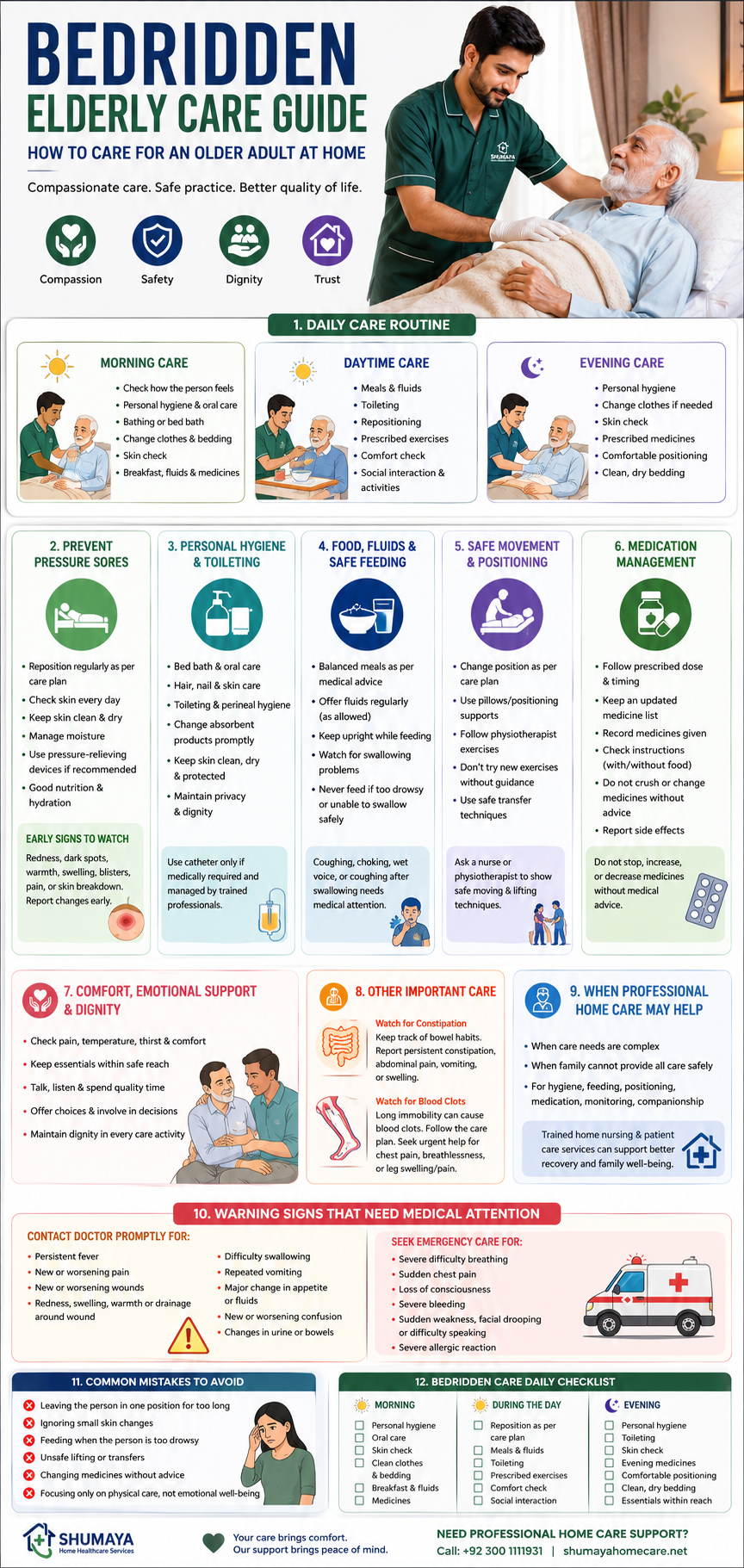
Quick Summary
Caring for a bedridden older adult requires a consistent routine and close attention to changes in their condition.
The main priorities are:
Keep the skin clean, dry, and regularly checked.
Reposition the person according to their individual care plan.
Provide safe meals and fluids based on their medical needs.
Watch for swallowing problems.
Support safe movement and prescribed exercises.
Give medicines exactly as prescribed.
Provide regular toileting and incontinence care.
Protect dignity and emotional well-being.
Watch for warning signs and seek medical help when needed.
Get professional support when the family’s caregiving needs become difficult to manage safely.
With the right routine and support, families can make home care safer, more comfortable, and more respectful for a bedridden older adult.