

When a family member returns home from hospital with a urinary catheter, relatives often have questions. How should the catheter be cleaned? How often should the drainage bag be emptied? What signs may indicate an infection or blockage?
A urinary catheter can make urination easier for patients who cannot empty their bladder normally. However, it needs proper daily care to reduce discomfort, prevent complications, and help the drainage system work correctly.
For families caring for an elderly, bedridden, or recovering patient, understanding the basics of catheter care at home is especially important. This guide explains the different types of urinary catheters, daily hygiene, drainage bag management, warning signs, and when professional nursing support may be needed.
What Is a Urinary Catheter?
A urinary catheter is a thin, flexible tube used to drain urine from the bladder into a collection bag or container.
A healthcare professional may recommend a catheter when a patient:
Cannot empty the bladder properly.
Has urinary retention due to a medical condition.
Needs urine drainage after certain operations.
Requires urine output monitoring during medical treatment.
Has limited mobility or another condition that makes normal urination difficult.
The type of catheter and how long it remains in place depend on the patient’s medical condition and the treating clinician’s instructions.

Types of Urinary Catheters
Different catheters are used for different medical needs. Families should understand which type their patient has because the care requirements may vary.
1. Foley Catheter (Indwelling Urinary Catheter)
A Foley catheter is inserted through the urethra into the bladder. A small balloon near its tip is filled with sterile water to help keep it in position.
The catheter remains in place and continuously drains urine into a collection bag.
It may be used for patients who need ongoing bladder drainage, including some post-surgical, bedridden, or elderly patients.
2. Suprapubic Catheter
A suprapubic catheter enters the bladder through a small opening in the lower abdomen rather than through the urethra.
It may be recommended when a urethral catheter is unsuitable or when longer-term drainage is required.
The skin around the insertion site needs appropriate care according to the healthcare professional’s instructions. Families should not apply antiseptics, creams, or dressings unless advised.
3. Intermittent Catheter
An intermittent catheter is inserted to empty the bladder and then removed. Unlike an indwelling catheter, it does not remain connected to a drainage bag.
Patients or caregivers should perform intermittent catheterization only after receiving appropriate training and following the individual care plan. The required technique and hygiene approach may differ depending on the patient’s circumstances.
Daily Catheter Care at Home
Good daily care helps maintain hygiene, reduce irritation, and support proper urine drainage.
1. Wash Hands Before and After Care
Hand hygiene is one of the most important parts of catheter care.
Wash hands with soap and water before and after touching the catheter, tubing, or drainage bag. If handwashing facilities are unavailable, use an appropriate alcohol-based hand rub.
Caregivers should avoid touching the catheter connection points unnecessarily.
2. Clean the Area Around the Catheter
For a urethral catheter, gently clean the area where the tube enters the body during daily personal hygiene.
Use mild soap and water, then gently rinse and dry the area. Avoid pulling or twisting the catheter while cleaning.
Routine use of strong antiseptics, powders, or creams is generally unnecessary and may cause irritation. Use these products only if specifically advised by a healthcare professional.
For a suprapubic catheter, follow the separate instructions provided for cleaning and caring for the abdominal insertion site.
3. Keep the Drainage Bag Below Bladder Level
The urine collection bag should remain below the level of the patient’s bladder. This helps prevent urine from flowing backward.
Remember to:
Keep the bag below bladder level when the patient is lying, sitting, or walking.
Never place the drainage bag directly on the floor.
Avoid pulling or stretching the tubing.
Keep the drainage tube free from bends, twists, and kinks.
Make sure the bag is supported properly during movement.
A suitable bag holder or securement arrangement can help prevent accidental pulling.
4. Empty the Drainage Bag Properly
The drainage bag should be emptied before it becomes too full. A practical approach is to empty it when it is around half to two-thirds full, unless the healthcare professional or device instructions specify otherwise.
When emptying the bag:
Wash your hands before and after the task.
Use a clean, suitable container if urine needs to be measured.
Avoid allowing the drainage outlet to touch the container or other surfaces.
Open the outlet carefully and allow urine to drain.
Close the outlet securely afterwards.
If urine output needs to be monitored, record it according to the patient’s care plan. Families should not make medical decisions based on a single urine measurement without clinical guidance.
5. Keep the Catheter Secure
A catheter that moves or pulls can cause discomfort and injury.
Use an appropriate catheter securement device or arrangement recommended by the healthcare professional. Leave enough tubing movement for the patient to change position without tension.
For example, an elderly patient may accidentally pull the catheter while turning in bed. Checking the tubing and securement before repositioning can help reduce this risk.
Leg Bag vs Night Drainage Bag
Some patients use different drainage bags during the day and night.
Leg bag: A smaller collection bag that can be attached to the leg under clothing. It allows easier movement and may be more convenient during the day.
Night drainage bag: A larger collection bag designed to hold more urine while the patient sleeps. It should be positioned safely below bladder level and supported so that the tubing does not become stretched or kinked.
Use and connect these bags according to the device instructions and the healthcare professional’s guidance. Avoid disconnecting the catheter system unnecessarily because this can increase the risk of contamination.
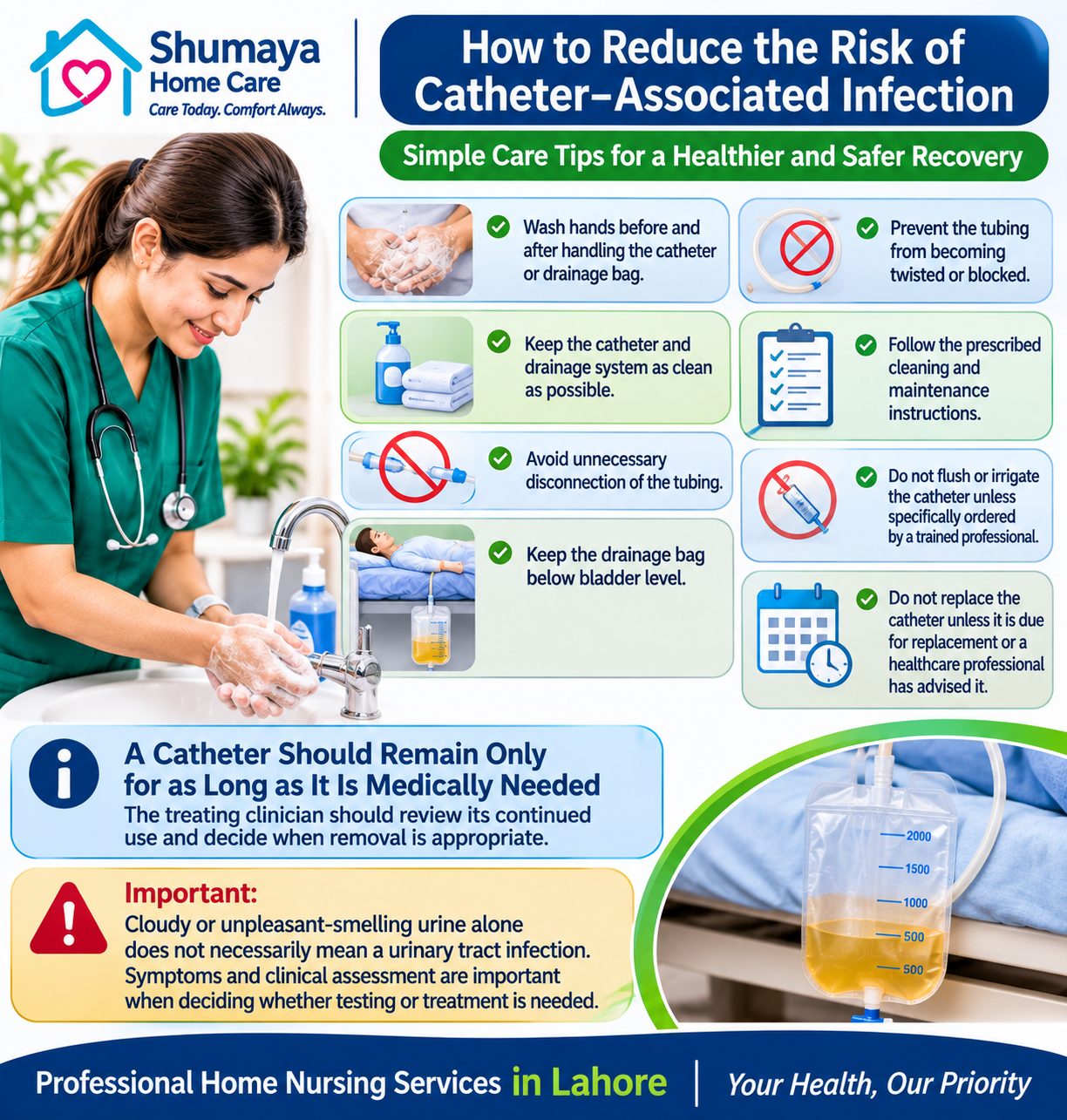
How to Reduce the Risk of Catheter-Associated Infection
A urinary tract infection can develop in a patient with a urinary catheter. This is commonly referred to as a catheter-associated urinary tract infection (CAUTI).
Good catheter care can help reduce the risk.
Important precautions include:
Wash hands before and after handling the catheter or drainage bag.
Keep the catheter and drainage system as clean as possible.
Avoid unnecessary disconnection of the tubing.
Keep the drainage bag below bladder level.
Prevent the tubing from becoming twisted or blocked.
Follow the prescribed cleaning and maintenance instructions.
Do not flush or irrigate the catheter unless specifically ordered and performed by someone appropriately trained.
Do not replace the catheter unless it is due for replacement or a healthcare professional has advised it.
A catheter should remain in place only for as long as it is medically needed. The treating clinician should review its continued use and decide when removal is appropriate.
Important: Cloudy or unpleasant-smelling urine alone does not necessarily mean that a patient has a urinary tract infection. Symptoms and clinical assessment are important when deciding whether testing or treatment is needed.
Warning Signs Families Should Not Ignore
Families should observe the patient’s comfort, urine drainage, and general condition.
Contact a healthcare professional if you notice:
Fever or chills.
New pain or discomfort in the lower abdomen.
Pain in the back or side.
New or worsening discomfort around the catheter.
Blood in the urine or blood clots.
Urine leaking around the catheter.
The catheter coming out or appearing displaced.
A sudden change in the patient’s general condition.
In elderly patients, new confusion or unusual behaviour can sometimes accompany an infection or another medical problem. It should not automatically be assumed to be a urinary infection; the patient needs appropriate assessment.
Signs of Possible Catheter Blockage
A catheter may be blocked or not draining properly if:
Little or no urine is entering the drainage bag.
The patient feels bladder pressure or pain.
The lower abdomen becomes swollen or uncomfortable.
Urine leaks around the catheter.
The tubing appears bent, twisted, or compressed.
What should you do?
First, check whether the drainage bag is below bladder level and whether the tubing is visibly kinked or trapped. Correct an obvious external bend without pulling the catheter.
If urine still does not drain, or the patient has bladder pain or swelling, seek urgent medical advice. Do not try to push, pull, flush, or remove the catheter yourself.
Fever, chills, significant pain, heavy bleeding, or a catheter that has come out also requires prompt medical assessment. Do not wait for several symptoms to appear together.
Catheter Care for Elderly and Bedridden Patients
Elderly and bedridden patients may need extra assistance because they can have limited mobility, difficulty communicating discomfort, or other medical conditions.
Family members and caregivers can help by:
Keeping the patient’s personal hygiene routine consistent.
Checking that the drainage bag is positioned correctly.
Making sure the tubing is not trapped under the patient’s body.
Supporting safe movement and repositioning.
Observing changes in urine drainage and the patient’s comfort.
Reporting unusual symptoms to the healthcare professional.
Following fluid intake instructions provided by the treating clinician.
Some patients have fluid restrictions because of heart or kidney conditions. Therefore, families should not increase water intake simply because urine output appears low. Reduced drainage may have several causes and should be assessed appropriately.
Patients who spend long periods in bed may also need help with skin care, pressure-area prevention, and safe repositioning. These needs should be included in their wider care plan.
Patient Attendant vs Professional Nurse for Catheter Care
Families should understand the difference between personal care assistance and clinical nursing responsibilities.
| Responsibility | Professional Nurse | Patient Attendant |
|---|---|---|
| Personal hygiene and cleaning | Yes, within the care plan | Yes |
| Helping with positioning and mobility | Yes | Yes |
| Observing urine drainage and reporting changes | Yes | Yes, as instructed |
| Emptying the drainage bag | Yes | Only if trained and authorised |
| Clinical assessment of catheter-related problems | Within qualifications and competence | Not an independent responsibility |
| Catheter insertion or replacement | Only if qualified, competent, and authorised | Not an independent responsibility |
| Catheter flushing or irrigation | Only when prescribed, trained, and authorised | Not an independent responsibility |
| Reporting warning signs | Yes | Yes, promptly |
A patient attendant can provide valuable help with daily comfort, hygiene, mobility, and observation. However, an attendant should not independently perform clinical catheter procedures.
A qualified nurse may be needed when the patient requires clinical assessment, prescribed catheter-related procedures, or nursing care beyond the attendant’s role. All clinical tasks must remain within the nurse’s qualifications, competence, and applicable professional requirements.
When Should a Catheter Be Reviewed or Replaced?
A catheter should be reviewed regularly by the treating healthcare professional to confirm that it is still required and working properly.
There is no single replacement schedule suitable for every catheter. The timing depends on the catheter type, manufacturer instructions, the patient’s condition, and clinical assessment.
Families should arrange medical advice if the catheter:
Stops draining properly.
Becomes damaged or displaced.
Causes persistent pain or discomfort.
Develops leakage or other problems.
Needs replacement according to the prescribed schedule.
Never attempt to remove or replace an indwelling catheter at home unless a qualified healthcare professional has specifically assessed the situation and the person performing the procedure is appropriately trained and authorised.
When Is Professional Home Nursing Support Helpful?
Professional home nursing support may be useful when a patient needs clinical observation, catheter-related nursing care, or assistance following hospital discharge.
It can be particularly helpful for:
Elderly patients with limited mobility.
Bedridden patients who need regular nursing assistance.
Patients recovering after surgery.
Patients who require prescribed catheter-related procedures.
Families who need guidance about safe daily care and warning signs.
The level of support should match the patient’s medical needs. Not every patient with a urinary catheter requires continuous nursing care, but families should know when professional assistance is appropriate.
Catheter Care Support at Home in Lahore
Caring for a patient with a urinary catheter requires attention to hygiene, safe drainage, comfort, and early recognition of problems.
Shumaya Home Care & Patient Service provides home nursing and patient care support in Lahore. Families can discuss their patient’s condition and care requirements to understand whether a professional nurse or patient attendant is the more suitable option.
Our home care services can support patients who need assistance with personal care, mobility, routine observation, and nursing care according to their individual requirements.
To learn more, visit our Home Nursing Services in Lahore page or contact Shumaya Home Care to discuss the support your family needs.
Frequently Asked Questions About Catheter Care at Home
1. How often should a urinary catheter be cleaned?
The area around a urethral catheter should be gently cleaned during daily personal hygiene and whenever it becomes soiled. Follow the specific instructions provided for a suprapubic catheter insertion site.
2. Should the catheter drainage bag always remain below the bladder?
Yes. Keeping the drainage bag below bladder level helps prevent urine from flowing backward. The bag should also be kept off the floor and supported safely.
3. Can a patient take a bath with a urinary catheter?
Many patients can shower with a urinary catheter, but they should follow their healthcare professional’s advice. Avoid pulling the tube, and follow any specific instructions for protecting a suprapubic insertion site.
4. What should I do if urine stops flowing into the catheter bag?
Check whether the tubing is bent, trapped, or twisted and confirm that the bag is below bladder level. If drainage does not resume, or the patient has pain or lower abdominal swelling, seek urgent medical advice. Do not attempt to flush or remove the catheter yourself.
5. Does cloudy or foul-smelling urine always mean infection?
No. Cloudy or unpleasant-smelling urine alone does not confirm a urinary tract infection. The patient’s symptoms and clinical assessment help determine whether further investigation or treatment is needed.
6. Can a patient attendant take care of a urinary catheter?
A patient attendant can help with personal hygiene, positioning, and observation. Emptying the drainage bag may be appropriate if the attendant has been trained and authorised. Clinical procedures such as catheter insertion, replacement, and irrigation must not be performed independently by an attendant.
7. How often should a urinary catheter be replaced?
There is no universal replacement interval for all catheters. The schedule depends on the catheter type, device instructions, patient condition, and healthcare professional’s assessment.
8. When should I contact a doctor about catheter problems?
Seek medical advice if the patient develops fever, chills, new pain, blood or clots in the urine, leakage, or changes in general condition. Little or no urine drainage accompanied by bladder pain or swelling requires urgent assessment. A catheter that comes out or becomes displaced also needs prompt medical attention.
Medical note: This article provides general educational information and does not replace advice from a qualified healthcare professional. Catheter procedures, changes, and treatment decisions should be made by appropriately qualified and authorised professionals based on the patient’s individual condition.