
A Practical Guide for Families
Monitoring a heart patient at home involves checking the readings recommended by the doctor, watching for changes in breathing or swelling, following the prescribed medication schedule, and recording new symptoms. The exact routine depends on the patient’s heart condition, treatment, and recovery plan.
Whether your loved one is recovering from a heart attack, has undergone heart surgery, or lives with heart failure or high blood pressure, knowing what to monitor can help you recognize changes and seek medical advice at the right time.
Important: If a heart patient develops chest pain, severe difficulty breathing, fainting, or signs of a stroke, seek emergency medical help immediately. Do not delay care to take measurements or arrange a routine home visit.
For families providing heart patient care at home in Lahore, this guide explains the essential monitoring tasks, warning signs, and situations in which professional home-care support may be helpful.
1. Understand the Patient’s Heart Condition
Before starting a monitoring routine, understand the patient’s diagnosis and follow the instructions provided by their healthcare team. Different heart conditions require different types of monitoring.
Heart failure: Monitoring may include daily weight, swelling, breathing changes, and other symptoms of fluid retention.
Recovery after a heart attack: Families may need to observe chest discomfort, unusual fatigue, breathlessness, and changes in activity tolerance.
Recovery after heart surgery: Follow instructions for wound care, medication, physical activity, and follow-up appointments.
High blood pressure: Regular blood pressure checks may be recommended to assess how well treatment is working.
Abnormal heart rhythms: Monitoring the pulse and reporting palpitations, dizziness, or fainting may be important.
Ask the treating clinician which measurements are necessary, how frequently they should be taken, and what results require medical attention.
Not every heart patient needs the same monitoring schedule. A stable patient may need fewer checks than someone who has recently returned home after hospitalization.
2. Monitor Blood Pressure Correctly
Blood pressure monitoring can help families identify changes in patients who have high blood pressure or certain heart conditions.
How to check blood pressure at home
Use a validated automatic upper-arm blood pressure monitor with the correct cuff size.
Let the patient sit quietly for about five minutes before taking a routine reading, if their condition allows.
Keep the back supported, feet flat on the floor, and legs uncrossed.
Place the cuff on the bare upper arm and support the arm at heart level.
Ask the patient not to talk during the measurement.
When practical, take two readings about one minute apart and record both.
Record the upper number (systolic pressure), the lower number (diastolic pressure), and the time of measurement.
What if the reading is unusually high or low?
The appropriate blood pressure range depends on the patient’s diagnosis, medication, and care plan.
If a reading is unexpectedly high or low but the patient feels well, allow them to rest and repeat the measurement using the correct technique. Follow the clinician’s instructions about when to report the result.
If the blood pressure is around 180/120 mmHg or higher and the patient has no emergency symptoms, repeat the measurement after at least one minute. If it remains this high, seek urgent medical advice.
If the patient has chest pain, severe breathlessness, weakness, confusion, difficulty speaking, or vision changes, call emergency services immediately. Do not delay help to repeat the reading.
Do not give an extra dose of blood pressure medicine or change the prescribed dose without medical instructions.
3. Check the Pulse and Heart Rate
The pulse indicates how many times the heart beats per minute. Monitoring it can help families notice changes in heart rate or rhythm.
How to measure the pulse
Help the patient rest comfortably.
Place two fingers on the inside of the wrist, below the base of the thumb.
Count the beats for a full 60 seconds, particularly if the pulse feels irregular.
Record the number and whether the rhythm seems regular or irregular.
Some blood pressure monitors and wearable devices also display heart rate. However, these devices cannot reliably diagnose every heart rhythm problem.
Which changes need attention?
Watch for:
A resting pulse that is much faster or slower than usual.
A newly irregular heartbeat.
Palpitations accompanied by dizziness or weakness.
A change in pulse associated with chest discomfort or breathlessness.
A resting heart rate of 60–100 beats per minute is common in adults, but some heart patients have different targets. Medicines such as beta-blockers may lower the heart rate.
Follow the patient’s prescribed limits rather than relying on general ranges alone. Report new or persistent changes to the healthcare team. If the patient experiences fainting, chest pain, severe breathlessness, or other serious symptoms, seek emergency help.
Do not change heart medication based on a single pulse reading without medical advice.
4. Watch Breathing and Oxygen Levels When Needed
Changes in breathing can be an important warning sign, especially in patients with heart failure or those recovering from a cardiac procedure.
Observe whether the patient:
Becomes breathless during activities they previously managed comfortably.
Needs more pillows to sleep comfortably.
Wakes suddenly at night struggling to breathe.
Develops increasing breathlessness while resting.
Has worsening swelling or a persistent cough.
Becomes unusually confused, drowsy, or exhausted.
New or worsening breathing difficulties need prompt medical assessment. Severe or sudden difficulty breathing is an emergency.
Should you check oxygen saturation?
A pulse oximeter measures oxygen saturation (SpO₂). A clinician may recommend one for particular patients, but routine oxygen monitoring is not necessary for every person with heart disease.
If advised to use a pulse oximeter, make sure the patient’s hand is warm and still, and wait for a stable reading. Movement, poor circulation, and other factors can affect accuracy.
Follow the oxygen target recommended for that patient. A normal-looking reading does not rule out a serious heart problem.
Never delay emergency care to check oxygen saturation if the patient has severe breathing difficulty, blue or grey lips, chest pain, or reduced consciousness.
5. Monitor Weight and Swelling in Heart Failure
For many patients with heart failure, daily weight monitoring can help identify possible fluid retention before symptoms become more severe.
How to monitor weight
Weigh the patient at the same time each morning, preferably after using the toilet and before breakfast.
Use the same scale on a firm, level surface.
Keep clothing similar each day.
Record the weight in a notebook or monitoring chart.
If standing is unsafe, do not risk a fall to obtain a reading. Ask the healthcare team about an appropriate alternative.
What changes should families watch for?
Look for:
A sudden increase in weight.
Swelling in the feet, ankles, or legs.
Tighter shoes or clothing.
Increasing abdominal swelling.
Worsening breathlessness or difficulty lying flat.
Some heart failure care plans use weight gains of approximately 1–1.5 kg in one day or 2–2.5 kg in a week as warning thresholds. However, these figures are not universal. Follow the threshold provided by the patient’s treating clinician.
Report concerning changes according to the patient’s care plan. Do not independently increase diuretics, restrict fluids, or make major changes to fluid intake.
6. Keep a Daily Heart Patient Monitoring Chart
A simple monitoring chart helps families identify patterns and communicate useful information to the treating clinician.
Record only the measurements recommended for the patient, along with any new symptoms.
| Date and time | Blood pressure | Pulse | Weight, if advised | Symptoms or notes |
|---|---|---|---|---|
| Morning | ______ | ______ | ______ | ______ |
| Evening, if advised | ______ | ______ | — | ______ |
You can copy this chart into a notebook or print it for daily use.
Also record missed medication doses, unusual fatigue, dizziness, swelling, breathing changes, or difficulty with everyday activities.
A consistent record is generally more useful than taking frequent measurements without a clear plan. Bring the chart to follow-up appointments or share it with the healthcare team when requested.
7. Follow the Prescribed Medication Routine
Many heart patients take several medicines to control blood pressure, manage heart rhythm, reduce blood clot risk, or manage fluid retention.
Families can support safe medication routines by:
Keeping an updated list of medicines and prescribed doses.
Using a suitable pill organizer if appropriate.
Recording doses taken when supervision is needed.
Checking refill dates to avoid running out of medication.
Following instructions about timing, food, and possible side effects.
If a dose is missed, check the medicine-specific instructions or contact a pharmacist or clinician. Do not double a dose unless specifically instructed.
Never stop a prescribed heart medicine, change its dose, or give an extra dose because a reading appears unusual without professional advice.
Report suspected side effects to the treating clinician. Severe bleeding, collapse, or other life-threatening symptoms require emergency care.
8. Support Safe Daily Activities
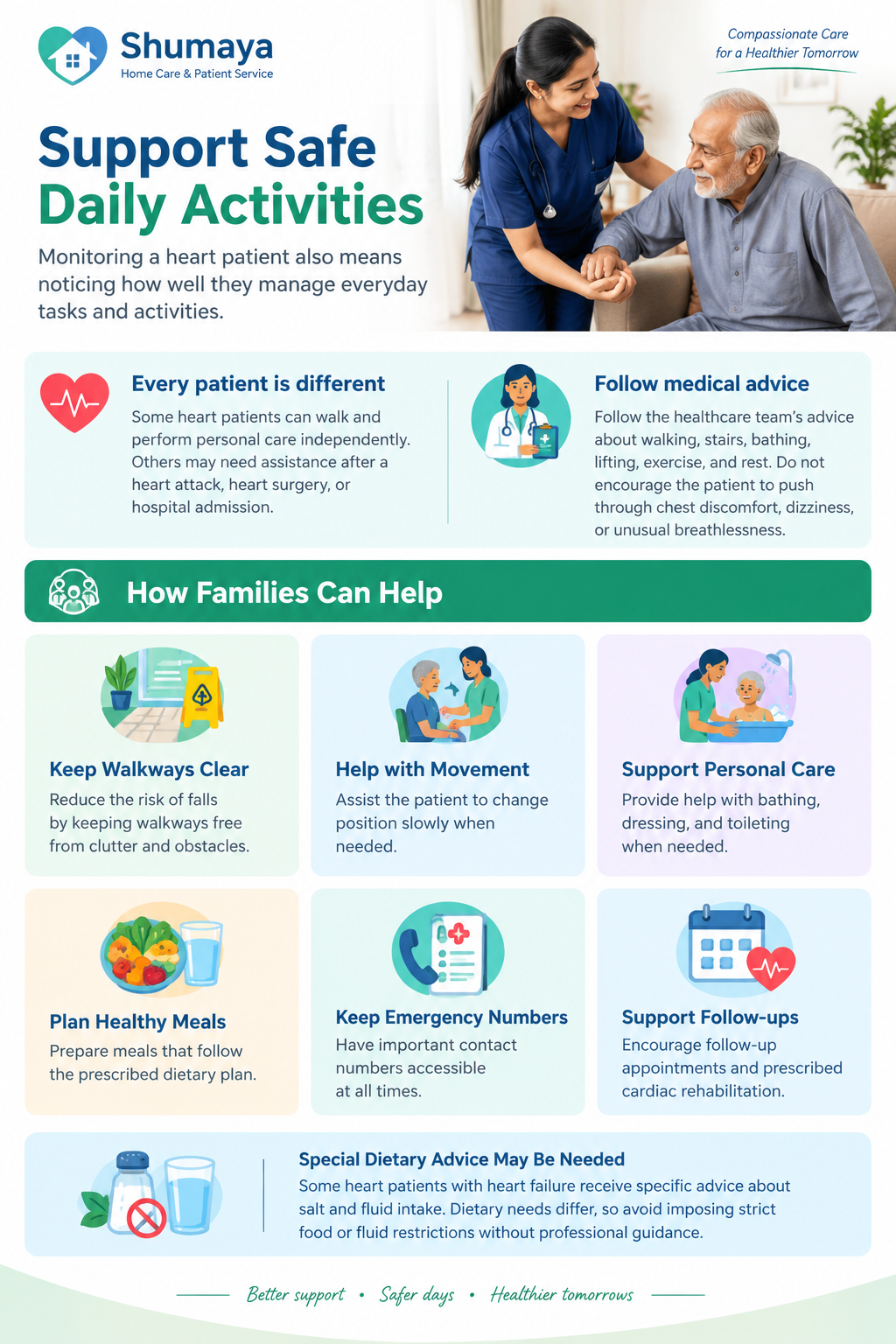
Monitoring also means noticing how well the patient manages everyday tasks.
Some heart patients can walk and perform personal care independently. Others may need assistance after a heart attack, heart surgery, or hospital admission.
Follow the healthcare team’s advice about walking, stairs, bathing, lifting, exercise, and rest. Do not encourage the patient to push through chest discomfort, dizziness, or unusual breathlessness.
Families can help by:
Keeping walkways clear to reduce the risk of falls.
Helping the patient change position slowly when needed.
Providing assistance with bathing, dressing, and toileting.
Preparing meals that follow the prescribed dietary plan.
Keeping emergency contact numbers accessible.
Supporting follow-up appointments and prescribed cardiac rehabilitation.
Some patients with heart failure receive specific advice about salt and fluid intake. Dietary needs differ, so avoid imposing strict fluid or food restrictions without professional guidance.
9. When Should You Seek Medical Help?
Knowing when to act is just as important as recording blood pressure or pulse readings.
Call emergency services immediately if the patient develops:
New, severe, or persistent chest pain, pressure, or discomfort.
Severe or sudden difficulty breathing.
Fainting or collapse, particularly with chest discomfort or palpitations.
Facial drooping, weakness on one side, difficulty speaking, or other possible stroke symptoms.
Sudden confusion, blue or grey lips, or reduced responsiveness.
A very fast or irregular heartbeat accompanied by chest pain, severe breathlessness, or fainting.
Call Pakistan’s Rescue 1122 where available, or your local emergency service. Do not wait for a home nurse or routine medical appointment if the patient may be experiencing a life-threatening emergency.
If the patient becomes unresponsive and is not breathing normally, call emergency services and follow the dispatcher’s instructions for CPR and use of an AED, if available.
Contact the treating doctor promptly if:
Weight increases beyond the patient’s prescribed threshold.
Swelling or breathlessness gradually worsens.
The patient needs more pillows to breathe comfortably at night.
Blood pressure or pulse repeatedly falls outside the prescribed range.
New palpitations, dizziness, unusual fatigue, or medication side effects develop.
The patient becomes increasingly weak or eats and drinks much less than usual.
When symptoms are severe, sudden, or rapidly worsening, seek emergency care rather than waiting for a routine appointment.
10. How Often Should You Monitor a Heart Patient?
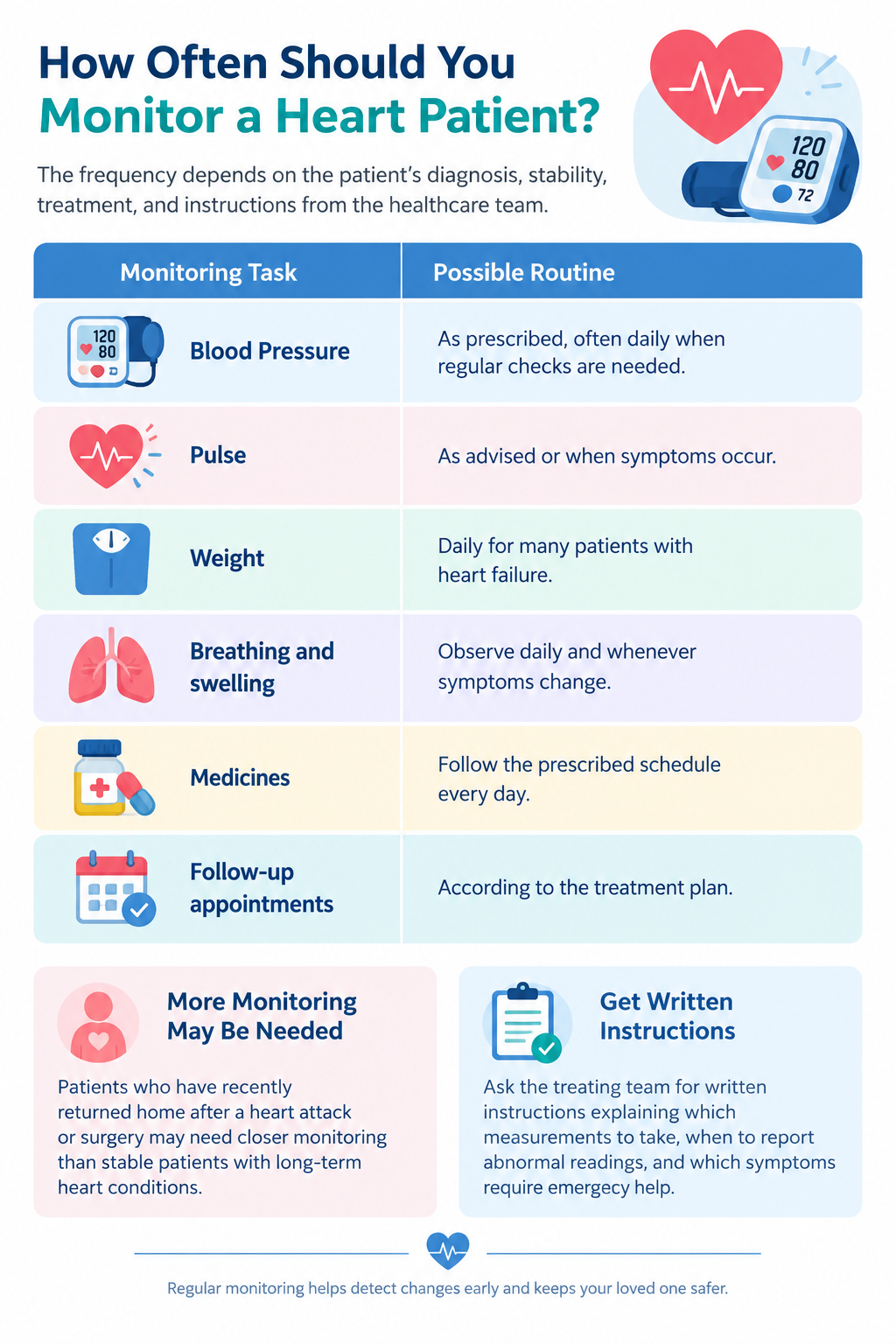
The frequency depends on the patient’s diagnosis, stability, treatment, and instructions from the healthcare team.
| Monitoring task | Possible routine |
|---|---|
| Blood pressure | As prescribed, often daily when regular checks are needed |
| Pulse | As advised or when symptoms occur |
| Weight | Daily for many patients with heart failure |
| Breathing and swelling | Observe daily and whenever symptoms change |
| Medicines | Follow the prescribed schedule every day |
| Follow-up appointments | According to the treatment plan |
Patients who have recently returned home after a heart attack or surgery may need closer monitoring than stable patients with long-term heart conditions.
Ask the treating team for written instructions explaining which measurements to take, when to report abnormal readings, and which symptoms require emergency help.
Can a Home Nurse or Patient Attendant Help?
Some families can safely monitor a stable heart patient themselves after receiving appropriate instructions. Others may need professional assistance, particularly after hospital discharge or when the patient requires help with daily activities.
A qualified home nurse may provide nursing assessments, monitor vital signs, carry out appropriate nursing procedures, and support medication-related care within their professional scope and the patient’s care plan.
A patient attendant may assist with bathing, dressing, meals, toileting, mobility, positioning, and other daily activities. An attendant is not a substitute for a qualified nurse when clinical nursing care is required.
The need for a male or female care professional depends on the patient’s preferences, privacy, personal-care needs, and the staff member’s qualifications.
For families seeking home nursing services in Lahore, Shumaya Home Care & Patient Service can discuss suitable nursing or patient-care support based on the patient’s needs.
Frequently Asked Questions
1. What is the most important thing to monitor in a heart patient at home?
It depends on the patient’s condition. Blood pressure and pulse may be important for some patients, while daily weight, swelling, and breathing changes are particularly important for many people with heart failure. Always follow the individual care plan and pay attention to new symptoms.
2. Can I monitor a heart patient at home without medical equipment?
You can observe breathing, alertness, swelling, comfort, and changes in daily activity without special equipment. However, some patients need blood pressure, pulse, weight, or other measurements. Follow the clinician’s recommendations.
3. Can a patient attendant monitor a heart patient?
A patient attendant can observe general changes, help with daily activities, and report concerns to the family or healthcare team. Clinical assessments and nursing procedures should be handled by appropriately qualified staff when required.
4. When should I arrange a home nurse for a heart patient?
A home nurse may be appropriate after hospital discharge, following heart surgery, or when a patient requires clinical monitoring or other nursing care. The decision should reflect the patient’s medical needs and the treating clinician’s recommendations.
5. Is normal blood pressure enough to show that a heart patient is safe?
No. A patient may have a serious heart problem even when blood pressure appears normal. Chest pain, severe breathlessness, fainting, and possible stroke symptoms require urgent assessment regardless of the readings.
6. Can a heart patient stay at home without a nurse?
Some stable patients can be cared for at home by family members who understand the care plan. Others need professional nursing or personal-care assistance. The decision depends on medical needs, safety, and available support.
Need Home Care Support for a Heart Patient in Lahore?
Monitoring a heart patient at home can become challenging when the patient needs regular observations, assistance with daily activities, or support after hospital discharge.
Shumaya Home Care & Patient Service can discuss suitable home nursing or patient-attendant support based on the patient’s needs. A qualified nurse may be appropriate when clinical nursing care is required, while a patient attendant can help with personal care, mobility, meals, and daily routines.
Contact our team to discuss your family’s home-care requirements and the type of support that may be suitable.
Explore our home nursing services in Lahore.
Medical disclaimer: This guide provides general educational information and does not replace advice from the patient’s treating doctor. Monitoring targets, medication instructions, and emergency plans should be individualized to the patient’s condition.