

Managing heart medicines at home can be challenging, especially for older adults, patients recovering from heart surgery, and people living with heart failure or irregular heart rhythms. Some patients take several medicines each day, and missing doses, taking an extra dose, or using medicines incorrectly can cause health problems.
Safe medication management for heart patients at home starts with an accurate medicine list, a clear daily routine, and an understanding of what to do if a dose is missed or a side effect occurs.
Families caring for a heart patient should follow the treatment plan provided by the patient’s doctor and ask a pharmacist or healthcare professional whenever medication instructions are unclear.
Why Is Medication Management Important for Heart Patients?
Heart medicines help control blood pressure, manage heart rate and rhythm, reduce the risk of blood clots, and treat conditions such as heart failure. Each medicine has a specific purpose, and the correct treatment depends on the patient’s diagnosis and medical history.
A safe medication routine helps families:
Give medicines according to the prescribed schedule.
Reduce missed or repeated doses.
Recognize possible side effects.
Keep an updated list of medicines.
Identify concerns that need medical attention.
Communicate clearly with the patient’s doctor or pharmacist.
Important: Never stop, start, or change a prescribed heart medicine without consulting the appropriate healthcare professional.
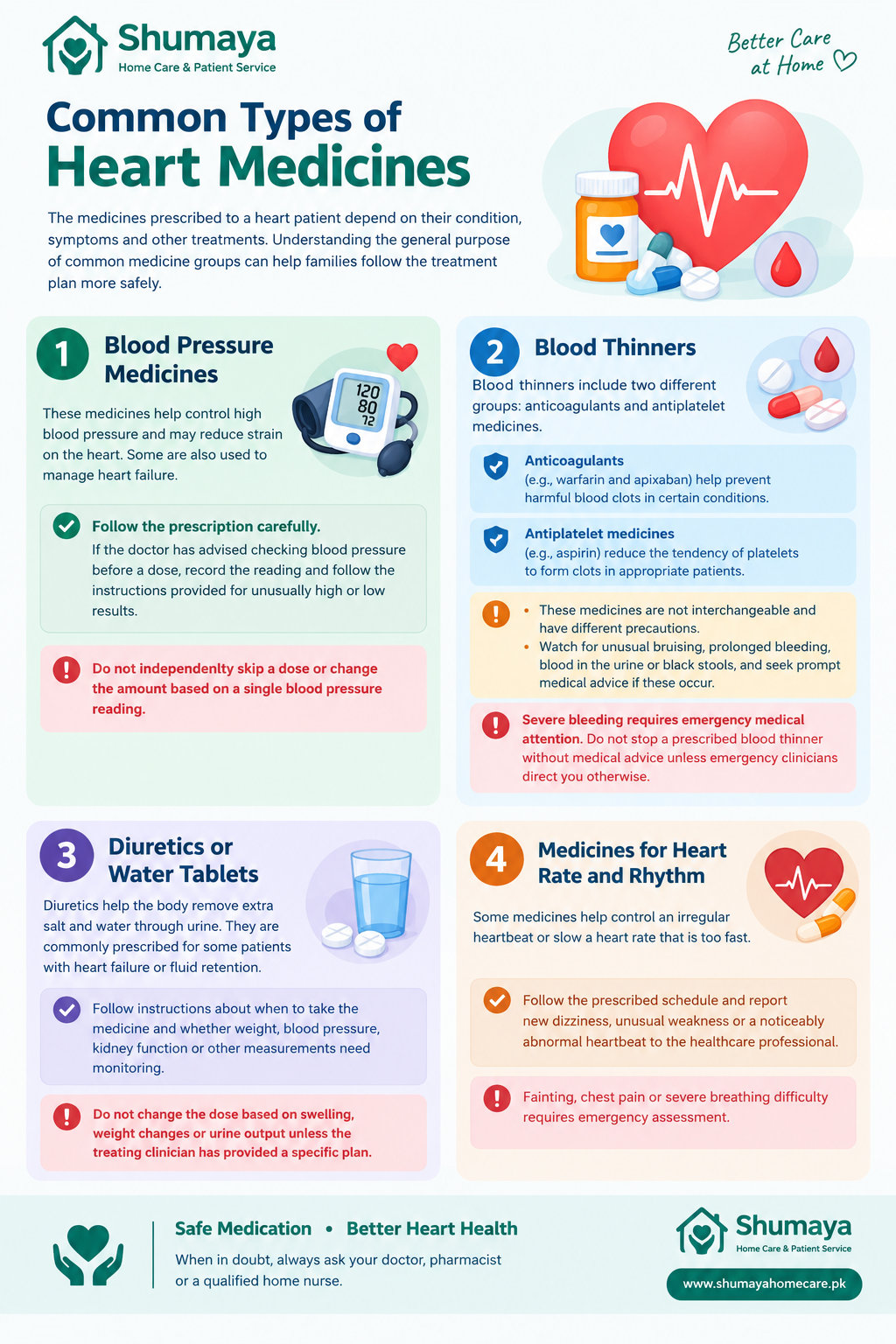
Common Types of Heart Medicines
The medicines prescribed to a heart patient depend on their condition, symptoms, and other treatments. Understanding the general purpose of common medicine groups can help families follow the treatment plan more safely.
1. Blood Pressure Medicines
These medicines help control high blood pressure and may reduce strain on the heart. Some are also used to manage heart failure.
Follow the prescription carefully. If the doctor has advised checking blood pressure before a dose, record the reading and follow the instructions provided for unusually high or low results.
Do not independently skip a dose or change the amount based on a single blood pressure reading.
2. Blood Thinners
Blood thinners include two different groups: anticoagulants and antiplatelet medicines.
Anticoagulants, such as warfarin and apixaban, help prevent harmful blood clots in certain conditions.
Antiplatelet medicines, such as aspirin, reduce the tendency of platelets to form clots in appropriate patients.
These medicines are not interchangeable and have different precautions. Watch for unusual bruising, prolonged bleeding, blood in the urine, or black stools, and seek prompt medical advice if these occur.
Severe bleeding requires emergency medical attention. Do not stop a prescribed blood thinner without medical advice unless emergency clinicians direct you otherwise.
3. Diuretics or Water Tablets
Diuretics help the body remove extra salt and water through urine. They are commonly prescribed for some patients with heart failure or fluid retention.
Follow instructions about when to take the medicine and whether weight, blood pressure, kidney function, or other measurements need monitoring.
Do not change the dose based on swelling, weight changes, or urine output unless the treating clinician has provided a specific plan.
4. Medicines for Heart Rate and Rhythm
Some medicines help control an irregular heartbeat or slow a heart rate that is too fast.
Follow the prescribed schedule and report new dizziness, unusual weakness, or a noticeably abnormal heartbeat to the healthcare professional. Fainting, chest pain, or severe breathing difficulty requires emergency assessment.
How to Manage Heart Medicines Safely at Home
A simple, consistent routine can help patients and family caregivers avoid common medication mistakes.
1. Keep an Updated Medicine List
Record the following for every medicine:
Name and strength.
Prescribed dose and timing.
Instructions about food or other precautions.
Reason for taking it, if known.
Prescribing doctor or clinic.
Known medicine allergies.
Include prescription medicines, over-the-counter products, vitamins, and herbal supplements. Update the list whenever the healthcare professional changes the treatment plan.
Keep a copy available for medical appointments and emergencies.
2. Follow the Prescribed Schedule
Give each medicine according to the current prescription and pharmacy label. Some medicines need to be taken with food, while others have different instructions.
Use a written timetable, calendar, or phone reminder if helpful. Make sure the patient and anyone helping with medication understand the schedule.
Do not rely on memory alone when several medicines are taken throughout the day.
3. Prevent Missed or Double Doses
Record each dose after it has been taken. A medication chart or a suitable pill organizer may help, provided the medicines can safely be stored that way and the organizer is filled correctly.
If a dose may have been missed, check the medicine-specific instructions or contact a pharmacist or healthcare professional. Do not automatically give an extra dose or double the next dose. The correct action depends on the medicine and how much time has passed.
If you are unsure whether a dose was already taken, check the medication record and seek advice before giving another dose.
4. Store Medicines Correctly
Follow the storage instructions on each medicine’s packaging. Protect medicines from excessive heat, moisture, and direct sunlight when required.
Keep medicines in their original packaging when practical, and make sure labels remain readable. Keep all medicines away from children.
Check expiry dates regularly and ask a pharmacist how to dispose of expired or unused medicines safely.
5. Review Medicines After Hospital Discharge
After a heart attack, heart surgery, or admission for heart failure, the patient’s medicine list may change.
Before settling into a home routine:
Compare the discharge prescription with the medicines previously used.
Confirm which medicines have been added, stopped, or changed.
Ask about any unclear dose, timing, or special instruction.
Make sure the current list is shared with everyone involved in the patient’s care.
Do not restart an old medicine simply because it is still available at home. Ask the treating healthcare professional to clarify any differences between prescriptions.
Example: Daily Heart Medication Record
A written record helps families and caregivers track prescribed medicines and identify missed doses.
| Medicine name | Prescribed dose | Prescribed time | Record |
|---|---|---|---|
| Medicine A | As prescribed | As directed | Taken / Not taken |
| Medicine B | As prescribed | As directed | Taken / Not taken |
| Medicine C | As prescribed | As directed | Taken / Not taken |
This is an illustrative template, not a medication schedule. Replace the examples with the patient’s actual prescription. Include any food instructions, missed-dose advice, and other precautions supplied by the healthcare professional.
For patients who need help with daily medication routines, keeping the record in one agreed place can reduce confusion among family members and caregivers.
How to Monitor a Heart Patient While Managing Medicines
Medication management also involves noticing changes in the patient’s condition and reporting them to the healthcare team.
Depending on the treatment plan, families may need to monitor:
Blood pressure and pulse: If the doctor has recommended regular checks.
Daily weight: Particularly for some patients with heart failure who have been instructed to track fluid-related changes.
Swelling: New or worsening swelling in the legs, ankles, or abdomen.
Breathing: New breathlessness or a decline in the ability to perform usual activities.
Possible side effects: Such as dizziness, unusual weakness, or signs of bleeding.
Follow the patient’s individual care plan. Not every heart patient needs the same measurements or monitoring schedule.
For a patient with heart failure, a sudden increase in weight or worsening swelling may indicate fluid retention. Contact the treating healthcare professional promptly and follow any written instructions the patient has received.
When Is Emergency Medical Help Needed?
Call local emergency services if a heart patient develops:
Severe or sudden difficulty breathing.
New or severe chest pain.
Fainting or collapse.
Signs of a stroke, such as sudden facial drooping, arm weakness, or difficulty speaking.
Severe or uncontrolled bleeding.
Do not delay emergency care while trying to adjust medicines or arrange a routine home-care visit.
What Should You Do if a Heart Patient Experiences Side Effects?
Some heart medicines can cause dizziness, changes in blood pressure, changes in heart rate, or bleeding. The possible effects depend on the medicine and the patient’s health.
If a new or concerning symptom develops:
Make sure the patient is safe. If they feel dizzy, help them sit or lie down to prevent a fall.
Check vital signs only if you are trained and the patient’s care plan recommends it.
Contact the prescribing healthcare professional for advice.
Record the symptom, when it started, and the medicines taken.
Do not independently stop or change the medicine.
Seek emergency help for severe breathlessness, chest pain, collapse, stroke symptoms, or severe bleeding.
Which Medicines and Supplements Can Interact With Heart Medicines?
Some over-the-counter medicines, supplements, and herbal products can interact with heart treatments or worsen certain conditions.
For example:
Some painkillers, including ibuprofen and naproxen, may be unsuitable for people with heart failure, kidney problems, or certain cardiovascular risks.
Some cold and flu products contain ingredients that can raise blood pressure or heart rate.
Potassium supplements and potassium-containing salt substitutes may be unsafe for some patients taking particular heart or blood pressure medicines.
Herbal products and vitamins may affect prescribed medicines, including some blood thinners.
These products are not unsafe for every patient, but their suitability depends on the person’s condition and medication list.
Before starting an over-the-counter medicine, supplement, or herbal product, ask the doctor or pharmacist to check for possible interactions.
Patients taking warfarin may need regular blood tests and advice about keeping their vitamin K intake consistent. Other anticoagulants have different monitoring requirements. Follow the specific instructions for the prescribed medicine.
Can a Home Nurse Help With Medication Management?
Some heart patients can manage their own medicines, while others need support because of poor memory, limited mobility, complex prescriptions, or recovery after hospital discharge.
A qualified home nurse may provide medication-related nursing care within their qualifications, professional scope, applicable rules, and the patient’s prescribed care plan. Depending on the patient’s needs, this may include:
Supporting prescribed medication routines.
Helping maintain accurate medication records.
Monitoring vital signs when indicated.
Observing and reporting possible side effects.
Identifying discrepancies in medication instructions for clarification.
Communicating concerns to the treating healthcare team.
A home nurse does not independently replace the prescribing clinician or make unauthorized changes to the treatment plan.
Home Nurse vs Patient Attendant
A home nurse and a patient attendant have different responsibilities.
| Care requirement | Appropriate support |
|---|---|
| Clinical monitoring required by the care plan | Qualified nurse, when indicated |
| Medication-related nursing tasks | Appropriately qualified nurse, within professional scope |
| Reminders and help following a daily routine | Patient attendant or caregiver, according to training and assigned duties |
| Assistance with bathing, dressing, feeding, or mobility | Patient attendant or other suitable care professional |
| Prescription changes or decisions about treatment | Prescribing doctor or other authorized clinician |
The right arrangement depends on the patient’s medical condition, level of independence, and care plan. Some families need a nurse, some need an attendant, and some need both.
Families may also discuss a preference for a male or female care professional based on personal comfort, privacy, and the patient’s needs.
For patients who need clinical support at home, Shumaya’s home nursing services in Lahore may be relevant.
Frequently Asked Questions
Can a heart patient take all medicines together?
Not necessarily. Some medicines have specific timing, food, or interaction requirements. Follow the prescription and ask a pharmacist to review the schedule if the instructions are unclear.
What should I do if I am unsure whether a heart patient has taken their medicine?
Check the medication record and follow the medicine-specific instructions. Do not automatically give another dose, as this may result in a double dose. Contact a pharmacist or healthcare professional if you cannot confirm what happened.
Should heart medicines be stopped when the patient feels better?
No. Some heart conditions require ongoing treatment even when symptoms improve. Only the appropriate healthcare professional should decide whether a medicine needs to be stopped or changed.
What should I do if a heart patient refuses medicine?
Ask calmly why the patient does not want to take it. They may be experiencing side effects, difficulty swallowing, or confusion about the prescription. Contact the healthcare professional for advice. Do not force the medicine or hide it in food without appropriate guidance and consent.
Can a patient attendant give heart medicines?
This depends on the person’s training, assigned duties, applicable rules, and the care arrangement. Reminders and general support may be appropriate, but medication administration and other clinical nursing tasks require appropriately qualified staff when indicated.
When should a heart patient’s medicines be reviewed?
A review may be needed after hospital discharge, when a medicine is added or changed, when side effects occur, or when the patient’s condition changes. Ask the doctor or pharmacist to review the complete medicine list periodically.
Medication Management Support From Shumaya Home Care & Patient Service
Managing heart medicines can become difficult when a patient needs regular assistance, close observation, or help with everyday activities. A clear medication record, a consistent routine, and communication with the treating healthcare team can help families provide safer care.
Shumaya Home Care & Patient Service provides home nursing and patient care support in Lahore. If your loved one needs help at home, our team can discuss the care requirements and whether a qualified home nurse or a patient attendant is more suitable.
Contact Shumaya Home Care & Patient Service to discuss home-care support for a heart patient in Lahore.
Medical disclaimer: This article provides general educational information and does not replace advice from a doctor or pharmacist. Follow the patient’s individual treatment plan and seek professional advice about medication concerns.