

Caring for a patient with a nasogastric tube at home can feel challenging, especially for families who are managing tube feeding for the first time. An NG tube is a thin, flexible tube that passes through the nose into the stomach. It allows patients who cannot eat or drink safely or adequately by mouth to receive nutrition, fluids, and certain prescribed medicines.
Although NG tube feeding can support recovery and ongoing care, it requires proper training, hygiene, and regular monitoring. Families need to understand how to follow the feeding plan, recognise possible complications, and know when professional help is necessary.
This guide explains the essential aspects of NG tube care at home, including feeding safety, tube-position precautions, daily hygiene, common problems, and the role of professional nursing support.
What Is a Nasogastric (NG) Tube?
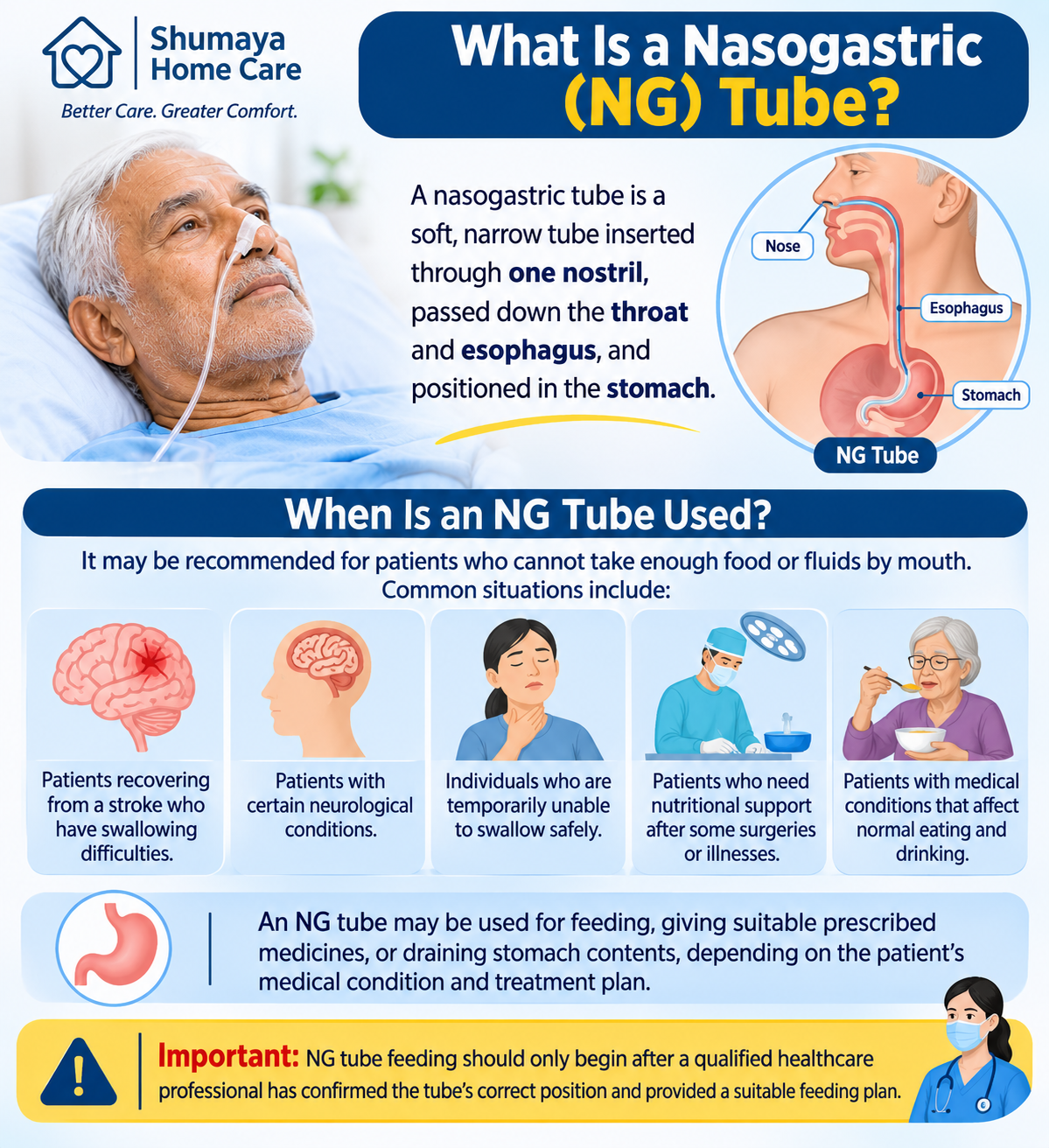
A nasogastric tube is a soft, narrow tube inserted through one nostril, passed down the throat and esophagus, and positioned in the stomach.
It may be recommended for patients who cannot take enough food or fluids by mouth. Common situations include:
Patients recovering from a stroke who have swallowing difficulties.
Patients with certain neurological conditions.
Individuals who are temporarily unable to swallow safely.
Patients who need nutritional support after some surgeries or illnesses.
Patients with medical conditions that affect normal eating and drinking.
An NG tube may be used for feeding, giving suitable prescribed medicines, or draining stomach contents, depending on the patient’s medical condition and treatment plan.
Important: NG tube feeding should only begin after a qualified healthcare professional has confirmed the tube’s correct position and provided a suitable feeding plan.
What Families Should Know Before NG Tube Feeding at Home
Before managing an NG tube at home, families should receive clear instructions from the treating healthcare team.
Make sure you understand:
Feeding formula: Which prescribed formula or feed should be used?
Feeding amount: How much feed should the patient receive?
Feeding schedule: How often should feeding take place?
Feeding method: Should the patient receive bolus feeding, gravity feeding, or pump feeding?
Flushing instructions: What type of water and what volume should be used?
Medication instructions: Which medicines can safely be given through the tube?
Position-checking procedure: How should tube position be checked before use?
Emergency contacts: Who should you contact if the tube moves, becomes blocked, or causes problems?
Keep the written feeding plan somewhere accessible. Do not change the formula, feeding amount, rate, or schedule without consulting the healthcare professional responsible for the patient’s care.
Daily NG Tube Care at Home
Good daily care helps maintain comfort, reduce irritation, and support safe feeding.
1. Wash Hands Before Handling the Tube
Hand hygiene is one of the most important precautions.
Wash your hands with soap and water before and after handling the tube or feeding equipment.
Dry your hands with a clean towel.
Use gloves when instructed by the healthcare team.
Keep feeding equipment clean and handle it according to the manufacturer’s instructions.
Avoid touching the tube connectors unnecessarily. Clean handling helps reduce the risk of contamination.
2. Check the Tube’s External Marking
NG tubes usually have an external marking or recorded measurement near the nostril. This helps identify whether the tube may have moved.
Before using the tube:
Look at the marking or measurement specified in the patient’s care plan.
Check whether the tube appears longer or shorter than usual.
Observe whether the fixation tape is loose.
Look for signs that the tube has been pulled or displaced.
A normal-looking external marking does not, by itself, prove that the tube is correctly positioned inside the stomach. Follow the approved tube-position checking procedure taught by the healthcare team. Depending on the clinical protocol, this may involve checking gastric aspirate pH or an X-ray.
Never use the traditional “whoosh test” by injecting air and listening over the stomach. It is not a reliable method of confirming NG tube placement.
If the tube has moved, its position is uncertain, or the required check cannot be completed, do not give feed, water, or medicines through it. Contact the responsible healthcare professional.
3. Keep the Tube Properly Secured
The tube should be secured to reduce accidental pulling and movement.
Check that the tape or approved fixation device is holding the tube comfortably.
Make sure the tube is not pulling on the nostril.
Avoid placing pressure on the tube while changing clothes or repositioning the patient.
Replace loose or damaged fixation according to the instructions provided.
Do not push the tube further into the nose or pull it outward to adjust its position.
If the patient develops pain, bleeding, skin irritation, or repeated problems with tube fixation, seek professional advice.
4. Maintain Nose and Mouth Hygiene
An NG tube can cause dryness or irritation around the nostril and mouth.
For daily comfort:
Clean around the nostril gently with a soft, clean cloth or the recommended cleaning method.
Keep the skin around the tube clean and dry.
Check for redness, soreness, swelling, or pressure marks.
Provide regular mouth care, even if the patient is not eating by mouth.
Clean the tongue, gums, and teeth as appropriate.
Use lip moisturiser if needed and suitable.
Do not apply creams, powders, or antiseptic products around the tube unless advised by a healthcare professional.
How to Feed a Patient Through an NG Tube Safely
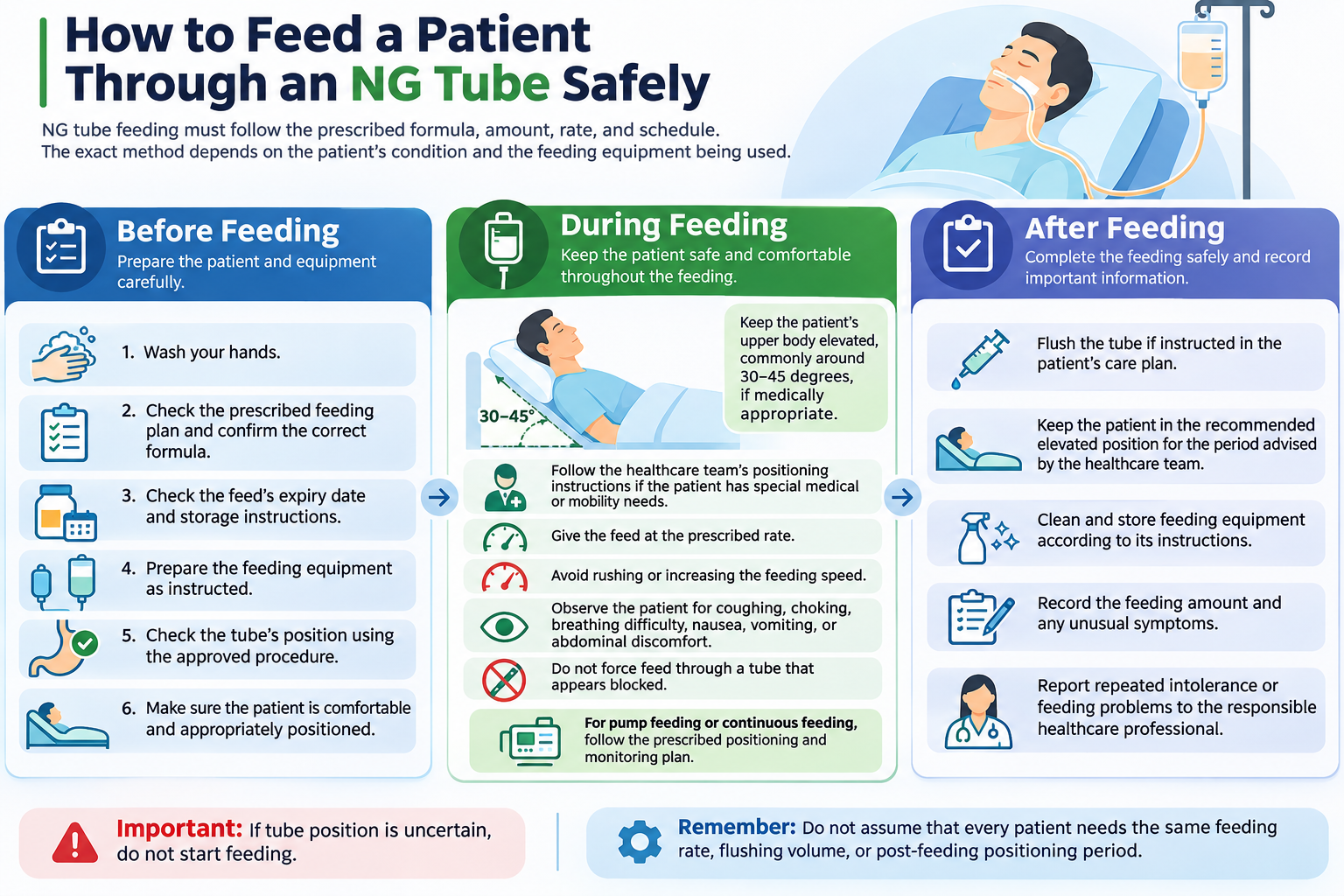
NG tube feeding must follow the prescribed formula, amount, rate, and schedule. The exact method depends on the patient’s condition and the feeding equipment being used.
Before Feeding
Prepare the patient and equipment carefully.
Wash your hands.
Check the prescribed feeding plan and confirm the correct formula.
Check the feed’s expiry date and storage instructions.
Prepare the feeding equipment as instructed.
Check the tube’s position using the approved procedure.
Make sure the patient is comfortable and appropriately positioned.
If tube position is uncertain, do not start feeding.
During Feeding
The patient’s position is important because feeding while lying flat may increase the risk of stomach contents entering the airway.
Keep the patient’s upper body elevated, commonly around 30–45 degrees, if medically appropriate.
Follow the healthcare team’s positioning instructions if the patient has special medical or mobility needs.
Give the feed at the prescribed rate.
Avoid rushing or increasing the feeding speed.
Observe the patient for coughing, choking, breathing difficulty, nausea, vomiting, or abdominal discomfort.
Do not force feed through a tube that appears blocked.
For pump feeding or continuous feeding, follow the prescribed positioning and monitoring plan.
After Feeding
After feeding:
Flush the tube if instructed in the patient’s care plan.
Keep the patient in the recommended elevated position for the period advised by the healthcare team.
Clean and store feeding equipment according to its instructions.
Record the feeding amount and any unusual symptoms.
Report repeated intolerance or feeding problems to the responsible healthcare professional.
Do not assume that every patient needs the same feeding rate, flushing volume, or post-feeding positioning period.
Flushing an NG Tube
Flushing helps prevent formula and medicine residue from building up inside the tube.
However, the water type and volume must follow the patient’s prescribed plan. These instructions may differ depending on the patient’s age, medical condition, fluid restrictions, and type of feeding tube.
Important precautions include:
Use only the water type recommended by the healthcare team.
Follow the prescribed flushing volume and timing.
Flush before and after medicines when instructed.
Follow the care plan for flushing before and after feeding.
Use the correct syringe and technique demonstrated by a trained professional.
Patients with kidney disease, heart failure, or other conditions requiring fluid restriction may need special instructions.
Never force water into a blocked tube. Stop and contact a qualified healthcare professional for advice.
Giving Medicines Through an NG Tube
Some medicines can be given through an NG tube, but not every medicine is suitable.
Before giving any medicine:
Confirm with the doctor or pharmacist that it can be administered through the tube.
Check whether a suitable liquid formulation is available.
Follow instructions about crushing, dissolving, or preparing medicines.
Give medicines separately unless the healthcare professional has instructed otherwise.
Flush the tube as directed between medicines.
Do not crush extended-release, modified-release, or enteric-coated tablets unless a pharmacist or prescriber has specifically confirmed that it is safe. Some liquid medicines may also be unsuitable because of their ingredients or consistency.
Never mix medicines directly into the feeding formula unless specifically instructed by the healthcare team.
Common NG Tube Problems and What to Do
Patients using an NG tube may experience problems that require attention. Knowing the warning signs can help families respond appropriately.
1. Blocked NG Tube
A tube may become blocked because of thick formula, medicine residue, or inadequate flushing.
Possible signs include:
Feed or water does not pass through easily.
The tube appears obstructed.
Flushing becomes difficult.
What to do: Stop using the tube and contact the healthcare professional for guidance. Do not force water, insert objects, or use unapproved solutions to clear the blockage.
2. Tube Displacement
The tube may move because of coughing, vomiting, pulling, or accidental movement.
Possible signs include:
A change in the external tube marking.
Loose or displaced fixation tape.
The tube appears longer or shorter than usual.
New coughing, gagging, or discomfort.
What to do: Stop feeding and do not give medicines or water through the tube. Do not attempt to push it back into place or reinsert it unless you are specifically trained and authorised under the patient’s care plan. Contact the responsible healthcare professional to arrange position confirmation.
3. Nasal Irritation or Skin Damage
The tube may cause pressure or friction around the nostril.
Watch for:
Redness or soreness.
Swelling or bleeding.
Skin breakdown.
Pain around the nose.
What to do: Keep the area clean, avoid pulling the tube, and seek professional advice if irritation persists or the skin becomes damaged.
4. Coughing, Choking, or Breathing Difficulty
Coughing or choking during feeding may indicate a serious problem, including possible aspiration or tube displacement.
What to do: Stop feeding immediately. If the patient has breathing difficulty, severe choking, or becomes unresponsive, seek emergency medical assistance. Do not restart feeding until the patient has been assessed and the tube’s position and feeding safety have been confirmed.
5. Vomiting or Feeding Intolerance
Some patients may develop nausea, vomiting, abdominal discomfort, or bloating during feeding.
Possible contributing factors include feeding rate, formula intolerance, delayed stomach emptying, or an underlying medical problem.
What to do: Stop the feed and contact the healthcare team for advice. Repeated vomiting, severe abdominal pain, or breathing symptoms need prompt medical assessment.
Signs That NG Tube Feeding May Not Be Well Tolerated
Families should observe the patient during and after feeding.
Contact the healthcare team if the patient develops:
Repeated nausea or vomiting.
New or increasing abdominal swelling.
Persistent abdominal discomfort.
Repeated coughing during feeding.
Unusual diarrhoea or constipation.
Reduced urine output or other possible signs of dehydration.
Unexpected changes in alertness or general condition.
These symptoms can have different causes. Do not independently change the feeding formula, amount, or rate to manage them.
When to Seek Urgent Medical Help
Some symptoms require immediate attention rather than routine follow-up.
Seek emergency medical help if the patient develops:
Severe breathing difficulty or choking.
Blue or grey lips or skin.
Loss of consciousness or inability to wake normally.
Severe chest pain.
Signs of serious aspiration or sudden respiratory distress.
Stop using the NG tube if its position is uncertain, if it has come out, or if displacement is suspected. Do not resume feeding until a qualified healthcare professional has confirmed that it is safe.
What Should You Do If the NG Tube Comes Out?
An NG tube may become accidentally dislodged during sleep, coughing, vomiting, or movement.
If this happens:
Stop feeding immediately.
Do not give water or medicines through the tube.
Do not attempt to reinsert it unless you have specific training and authorisation.
Keep the patient comfortable and observe for breathing problems or distress.
Contact the treating healthcare team for assessment and replacement instructions.
If the patient develops breathing difficulty, choking, or reduced consciousness, seek emergency medical assistance.
Daily NG Tube Care Checklist for Families
Use this checklist to help maintain a consistent care routine.
Wash hands before and after handling the tube.
Check the external tube marking and fixation.
Follow the approved tube-position checking procedure before use.
Keep the nostril and mouth clean.
Follow the prescribed feeding formula and schedule.
Maintain the recommended patient position during feeding.
Flush the tube according to the written care plan.
Give only medicines approved for NG tube administration.
Observe for coughing, vomiting, pain, or breathing changes.
Record feed amounts and any unusual symptoms.
Keep feeding equipment clean and properly stored.
Keep the healthcare team’s contact details accessible.
This checklist supports daily care but does not replace the patient’s individual feeding and nursing instructions.
Role of a Home Nurse in NG Tube Care
Patients who depend on an NG tube may need support from a qualified nurse, particularly when feeding, tube-position checks, medication administration, or clinical monitoring are part of the care plan.
A suitably qualified and trained home nurse may help with:
Following the prescribed feeding and nursing plan.
Performing tube-related procedures within their training and professional scope.
Carrying out tube-position checks according to the approved protocol.
Administering suitable prescribed medicines through the tube when authorised.
Monitoring the patient’s response to feeding.
Identifying signs of complications and reporting concerns.
Guiding family members on safe daily care.
A patient attendant has a different role. An attendant may assist with personal hygiene, comfortable positioning, mobility, and general daily support. NG tube feeding, position verification, and other clinical procedures should not be assumed to be part of an attendant’s duties. These tasks require appropriate professional training, authorisation, and a documented care plan.
Families should select staff according to the patient’s clinical needs and the level of care required. Some families may also prefer a male or female care professional based on the patient’s comfort and privacy.
Home Nursing Support from Shumaya Home Care & Patient Service
Managing an NG tube at home can be demanding for families, especially when the patient also needs help with mobility, hygiene, medication support, or ongoing monitoring.
Shumaya Home Care & Patient Service provides home nursing and patient-care support in Lahore. Families can discuss their needs and arrange suitable male or female care staff according to the patient’s condition and required level of assistance.
If your loved one needs clinical support at home, explore our home nursing services in Lahore. You can also read our guide to urinary catheter care and infection prevention at home.
Contact Shumaya Home Care & Patient Service to discuss suitable home-care arrangements for your family.
Frequently Asked Questions About NG Tube Care at Home
1. Can NG tube feeding be managed at home?
Yes. NG tube feeding may be managed at home when it has been prescribed by the treating healthcare team and the patient has an appropriate feeding plan. The family or caregiver must receive practical training and know how to recognize complications.
2. How often should an NG tube be checked?
Tube position must be checked according to the healthcare team’s instructions and the approved protocol before use. The external marking should also be observed for possible movement, but it cannot independently confirm correct placement.
3. Can a patient sleep with an NG tube?
Many patients can sleep with an NG tube in place. The tube should be secured properly, and the patient should follow the positioning instructions provided by the healthcare team. Feeding during sleep requires a specific clinical plan.
4. Can water be given through an NG tube?
Water may be given through an NG tube when prescribed as part of the patient’s hydration or flushing plan. The type and amount of water must follow professional instructions, particularly for patients with fluid restrictions.
5. What should I do if the NG tube becomes blocked?
Stop using the tube and contact a qualified healthcare professional. Do not force water through it, use sharp objects, or apply unapproved methods to clear the blockage.
6. Can medicines be given through an NG tube?
Some medicines can be administered through an NG tube, but others cannot. A doctor or pharmacist should confirm which medicines are suitable and explain how they should be prepared and given.
7. Is a nurse needed for NG tube care at home?
A qualified and appropriately trained nurse may be needed when the patient requires clinical procedures, tube-position checks, medication administration, or monitoring. The level of support depends on the patient’s condition and the prescribed care plan.
Final Advice
NG tube care at home requires attention, hygiene, proper training, and a clear medical plan. Families should never guess about tube position, change feeding instructions independently, or force a blocked tube.
With guidance from the treating healthcare team and appropriate home nursing support, families can manage daily care more confidently while keeping the patient’s safety and comfort a priority.
Medical disclaimer: This article is for general educational purposes only. It does not replace individual medical advice, hands-on training, or instructions from the patient’s doctor or qualified healthcare team. NG tube placement, position verification, feeding, flushing, and medication administration must follow the patient’s prescribed care plan and applicable professional protocols.