
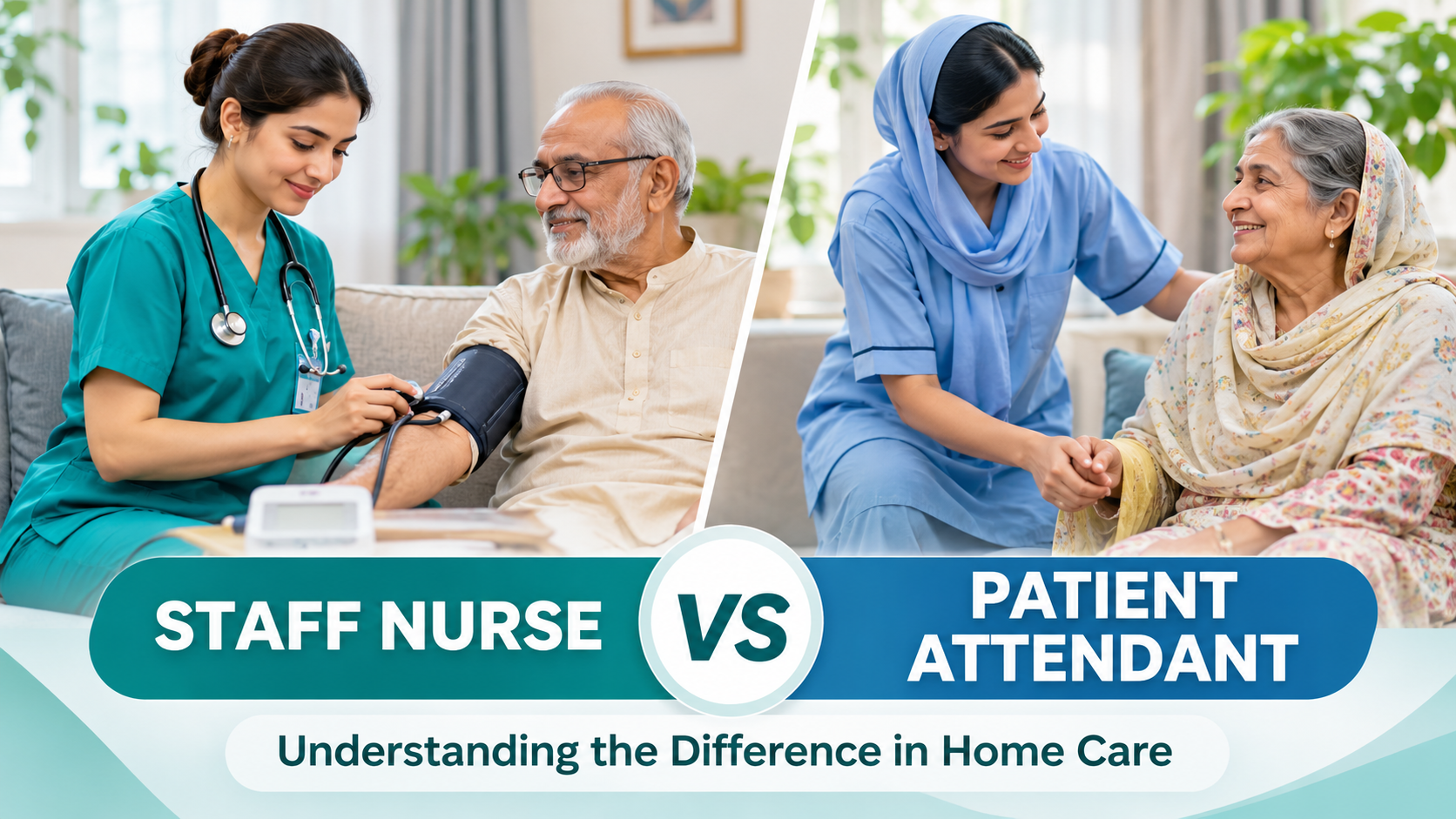
When arranging care for a patient at home, families often face an important question: Should they hire a staff nurse or a patient attendant?
Although both professionals support patients, their qualifications, responsibilities, and levels of clinical involvement are different. A staff nurse provides professional nursing care within their training and scope of practice, while a patient attendant mainly assists with daily activities such as bathing, feeding, mobility, hygiene, and companionship.
Choosing the right professional depends on the patient’s medical condition, level of independence, mobility, and need for nursing procedures or everyday personal care.
In this guide, we explain the difference between a staff nurse and a patient attendant, their duties, when each is needed, and how families can choose suitable home-care support in Lahore.
Quick Answer: Staff Nurse vs Patient Attendant
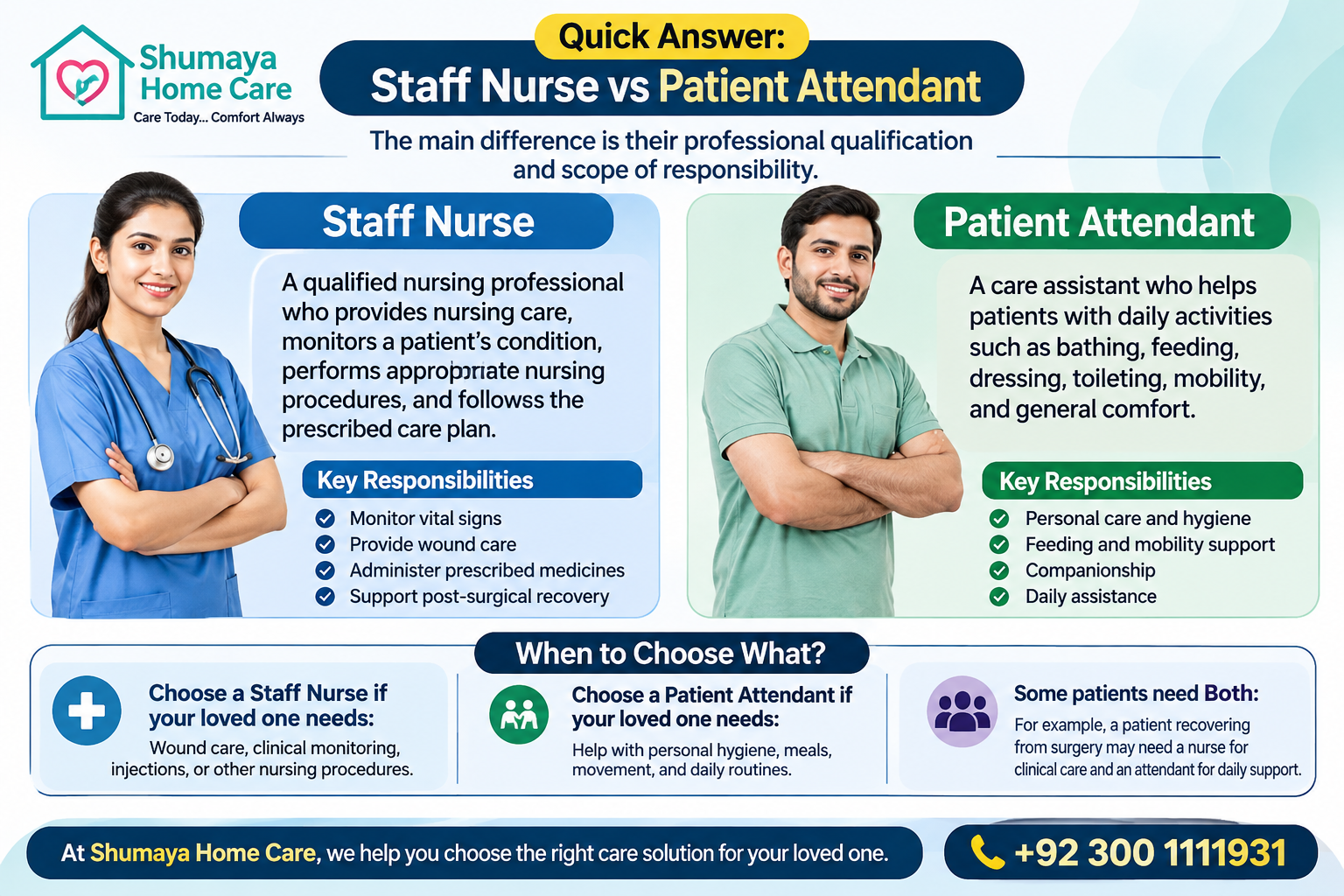
The main difference between a staff nurse and a patient attendant is their professional qualification and scope of responsibility.
Staff Nurse: A qualified nursing professional who provides nursing care, monitors a patient’s condition, performs appropriate nursing procedures, and follows the prescribed care plan within their professional scope.
Patient Attendant: A care assistant who helps patients with daily activities such as bathing, feeding, dressing, toileting, mobility, and general comfort.
A patient who needs wound care, clinical monitoring, injections, or other nursing procedures may require a qualified nurse. Someone who mainly needs help with personal hygiene, meals, movement, and daily routines may benefit from a patient attendant.
Some patients need both professionals, depending on their medical and personal-care requirements.
What Is a Staff Nurse?
A staff nurse is a trained nursing professional who provides healthcare support to patients in hospitals, clinics, and home-care settings.
A professional nurse should have completed the required nursing education and hold the applicable professional registration and credentials for their role. When hiring a nurse in Pakistan, families should verify their qualifications, relevant experience, and current Pakistan Nursing and Midwifery Council (PNMC) registration where applicable.
Staff nurses can help patients who need professional nursing attention, ongoing observation, or care following an illness, injury, or operation.
Main Responsibilities of a Staff Nurse
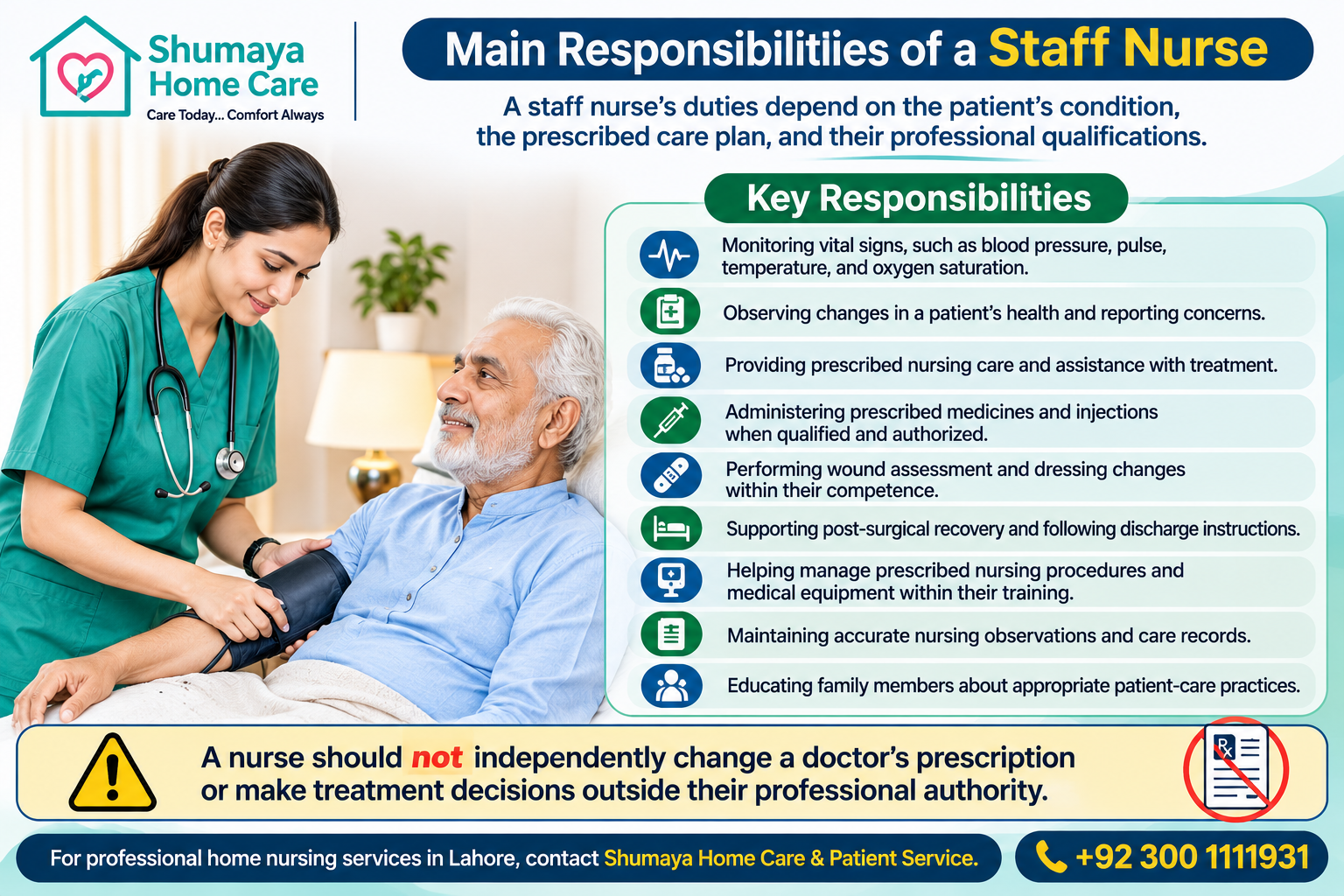
A staff nurse’s duties depend on the patient’s condition, the prescribed care plan, and the nurse’s qualifications and scope of practice.
Common responsibilities may include:
Monitoring vital signs, such as blood pressure, pulse, temperature, and oxygen saturation.
Observing changes in a patient’s health and reporting concerns.
Providing prescribed nursing care and assistance with treatment.
Administering prescribed medicines and injections when qualified and authorized.
Performing wound assessment and dressing changes within their competence.
Supporting post-surgical recovery and following discharge instructions.
Helping manage prescribed nursing procedures and medical equipment within their training.
Maintaining accurate nursing observations and care records.
Educating family members about appropriate patient-care practices.
A nurse should not independently change a doctor’s prescription or make treatment decisions outside their professional authority.
When Do You Need a Staff Nurse at Home?
A home nurse may be appropriate when a patient requires professional nursing care, including:
Recovery after major surgery.
Regular wound assessment or dressing changes.
Prescribed injections or other nursing procedures.
Monitoring of patients with complex medical conditions.
Nursing support for bedridden patients with additional clinical needs.
Care following hospital discharge.
Assistance with a prescribed treatment plan.
For these situations, families may consider professional home nursing services in Lahore.
What Is a Patient Attendant?
A patient attendant is a care assistant who helps patients manage everyday activities when illness, old age, disability, weakness, or limited mobility makes independent living difficult.
Patient attendants are particularly helpful for elderly people, bedridden patients, individuals recovering from illness, and people who need regular assistance with personal care.
Unlike a staff nurse, a patient attendant is not necessarily a registered healthcare professional. Their qualifications and training can vary, so families should ask about previous experience, patient-care training, and the type of assistance they can safely provide.
Main Responsibilities of a Patient Attendant
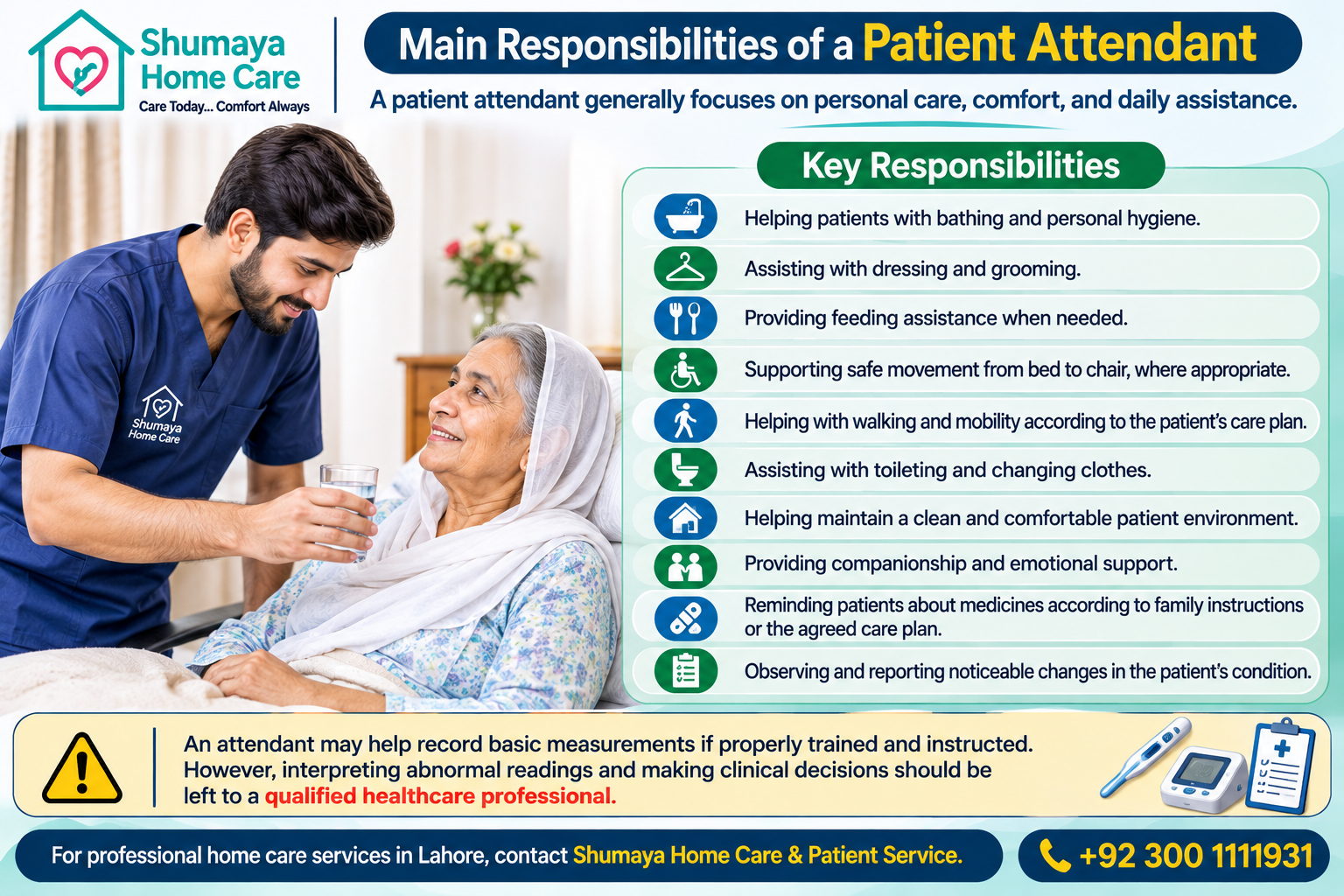
A patient attendant generally focuses on personal care, comfort, and daily assistance.
Their responsibilities may include:
Helping patients with bathing and personal hygiene.
Assisting with dressing and grooming.
Providing feeding assistance when needed.
Supporting safe movement from bed to chair, where appropriate.
Helping with walking and mobility according to the patient’s care plan.
Assisting with toileting and changing clothes.
Helping maintain a clean and comfortable patient environment.
Providing companionship and emotional support.
Reminding patients about medicines according to family instructions or the agreed care plan.
Observing and reporting noticeable changes in the patient’s condition.
An attendant may help record basic measurements if properly trained and instructed. However, interpreting abnormal readings and making clinical decisions should be left to a qualified healthcare professional.
When Do You Need a Patient Attendant at Home?
A patient attendant may be suitable when a patient mainly needs help with everyday activities, such as:
An elderly person who needs assistance with bathing, dressing, and meals.
A bedridden patient who needs regular personal care.
A person with limited mobility who needs help moving safely.
A patient recovering from an illness who needs support with daily routines.
Someone who needs companionship and supervision during the day or night.
For families arranging elderly patient care at home in Lahore, an attendant can provide valuable daily support when the patient’s needs do not require continuous professional nursing procedures.
Staff Nurse vs Patient Attendant: Main Differences
Although both professionals contribute to patient comfort and safety, their responsibilities are not interchangeable.
| Area | Staff Nurse | Patient Attendant |
|---|---|---|
| Professional background | Required nursing education and applicable registration | Training and experience may vary; not necessarily a registered professional |
| Main responsibility | Professional nursing care | Daily personal care and assistance |
| Clinical assessment | Performs nursing assessment within professional scope | Does not independently perform clinical assessments |
| Vital signs | Measures and monitors vital signs and reports concerns | May record basic measurements if trained and instructed |
| Wound care | Provides wound assessment and dressing within competence | Reports visible concerns; wound treatment is not a routine attendant duty |
| Injections | May administer prescribed injections when qualified and authorized | Not a routine attendant responsibility |
| Medication support | Provides medication-related nursing care within scope and prescription | May provide reminders or limited assistance according to the care plan |
| Personal hygiene | Can assist when needed | A major part of the role |
| Feeding assistance | Can assist when needed | A major part of the role |
| Mobility support | Helps according to the patient’s condition and care plan | Helps with everyday movement and transfers when appropriately trained |
| Clinical monitoring | Provides nursing observations and reports changes | Observes general comfort and reports noticeable changes |
| Companionship | May provide reassurance during care | Often an important part of daily support |
The most important point is that a nurse is responsible for professional nursing care, while an attendant primarily supports everyday living and personal care.
Can a Patient Attendant Replace a Staff Nurse?
No. A patient attendant cannot replace a qualified staff nurse when a patient requires professional nursing care or clinical procedures.
For example, a patient with a surgical wound that needs regular assessment and dressing may require a nurse. An attendant can help with bathing, feeding, mobility, and comfort, but should not independently take responsibility for clinical wound management.
Similarly, patients who need prescribed injections, nursing assessment, or monitoring of complex medical conditions should receive care from an appropriately qualified healthcare professional.
An attendant can be a valuable part of a home-care arrangement, but their role should remain within their training and assigned responsibilities.
Can a Staff Nurse Also Perform Patient Attendant Duties?
Yes. A staff nurse can often assist with everyday personal-care activities when required and appropriate.
For example, a nurse may help a patient with positioning, hygiene, feeding, or mobility while also providing nursing care.
However, families should understand that hiring a nurse for a role that mainly involves routine personal assistance may not always be necessary. The appropriate choice should depend on the patient’s actual care requirements.
If a patient needs daily assistance but does not require nursing procedures, a patient attendant may be a more suitable arrangement.
Signs That Your Patient Needs a Nurse Instead of an Attendant
Some patients need more than everyday personal assistance. Professional nursing support may be appropriate when a patient has clinical care requirements.
Consider discussing nursing support with the treating doctor if the patient:
Needs regular wound assessment or dressing changes.
Requires prescribed injections or nursing procedures.
Has a medical condition requiring professional monitoring.
Is recovering from major surgery.
Has a complicated treatment plan requiring nursing support.
Experiences changes in health that need clinical assessment.
Requires care involving medical equipment that needs a trained professional.
A doctor or treating healthcare team can help determine the level of care required at home.
If the patient has severe breathing difficulty, chest pain, loss of consciousness, sudden weakness, or another medical emergency, seek emergency medical care rather than relying on a home-care worker.
Which Professional Is Better for Different Patients?
The right choice depends on the patient’s medical and personal-care needs.
1. Elderly Patients
Older adults may need help with bathing, dressing, meals, walking, and other daily activities.
A patient attendant may be suitable when the main requirement is everyday assistance and companionship.
However, an elderly patient with complex medical conditions, prescribed nursing procedures, or a need for clinical monitoring may require a staff nurse.
2. Bedridden Patients
Bedridden patients may need assistance with repositioning, hygiene, feeding, toileting, and maintaining comfort.
A patient attendant can support these daily activities. If the patient also needs wound care, clinical monitoring, or other nursing procedures, a qualified nurse may be necessary.
3. Post-Surgical Patients
Some patients recover at home with family assistance, while others need professional nursing support.
A staff nurse may be required for prescribed wound care, nursing observations, and other clinical responsibilities. An attendant can help with bathing, meals, mobility, and everyday activities during recovery.
New or worsening symptoms, such as fever, increasing wound redness, unusual discharge, or worsening pain, should be reported promptly to the treating healthcare team. Breathing difficulty, chest pain, or sudden deterioration requires urgent medical attention.
4. Patients with Chronic Conditions
People living with diabetes, heart disease, neurological conditions, or other long-term illnesses may need different levels of assistance.
An attendant can help with daily routines and personal care. A nurse may be needed when the patient’s care plan involves clinical monitoring or nursing procedures.
The treating doctor should guide the family on the appropriate level of home-care support.
5. Patients Requiring Continuous Daily Assistance
Some patients need assistance throughout the day or night but do not necessarily require continuous nursing procedures.
In such cases, a patient attendant may provide practical support with meals, hygiene, movement, and companionship. Nursing visits or additional nursing support can be arranged if clinical needs arise.
Male or Female Staff Nurse and Patient Attendant: Which Should You Choose?
Gender preference can be an important consideration when arranging care at home, particularly for personal hygiene, bathing, dressing, and other intimate care activities.
Families may prefer a female attendant for a female patient or a male attendant for a male patient. Similarly, they may request a male or female nurse according to the patient’s comfort and care requirements.
When selecting staff, consider:
The patient’s comfort and personal preference.
The worker’s qualifications and relevant experience.
The patient’s medical and mobility needs.
The nature of the required personal or nursing care.
Communication skills and professional conduct.
Gender preference should not replace professional qualifications. For nursing responsibilities, always verify the nurse’s credentials and suitability for the required care.
Can a Patient Need Both a Staff Nurse and a Patient Attendant?
Yes. Some patients benefit from having both professionals because their needs include clinical nursing care as well as regular personal assistance.
For example, a bedridden patient recovering from major surgery may need:
A staff nurse for:
Prescribed wound care and dressing.
Nursing observations and clinical monitoring.
Prescribed injections or other appropriate nursing procedures.
Reporting changes in the patient’s condition.
A patient attendant for:
Bathing and personal hygiene.
Feeding and daily comfort.
Toileting and dressing.
Mobility assistance and companionship.
This arrangement allows each professional to focus on their appropriate responsibilities. The care plan should clearly define duties and be guided by the patient’s medical requirements.
How to Choose the Right Home-Care Professional
Before hiring a staff nurse or patient attendant, families should understand the patient’s needs and check the suitability of the person providing care.
Consider the following points:
Understand the patient’s condition: Identify whether the patient needs nursing procedures, clinical monitoring, personal care, or a combination.
Check qualifications: Verify the nurse’s nursing education and applicable professional registration. Ask attendants about their training and experience.
Ask about relevant experience: A worker who has cared for similar patients may be better prepared for the required responsibilities.
Clarify the duties: Agree on the tasks the worker will perform and make sure they match their qualifications and training.
Discuss working hours: Decide whether the patient needs a few hours of assistance, a full-day arrangement, or night-time support.
Consider patient comfort: Discuss gender preference, communication, privacy, and the patient’s personal needs.
Follow medical guidance: Ask the treating doctor which services are appropriate at home and whether professional nursing care is necessary.
A clear care plan helps families avoid confusion and ensures that the patient receives appropriate assistance.
Home Nursing and Patient Attendant Services in Lahore
Finding suitable home-care support can make daily life easier for patients and their families. The right professional can help patients maintain comfort, dignity, and safety while receiving appropriate support at home.
Shumaya Home Care & Patient Service provides home-care support in Lahore, including nursing and patient attendant services. Families can discuss their requirements and request suitable male or female staff according to the patient’s needs and availability.
Whether you need a qualified nurse for professional nursing responsibilities or an attendant for everyday patient assistance, the first step is to understand the level of care required.
Explore our home nursing services in Lahore and registered and trained nurses in Lahore.
Contact Shumaya Home Care & Patient Service: +92 300 1111931
Discuss the patient’s condition, required duties, preferred staff, and working hours so that an appropriate care arrangement can be considered.
Frequently Asked Questions
1. What is the main difference between a staff nurse and a patient attendant?
A staff nurse is a qualified nursing professional who provides nursing care within their scope of practice. A patient attendant mainly helps with daily activities such as bathing, feeding, dressing, mobility, and personal hygiene.
2. Can a patient attendant give injections?
Giving injections is not a routine patient attendant responsibility. Prescribed injections should be administered by an appropriately qualified and authorized healthcare professional.
3. Can a patient attendant take care of a bedridden patient?
Yes. An appropriately trained attendant can assist a bedridden patient with hygiene, feeding, positioning, toileting, and daily comfort. If the patient needs wound treatment or other nursing procedures, a qualified nurse may also be required.
4. Does an elderly patient need a nurse or an attendant?
It depends on the patient’s condition. An attendant may be suitable for daily personal care and companionship. A nurse may be needed when the elderly patient requires professional nursing procedures, clinical monitoring, or other nursing support.
5. Can a staff nurse also help with bathing and feeding?
Yes. A nurse can assist with personal care activities when needed. However, if a patient only requires routine daily assistance, a patient attendant may be a more suitable option.
6. When should a family hire both a nurse and a patient attendant?
Both may be useful when a patient needs professional nursing care as well as regular assistance with hygiene, meals, mobility, and other daily activities.
7. Can families request a male or female patient attendant?
Families can discuss their gender preference when arranging home-care services. Availability should be confirmed according to the patient’s requirements and the service provider’s staffing.
8. How can I arrange a staff nurse or patient attendant in Lahore?
Contact Shumaya Home Care & Patient Service at +92 300 1111931 to discuss the patient’s condition, required care, preferred staff, and working hours.