
Choosing the right home care arrangement is an important decision for families looking after a patient. Some patients need professional nursing support for a few days or weeks, while others require regular assistance over a longer period because of old age, chronic illness, disability, or limited mobility.
Understanding the difference between temporary and long-term home nursing services can help families arrange suitable care according to the patient’s medical condition, daily needs, and recovery progress.
Temporary home nursing is generally suitable for patients who need professional nursing support for a limited period, such as after surgery, hospital discharge, or an acute illness. Long-term home care is suitable for patients who need ongoing nursing or personal assistance because of chronic illness, old age, disability, or limited mobility.
However, long-term care does not always mean that a patient needs a nurse every day. Some patients require clinical nursing services, while others mainly need help with bathing, feeding, dressing, mobility, and other daily activities.
This guide explains both options and helps families understand which arrangement may be appropriate for their patient.
What Are Temporary Home Nursing Services?
Temporary home nursing services provide professional nursing support for a limited period. They are generally arranged when a patient needs assistance during recovery, after hospital discharge, or while managing a health condition that requires short-term nursing attention.
The duration depends on the patient’s condition, treatment plan, and recovery progress. Some patients may need support for a few days, while others may require several weeks.
When Are Temporary Home Nursing Services Needed?
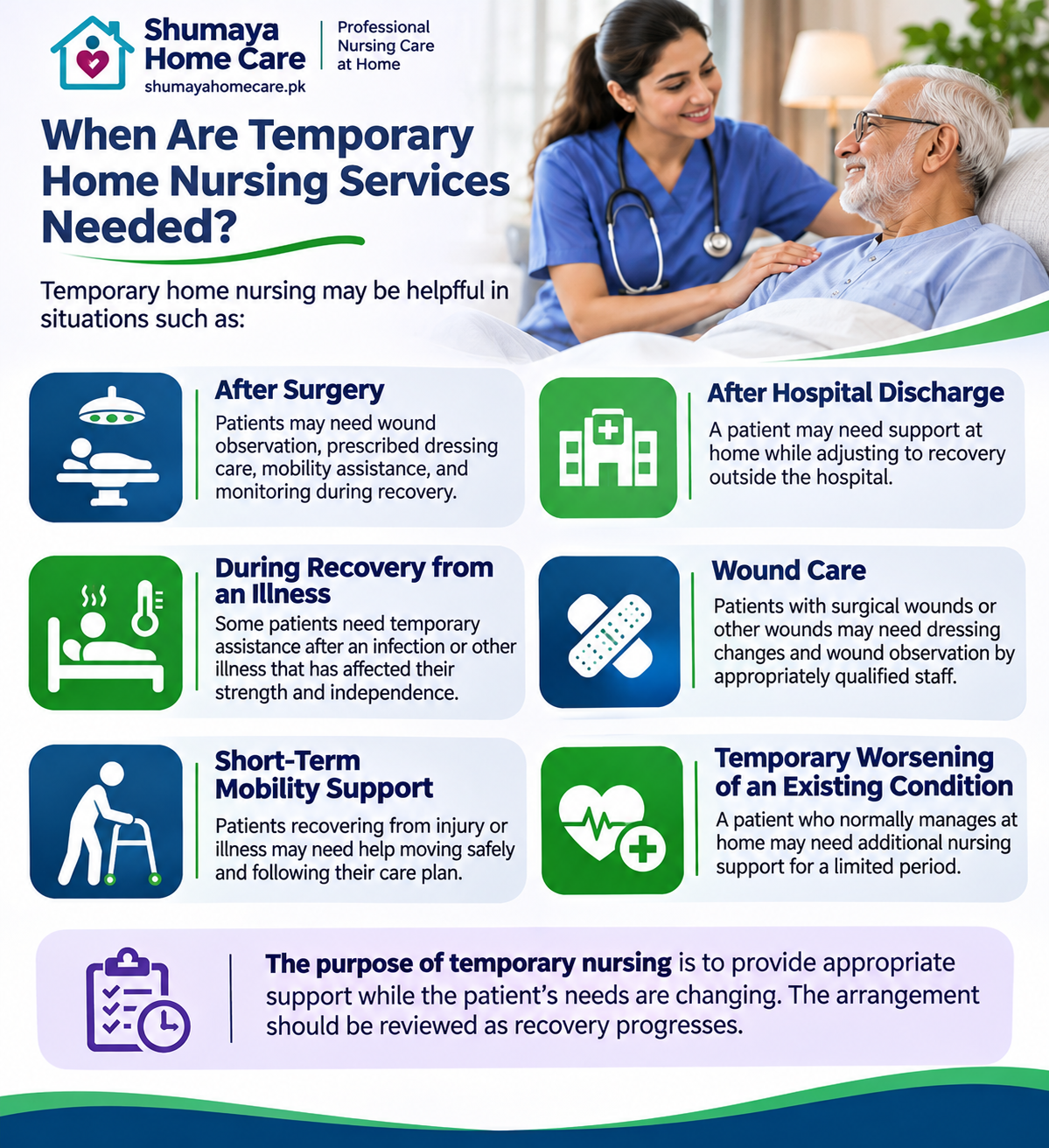
Temporary home nursing may be helpful in situations such as:
After surgery: Patients may need wound observation, prescribed dressing care, mobility assistance, and monitoring during recovery.
After hospital discharge: A patient may need support at home while adjusting to recovery outside the hospital.
During recovery from an illness: Some patients need temporary assistance after an infection or other illness that has affected their strength and independence.
Wound care: Patients with surgical wounds or other wounds may need dressing changes and wound observation by appropriately qualified staff.
Short-term mobility support: Patients recovering from injury or illness may need help moving safely and following their care plan.
Temporary worsening of an existing condition: A patient who normally manages at home may need additional nursing support for a limited period.
The purpose of temporary nursing is to provide appropriate support while the patient’s needs are changing. The arrangement should be reviewed as recovery progresses.
What Are Long-Term Home Nursing and Patient Care Services?
Long-term home care refers to ongoing support for patients who have continuing medical, physical, or personal care needs.
It may be appropriate for elderly patients, people living with chronic conditions, bedridden individuals, or patients with disabilities who need regular assistance at home.
An important point is that long-term home care does not always require continuous nursing. The type of staff depends on the patient’s actual needs.
For example, a patient who needs regular clinical procedures or skilled nursing observation may require a qualified nurse. A patient who is medically stable but needs help with bathing, feeding, dressing, and mobility may benefit more from a trained patient attendant.
Who May Need Long-Term Home Care?
Long-term home care may be suitable for:
Elderly patients: Older adults who need regular assistance with personal care, mobility, or daily routines.
Bedridden patients: Individuals who cannot move independently and need help with hygiene, repositioning, feeding, and comfort.
Patients with chronic illnesses: People whose conditions require ongoing monitoring or assistance according to a healthcare professional’s care plan.
Stroke patients: Individuals who need help with daily activities, safe mobility, and rehabilitation support under professional guidance.
Patients with disabilities: People who need regular assistance with personal care and everyday activities.
Patients with neurological conditions: Individuals who experience limitations in movement, coordination, or independence.
Long-term care arrangements should be reviewed periodically. A patient’s needs can change, so the type of staff, working hours, and level of assistance may also need adjustment.
Temporary vs Long-Term Home Nursing: Key Differences
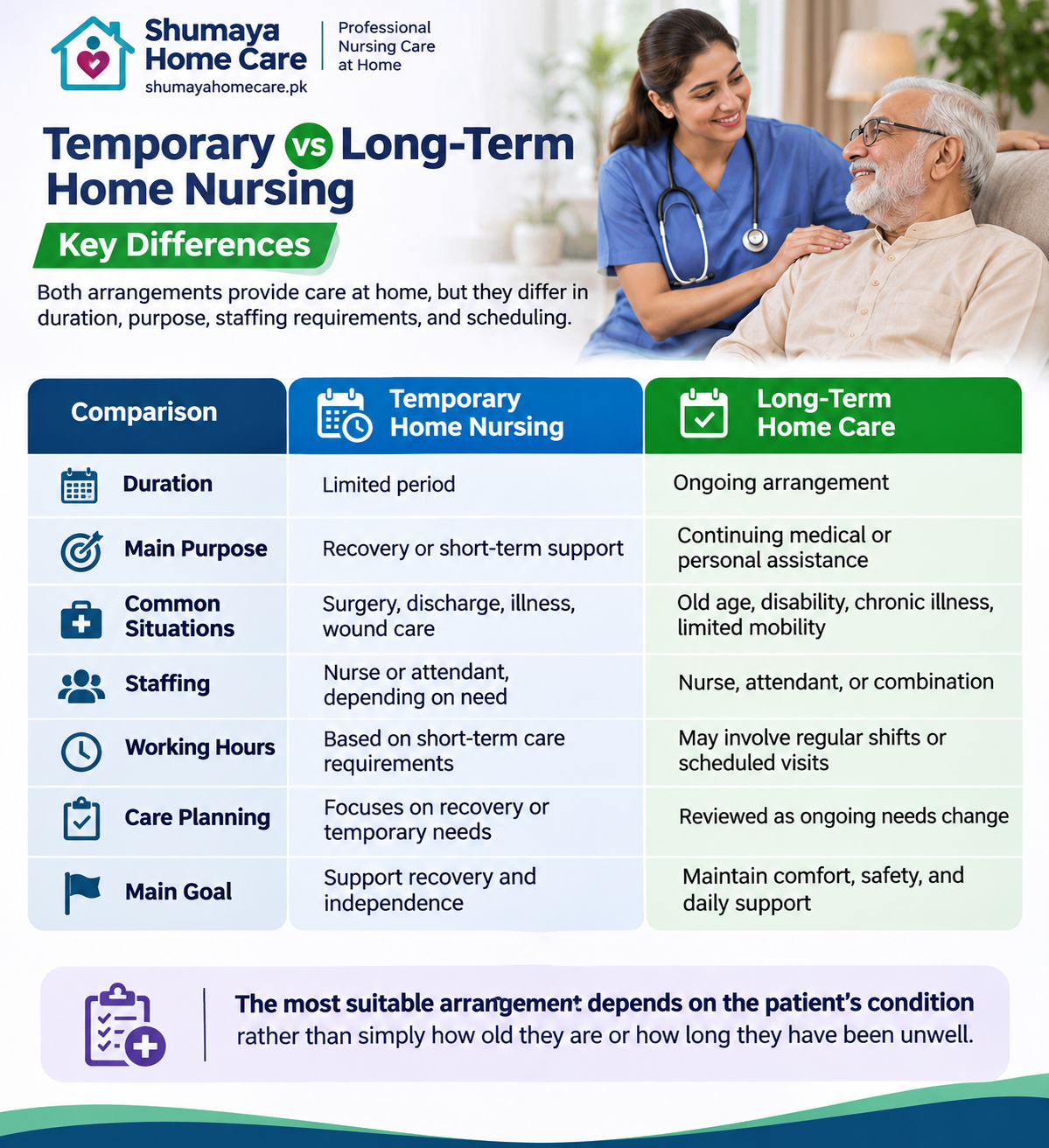
Both arrangements provide care at home, but they differ in duration, purpose, staffing requirements, and scheduling.
| Comparison | Temporary Home Nursing | Long-Term Home Care |
|---|---|---|
| Duration | Limited period | Ongoing arrangement |
| Main purpose | Recovery or short-term support | Continuing medical or personal assistance |
| Common situations | Surgery, discharge, illness, wound care | Old age, disability, chronic illness, limited mobility |
| Staffing | Nurse or attendant, depending on need | Nurse, attendant, or combination |
| Working hours | Based on short-term care requirements | May involve regular shifts or scheduled visits |
| Care planning | Focuses on recovery or temporary needs | Reviewed as ongoing needs change |
| Main goal | Support recovery and independence | Maintain comfort, safety, and daily support |
The most suitable arrangement depends on the patient’s condition rather than simply how old they are or how long they have been unwell.
When Does a Patient Need Temporary Home Nursing?
A patient may need temporary home nursing when professional support is required for a specific recovery period or treatment-related need.
For example, someone discharged after surgery may be able to return home but still need help with prescribed wound care, monitoring, or recovery-related activities.
Similarly, a patient recovering from an illness may temporarily need assistance with mobility and daily activities until their strength improves.
Temporary nursing may be appropriate when:
The patient is expected to recover or regain independence.
Nursing procedures are required for a limited period.
The patient needs short-term observation following discharge.
A medical condition has temporarily increased the need for care.
Family members need professional support during the recovery period.
The expected duration should be discussed with the treating healthcare professional and reviewed according to the patient’s progress.
When Does a Patient Need Long-Term Home Care?
Long-term home care may be needed when a patient has continuing difficulties managing daily activities or requires ongoing clinical support.
For example, an elderly patient with limited mobility may need help with bathing, dressing, toileting, feeding, and moving safely around the home. A bedridden patient may require regular hygiene support, repositioning according to an individualized care plan, and observation for changes in skin condition.
Long-term support may be appropriate when:
The patient cannot safely perform daily activities independently.
Mobility limitations are expected to continue.
A chronic condition creates ongoing care requirements.
The patient needs regular assistance with personal hygiene and feeding.
Family caregivers cannot provide all the required support.
Clinical nursing tasks must be performed according to a professional care plan.
Long-term care does not necessarily mean 24-hour nursing. Some patients need only a few hours of assistance each day, while others require more extensive coverage.
How Long Should You Hire a Home Nurse?
There is no single duration that is suitable for every patient. The required working period depends on the type of care, the patient’s condition, and the tasks that need to be performed.
The following examples can help families understand possible arrangements:
A few hours: Suitable when a patient needs assistance with specific nursing tasks, scheduled monitoring, or limited personal care.
Several days: May be appropriate for short-term support following a medical procedure, hospital discharge, or temporary illness.
Several weeks: May be considered when recovery requires continued nursing support, wound care, or assistance with mobility.
Ongoing care: May be needed when a patient has continuing medical or personal care requirements that are not expected to resolve quickly.
These are examples of possible arrangements, not fixed medical recommendations. The care schedule should be based on the patient’s individual needs and professional advice.
Home Nurse vs Patient Attendant: Which Do You Need?
One of the most important decisions when arranging home care is choosing the correct type of staff.
A qualified nurse and a patient attendant have different responsibilities. Hiring a nurse when only personal assistance is required may be unnecessary, while assigning clinical nursing tasks to an attendant may be unsafe.
When Do You Need a Home Nurse?
A qualified nurse may be required when a patient needs clinical nursing care, such as:
Monitoring vital signs according to the care plan.
Providing prescribed nursing procedures within professional scope.
Performing wound dressing and wound observation when appropriately qualified.
Supporting post-surgical nursing care.
Observing changes in the patient’s condition and reporting concerns.
Assisting with clinical care under the treating healthcare professional’s instructions.
The nurse’s qualifications, registration status, and experience should match the patient’s clinical requirements.
When Do You Need a Patient Attendant?
A trained patient attendant generally focuses on personal care, comfort, and everyday assistance.
Responsibilities may include:
Helping with bathing and personal hygiene.
Assisting with dressing and grooming.
Providing feeding assistance when appropriate.
Helping with toileting and changing.
Supporting safe movement from bed to chair.
Assisting with walking and daily activities according to the care plan.
Providing companionship and reporting changes in the patient’s condition.
An attendant should not be assigned clinical nursing procedures beyond their training and authorized responsibilities.
For a detailed explanation, read our guide: Staff Nurse vs Patient Attendant: Understanding the Difference.
Male or Female Home Care Staff: Which Is Suitable?
Families may also consider whether a male or female nurse or patient attendant is more suitable for their patient.
The decision can depend on the patient’s comfort, personal preferences, type of care, and staff availability.
Both male and female healthcare staff can provide professional care when they have the appropriate qualifications, training, and experience for their assigned responsibilities.
When arranging home care, families should consider:
The patient’s preference and comfort.
The nature of personal care required.
The staff member’s qualifications and experience.
The patient’s mobility and physical assistance needs.
The family’s preferences and home environment.
The most important consideration is that the assigned staff member is suitable for the patient’s care requirements.
Can Temporary Home Nursing Become Long-Term Care?
Yes. A patient’s care requirements can change during recovery or as a health condition progresses.
For example, an elderly patient may initially need a qualified nurse after hospital discharge because of wound care, clinical observation, or other nursing requirements.
As the patient’s condition improves, regular clinical nursing may no longer be necessary. However, the patient may still need help with bathing, dressing, feeding, and mobility.
In this situation, the family may move from temporary nursing support to an ongoing patient attendant arrangement.
The opposite can also happen. A patient who normally needs personal assistance may develop a new medical problem and require additional nursing support.
For this reason, families should review the care arrangement whenever the patient’s condition changes. The goal is to provide the right level of support without arranging unnecessary services or overlooking clinical needs.
How to Choose the Right Home Care Arrangement
Choosing between temporary and long-term home nursing requires an understanding of the patient’s medical and daily care needs.
Before arranging a service, consider the following factors:
1. Understand the patient’s medical condition
Discuss the patient’s condition, treatment plan, and expected recovery with the treating healthcare professional. Identify whether clinical nursing tasks are required.
2. Identify daily care requirements
Consider whether the patient needs help with bathing, feeding, dressing, toileting, mobility, or other daily activities.
3. Select the appropriate staff
Arrange a qualified nurse for clinical nursing requirements and a trained patient attendant for suitable personal care tasks. Some patients may need both.
4. Decide the working hours
Consider whether the patient needs a few hours of support, a scheduled shift, or more extensive care coverage.
5. Review staff qualifications and experience
Ask about relevant qualifications, training, experience, and suitability for the patient’s condition.
6. Discuss communication and reporting
Families should understand how staff will report changes in the patient’s condition and communicate with family members or the treating healthcare professional.
7. Review the arrangement regularly
Care requirements may change. Review the schedule and staffing arrangement as the patient’s condition improves or new needs develop.
What Affects the Cost of Home Nursing Services?
The cost of temporary and long-term home care depends on several factors. There is no single rate that applies to every patient because care requirements and staffing arrangements differ.
Important cost factors include:
| Cost Factor | How It Affects the Cost |
|---|---|
| Type of staff | Qualified nursing care and patient attendant services have different staffing requirements. |
| Working hours | A few hours, scheduled shifts, and extended coverage involve different arrangements. |
| Duration | Short-term and ongoing arrangements may have different payment structures. |
| Patient’s condition | Complex care requirements may need more experienced or qualified staff. |
| Number of staff | Some patients may require more than one staff member or different types of support. |
| Experience and qualifications | Specialized experience may affect staff availability and service costs. |
| Location and scheduling | Travel, shift timing, and staff availability may influence arrangements. |
Temporary care may be arranged for a defined period, while long-term arrangements may involve regular scheduling and ongoing budget planning.
Families should ask for a clear explanation of the service scope, working hours, staff responsibilities, and payment terms before confirming an arrangement.
When Is Home Nursing Not Enough?
Home nursing and patient care services can support patients at home, but they do not replace emergency medical treatment or hospital care when these are needed.
Seek urgent medical attention if a patient experiences serious symptoms such as:
Severe difficulty breathing.
Chest pain or pressure.
Sudden weakness, facial drooping, or difficulty speaking.
Loss of consciousness or a new seizure.
Severe bleeding.
Sudden confusion or a major change in responsiveness.
Families should follow the treating healthcare professional’s instructions and seek emergency assessment when serious symptoms occur. Do not delay emergency care while waiting for a home nurse or attendant.
Home Nursing Services in Lahore by Shumaya Home Care
Finding suitable home care staff is important for patients who need professional support outside a hospital.
Shumaya Home Care & Patient Service provides home nursing and patient care support in Lahore, helping families arrange care according to their patients’ requirements.
Our services include male and female staff nurses and patient attendants, depending on the type of assistance required.
Families can discuss their patient’s condition, required staff qualifications, working hours, and expected duration of care before arranging a service.
Whether a patient needs temporary nursing support after hospital discharge or ongoing assistance with daily activities, the care arrangement should match the patient’s individual needs.
Explore our Home Nursing Services in Lahore to learn more about available support.
You can also learn about Registered and Trained Nurses in Lahore.
Contact Shumaya Home Care to discuss a suitable home care arrangement for your patient.
Frequently Asked Questions
1. What is the difference between temporary and long-term home nursing?
Temporary home nursing provides professional support for a limited period, usually during recovery, after surgery, or following hospital discharge. Long-term home care provides ongoing nursing or personal assistance for patients with continuing medical or daily care needs.
2. How long can temporary home nursing services be arranged?
The duration depends on the patient’s condition and care requirements. It may last a few days or several weeks. The arrangement should be reviewed according to recovery progress and professional advice.
3. Does long-term home care always require a qualified nurse?
No. Some patients need clinical nursing care, while others mainly require assistance with daily activities. A qualified nurse should handle clinical nursing responsibilities, whereas a trained patient attendant may provide suitable personal care.
4. Can a patient attendant provide long-term care?
Yes. A trained patient attendant may provide ongoing assistance with bathing, dressing, feeding, toileting, mobility, and other daily activities when these tasks are appropriate for the attendant’s training and the patient’s care plan.
5. Is 24-hour home nursing necessary for every patient?
No. Not every patient needs 24-hour care. Some patients require only a few hours of assistance or scheduled nursing visits. Others may need longer coverage depending on their medical and personal care requirements.
Also, 24-hour care coverage does not automatically mean one nurse provides continuous clinical nursing throughout the day and night. The staffing arrangement should be planned according to the actual care needs.
6. Can home nursing help a patient recover after surgery?
Yes. Home nursing may support recovery through appropriate nursing procedures, prescribed wound care, monitoring, and assistance according to the patient’s discharge instructions and care plan. The services required depend on the type of surgery and the patient’s condition.
7. How do I choose between a home nurse and a patient attendant?
Choose a qualified nurse when the patient requires clinical nursing care. Choose a trained patient attendant when the main requirements involve personal care, mobility, hygiene, and daily assistance. Some patients may need both types of support.
8. Are temporary and long-term home care services available in Lahore?
Families in Lahore can arrange home nursing and patient care support according to their requirements. The appropriate staff, working hours, and duration should be discussed based on the patient’s condition and care needs.
Conclusion
The choice between temporary and long-term home nursing services depends on the patient’s medical condition, recovery progress, and daily care requirements.
Temporary nursing is generally suitable for short-term recovery, post-surgical support, and care after hospital discharge. Long-term home care is more appropriate when a patient needs continuing clinical or personal assistance.
Most importantly, families should distinguish between clinical nursing and everyday patient care. Selecting the right staff and working hours can help provide appropriate support while maintaining the patient’s comfort, safety, and dignity.
With a suitable care arrangement and regular review, families can make better decisions about supporting their loved ones at home.