

Helping an elderly heart patient take medicines safely is an important part of daily care at home. Older adults may take several medicines to manage high blood pressure, heart failure, an irregular heartbeat, or other health conditions. Keeping track of each medicine can become difficult, especially when a patient has memory problems, poor eyesight, or difficulty swallowing tablets.
Families can reduce medication mistakes by following the prescribed schedule, keeping an updated medicine list, watching for side effects, and staying in contact with the treating doctor.
For families caring for an older adult at home in Lahore, a clear medication routine can make daily care easier. When additional help is needed, professional home nursing services may provide support according to the patient’s condition, care plan, and the nurse’s qualifications.
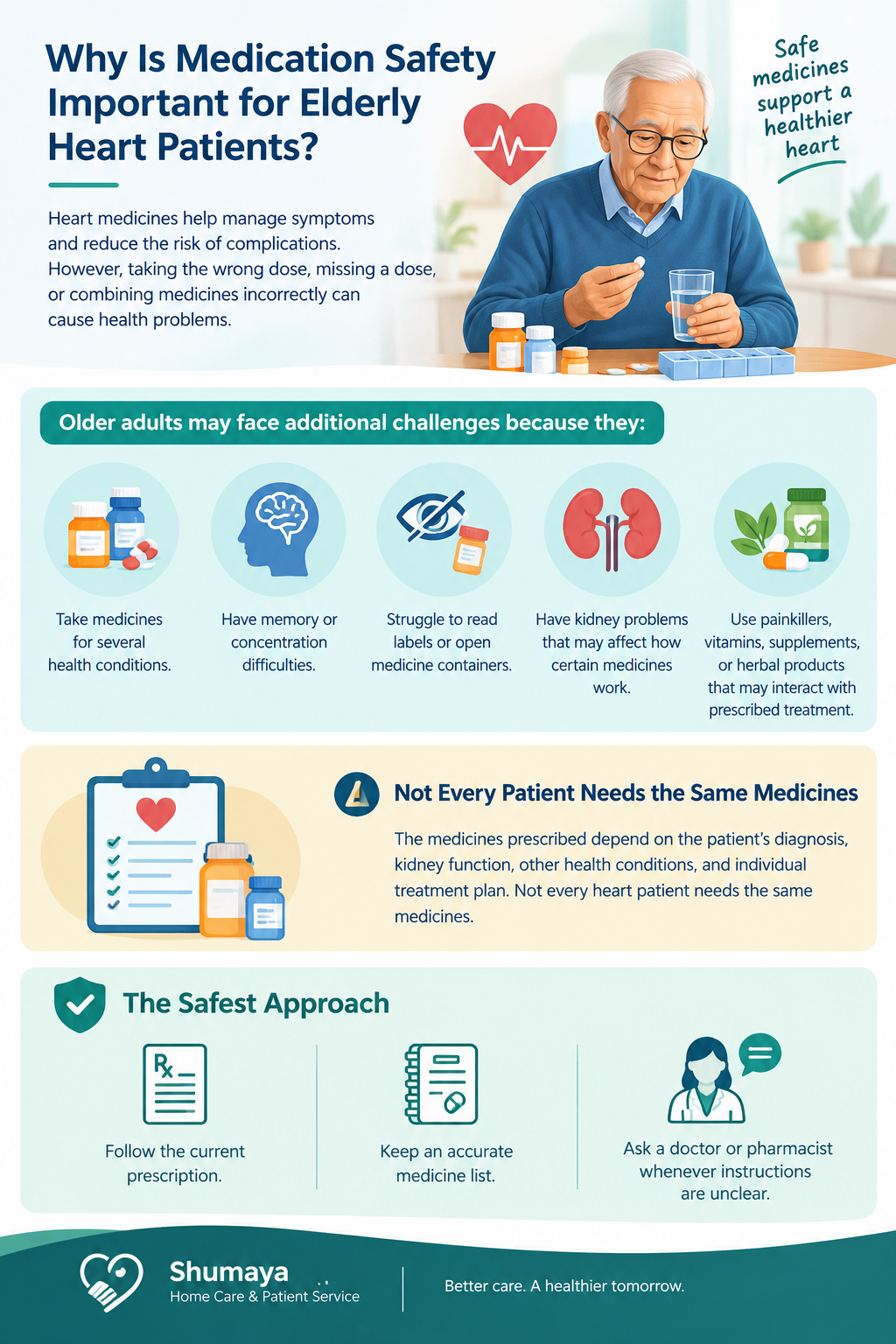
Why Is Medication Safety Important for Elderly Heart Patients?
Heart medicines help manage symptoms and reduce the risk of complications. However, taking the wrong dose, missing a dose, or combining medicines incorrectly can cause health problems.
Older adults may face additional challenges because they:
Take medicines for several health conditions.
Have memory or concentration difficulties.
Struggle to read labels or open medicine containers.
Have kidney problems that may affect how certain medicines work.
Use painkillers, vitamins, supplements, or herbal products that may interact with prescribed treatment.
The medicines prescribed depend on the patient’s diagnosis, kidney function, other health conditions, and individual treatment plan. Not every heart patient needs the same medicines.
The safest approach is to follow the current prescription, keep an accurate medicine list, and ask a doctor or pharmacist whenever instructions are unclear.
1. Make an Updated List of All Medicines
Start by creating a written list of every medicine the patient takes. Include prescription medicines, over-the-counter products, vitamins, and herbal supplements.
For each medicine, record:
Medicine name and prescribed strength.
Prescribed dose and timing.
Instructions for taking it, including any food-related directions.
The reason it was prescribed, if known.
Special precautions or monitoring instructions.
The prescribing doctor’s name, when available.
Keep the list in an accessible place and take it to medical appointments or hospital visits.
Update it whenever a doctor changes the treatment. Remove discontinued medicines from the active schedule, but keep a record of changes when useful for medical review.
Important: Do not start a new medicine, supplement, or herbal product without checking whether it is suitable for the patient’s condition and existing prescriptions.
2. Create a Simple Daily Medication Routine
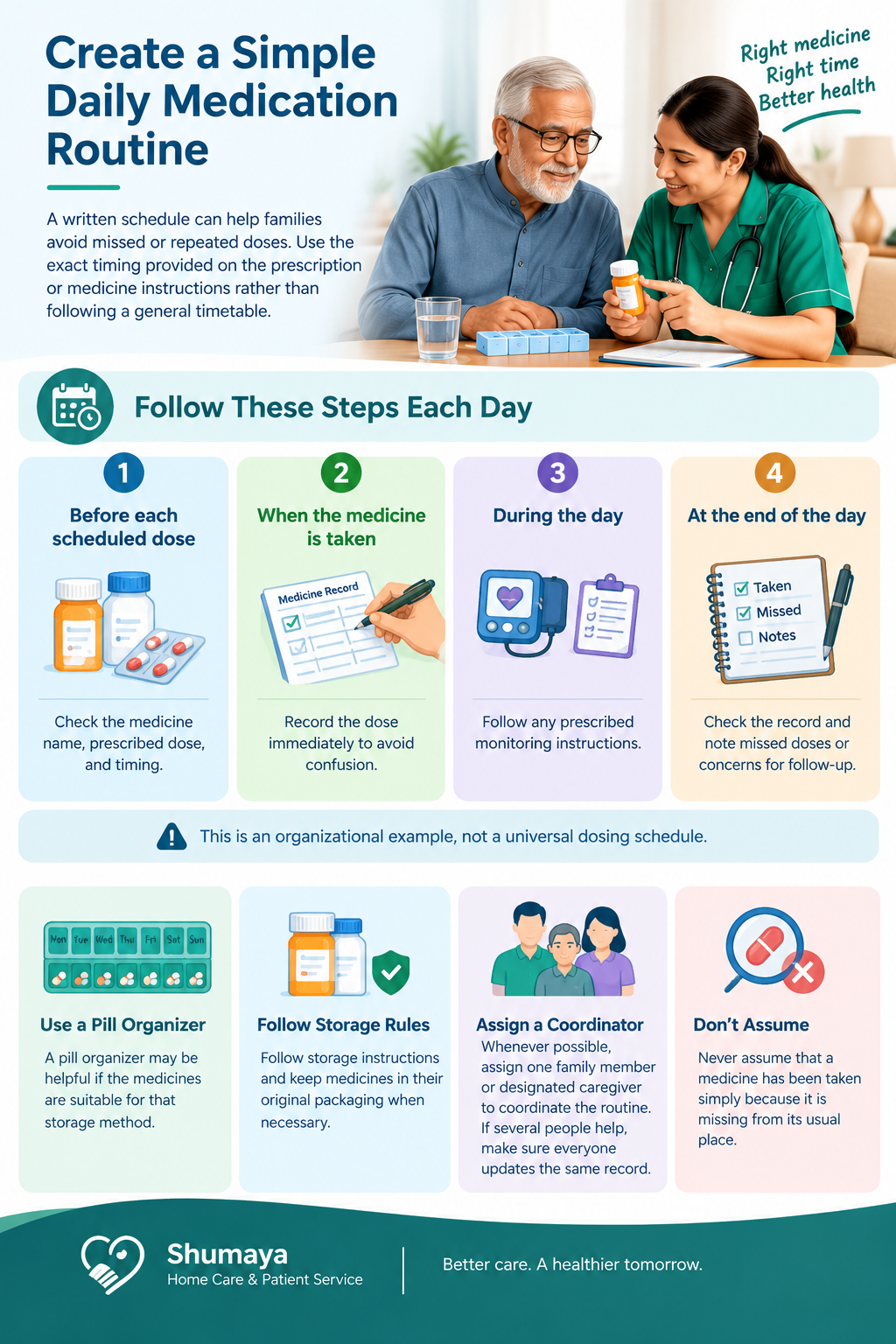
A written schedule can help families avoid missed or repeated doses. Use the exact timing provided on the prescription or medicine instructions rather than following a general timetable.
| Routine | What to do |
|---|---|
| Before each scheduled dose | Check the medicine name, prescribed dose, and timing. |
| When the medicine is taken | Record the dose immediately to avoid confusion. |
| During the day | Follow any prescribed monitoring instructions. |
| At the end of the day | Check the record and note missed doses or concerns for follow-up. |
This is an organizational example, not a universal dosing schedule.
A pill organizer may be helpful if the medicines are suitable for that storage method. Follow storage instructions and keep medicines in their original packaging when necessary.
Whenever possible, assign one family member or designated caregiver to coordinate the routine. If several people help, make sure everyone updates the same record.
Never assume that a medicine has been taken simply because it is missing from its usual place.
3. Check Medicines Carefully After Hospital Discharge
Medication safety deserves extra attention after a hospital stay, heart procedure, or change in treatment.
An elderly patient may return home with a new prescription, a different dose, or instructions to stop a medicine that was previously used.
To reduce confusion:
Collect the discharge prescription and any updated medicine instructions.
Compare them with the medicine list used before admission.
Identify medicines that have been started, changed, or discontinued.
Ask the doctor or pharmacist to clarify any differences you do not understand.
Update the daily schedule only after the instructions have been confirmed.
Do not restart an old medicine, combine conflicting instructions, or guess which prescription is correct.
If the patient has several doctors, make sure each knows about the medicines prescribed by the others. This can help identify possible interactions and unnecessary duplication.
4. What Should You Do if a Dose Is Missed?
An elderly patient may forget a dose, fall asleep, or become confused about the medication schedule.
If a dose is missed, the correct action depends on the specific medicine and how much time has passed.
Check the medicine’s patient information leaflet or missed-dose instructions.
Ask the pharmacist or prescribing doctor if the instructions are unclear.
Record the missed dose and any advice received.
Follow the professional guidance for returning to the regular schedule.
Never automatically give a double dose to make up for a missed one.
This is particularly important for medicines used to control heart rate, prevent blood clots, or manage heart failure. If you are unsure whether a dose has already been taken, do not give another dose simply to be safe. Check the record and seek advice.
5. Never Change Heart Medicines Without Medical Advice
A patient may feel better after taking medicines regularly and assume that treatment is no longer necessary. However, some heart conditions require ongoing treatment even when symptoms improve.
Stopping or changing medicines without medical advice may worsen the patient’s condition.
Examples of commonly prescribed medicine groups include:
Blood pressure medicines: Help control high blood pressure.
Diuretics: Help the body remove excess fluid when prescribed for conditions such as heart failure.
Anticoagulants or blood thinners: Reduce the risk of blood clots in selected patients.
Heart-rate medicines: Help control certain abnormal heart rhythms or other heart conditions.
Cholesterol-lowering medicines: Help reduce cardiovascular risk in appropriate patients.
These medicines have different purposes, precautions, and dosing instructions. Not every elderly heart patient needs all of them.
If the patient experiences dizziness, unusual weakness, bleeding, or other possible side effects, contact the treating healthcare professional. Do not independently stop or adjust the medicine unless emergency medical professionals direct you to do so.
6. Understand Medicines That Need Extra Care
Some medicines require particular attention because of their possible effects or interactions.
Blood thinners
Anticoagulants, including warfarin and certain newer medicines, help prevent blood clots in selected patients. They can also increase the risk of bleeding.
Families should:
Follow the prescribed dose carefully.
Check before giving new painkillers or supplements.
Report unusual bruising or bleeding.
Follow monitoring instructions, including INR blood tests when required for warfarin.
Seek urgent medical attention for serious bleeding, such as vomiting blood, black tarry stools, or bleeding that will not stop. A serious head injury also needs urgent assessment, even if the patient initially appears well.
Diuretics or water tablets
Diuretics may be prescribed to help manage excess fluid, including in some patients with heart failure.
These medicines can affect hydration, kidney function, and the levels of minerals such as potassium and sodium.
Follow the prescribed dose and the healthcare team’s instructions about fluid intake, weight monitoring, and blood tests. Do not restrict fluids or encourage extra water without considering the patient’s individual care plan.
Blood pressure and heart-rate medicines
Some medicines can lower blood pressure or slow the heart rate. Repeated dizziness, faintness, or unusual weakness should be reported to the treating doctor.
If the healthcare team has provided specific blood pressure or pulse limits, follow those instructions. Do not change a dose based on a single reading unless the care plan specifically tells you what action to take.
Potassium and supplements
Some heart patients need potassium-related treatment, while others must avoid extra potassium because of kidney problems or the effects of their medicines.
Do not give potassium supplements or salt substitutes containing potassium without checking with the doctor or pharmacist.
7. Check Before Giving Painkillers or Other New Medicines
An elderly heart patient may develop joint pain, a headache, a cough, or cold symptoms. Some medicines available without a prescription can affect heart conditions or interact with prescribed treatment.
For example, anti-inflammatory painkillers such as ibuprofen and naproxen can worsen fluid retention, blood pressure, kidney function, or heart failure in some patients. Certain cold remedies may also raise blood pressure or affect heart rate.
Before giving a new medicine:
Tell the pharmacist about the patient’s heart condition and other health problems.
Share the current medicine list.
Ask whether the product is suitable for the patient’s kidney function and existing treatment.
Check before using herbal products, supplements, or salt substitutes.
Do not assume a medicine is safe simply because it is available without a prescription.
8. Make Medicines Easier to Manage
Practical changes can help an older person who has poor eyesight, limited hand movement, memory difficulties, or trouble swallowing.
Families can:
Use a large-print medication schedule.
Set reminders on a phone or clock.
Provide good lighting when checking medicine labels.
Keep medicines in a secure, dry place according to the label.
Use a checklist to record each dose.
Ask the pharmacist about packaging that is easier to open.
If the patient has difficulty swallowing, ask the doctor or pharmacist whether an alternative formulation is available. Do not crush tablets or open capsules without checking first, because some formulations must remain intact.
If memory problems make it difficult to take medicines safely, arrange appropriate supervision rather than relying on reminders alone.
9. Watch for Side Effects and Changes in Health
Family members should pay attention to new or worsening symptoms and report concerns to the healthcare team.
Possible warning signs include:
Dizziness or light-headedness.
Unusual weakness or tiredness.
Fainting or near-fainting.
Unexplained bruising or bleeding.
An unusually slow or fast heartbeat.
Increasing swelling in the legs or ankles.
Worsening breathlessness.
New or worsening confusion.
These symptoms do not always mean a medicine is responsible. They may also indicate a change in the patient’s heart condition or another medical problem.
Depending on the care plan, families may be asked to record blood pressure, pulse, daily weight, swelling, or breathing changes.
For some heart failure patients, a sudden increase in weight may indicate fluid retention. Follow the patient’s individual weight-monitoring instructions and contact the healthcare team when the agreed threshold is reached.
Do not delay medical assessment while collecting measurements or completing a record.
10. Know When to Seek Medical Help
Contact the treating doctor or healthcare team when:
The patient repeatedly misses doses.
Side effects are persistent or interfere with daily activities.
The patient cannot swallow or keep medicines down.
A new medicine is prescribed by another healthcare professional.
Swelling or breathlessness becomes worse.
Blood pressure or pulse readings repeatedly fall outside the limits specified in the care plan.
The family is unsure how to manage a missed dose.
Memory problems make safe medication use difficult.
Seek emergency medical care immediately if the patient develops chest pain, severe breathing difficulty, collapses, shows signs of a stroke, or has another serious or rapidly worsening symptom.
Do not wait for a home nurse or routine appointment when emergency symptoms occur.
Can a Home Nurse Help an Elderly Heart Patient Take Medicines Safely?
Some elderly heart patients need additional support after hospital discharge or when their medication routine becomes difficult to manage.
A qualified home nurse may help with medication-related care within their professional scope and the prescribed care plan. This may include checking the current instructions, providing permitted medication assistance, monitoring the patient’s condition, documenting concerns, and communicating changes to the family and healthcare team.
A patient attendant has a different role. Depending on their training and care plan, an attendant may help with meals, personal hygiene, mobility, reminders, and other daily activities. Do not assume that a patient attendant is qualified to administer medicines or perform clinical nursing procedures.
The need for a male or female care professional depends on the patient’s preferences, privacy, personal-care needs, and the type of support required.
Families looking for elderly patient care at home in Lahore, Pakistan, should explain the patient’s condition, medication routine, mobility, and level of supervision needed when arranging care.
Shumaya Home Care & Patient Service provides home nursing and patient support services in Lahore. The suitable level of support depends on the patient’s needs and the qualifications of the staff assigned.
Learn more about home nursing services in Lahore to discuss suitable care options for your loved one.
Frequently Asked Questions
How can I help an elderly heart patient remember their medicines?
Use a written medication schedule, phone reminders, or a suitable pill organizer. Keep an updated medicine list and arrange supervision if memory problems make it difficult for the patient to take medicines safely.
What should I do if an elderly heart patient refuses medicine?
Ask calmly why the patient does not want to take it. They may have concerns about side effects, difficulty swallowing, or confusion about the treatment. Do not force the medicine or secretly mix it into food. Contact the treating healthcare professional to discuss the problem.
Should I give a missed heart medicine dose as soon as I remember?
Not always. The correct action depends on the medicine and how much time has passed. Check the medicine-specific instructions or ask a pharmacist or doctor. Never double the next dose unless a qualified healthcare professional specifically instructs you to do so.
Can an elderly heart patient take painkillers?
Some painkillers may be unsuitable for people with heart disease, high blood pressure, kidney problems, or certain prescriptions. Ask the doctor or pharmacist before giving a new painkiller, including one available without a prescription.
When should a family consider home nursing services for an elderly heart patient?
Home nursing may be useful when the patient needs professional nursing support, help following a care plan, monitoring as directed, or closer supervision after discharge. The appropriate level of care depends on the patient’s condition and the treating team’s recommendations.
Arrange Appropriate Home Care for an Elderly Heart Patient in Lahore
Helping an older adult take medicines safely requires a clear routine, accurate records, and regular communication with healthcare professionals. Families can reduce confusion by checking prescriptions carefully, recording doses, and reporting new symptoms promptly.
If your elderly family member needs additional help at home, Shumaya Home Care & Patient Service can discuss suitable care options in Lahore. Depending on the patient’s needs, these may include professional home nursing services or a trained patient attendant for everyday assistance.
Contact Shumaya Home Care & Patient Service to discuss your loved one’s condition, medication routine, and level of support required. Always follow the treating doctor’s instructions when starting, changing, or stopping medicines.