
Choosing the right home nurse is an important decision for families arranging professional healthcare at home. Besides qualifications and clinical experience, many families also consider whether a male or female nurse would be more suitable for their loved one.
Some patients feel more comfortable receiving personal care from a nurse of the same gender. Others prioritize clinical experience, specialized training, communication skills, and the nurse’s ability to manage their medical condition.
But is a male nurse better than a female nurse? Can a female nurse provide care to a male patient? What should families consider before hiring a home nurse?
The truth is that both male and female nurses can provide professional nursing care. The right choice depends on the patient’s medical requirements, personal preferences, privacy, and the nurse’s qualifications.
In this guide, we explain the differences between male and female nurses, their responsibilities, professional qualifications, and how to choose the right home nurse for your family.
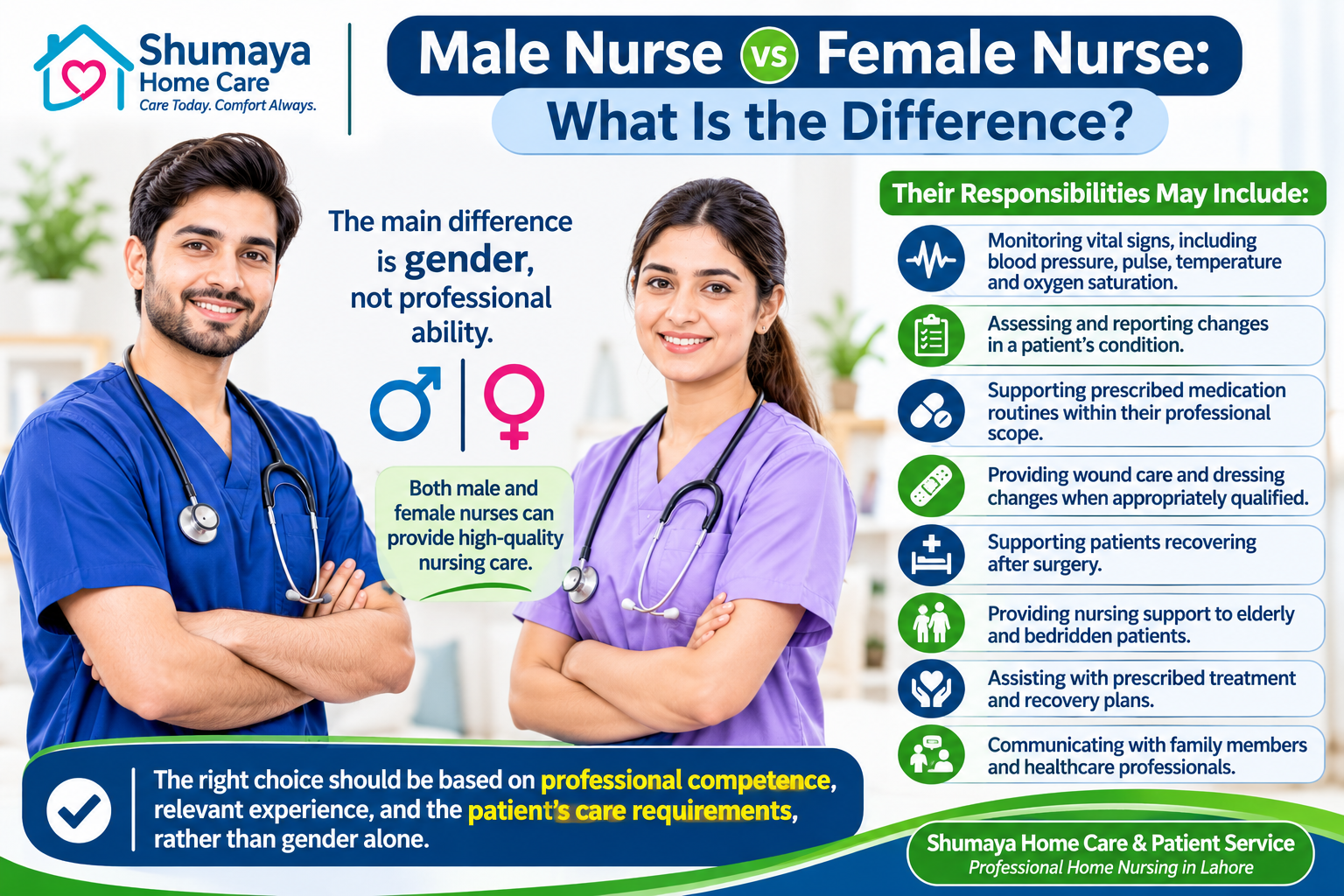
Male Nurse vs Female Nurse: What Is the Difference?
The main difference between a male nurse and a female nurse is gender, not professional ability.
Both can provide nursing services when they have the appropriate education, professional credentials, training, and clinical experience.
Their responsibilities may include:
Monitoring vital signs, including blood pressure, pulse, temperature, and oxygen saturation.
Assessing and reporting changes in a patient’s condition.
Supporting prescribed medication routines within their professional scope.
Providing wound care and dressing changes when appropriately qualified.
Supporting patients recovering after surgery.
Providing nursing support to elderly and bedridden patients.
Assisting with prescribed treatment and recovery plans.
Communicating with family members and healthcare professionals.
The suitability of a nurse should be determined by professional competence, relevant experience, and the patient’s care requirements rather than gender alone.
When Is a Male Nurse Preferred?
Some families prefer a male nurse when arranging nursing care for a male patient. This preference may be particularly important when the patient requires regular personal assistance, mobility support, or long-term home nursing.
Here are some situations in which a male nurse may be preferred.
1. Male Patients Who Prefer Male Nursing Staff
Some male patients feel more comfortable receiving personal care from another man.
This preference may be important when assistance involves personal hygiene, dressing, bathing, or other activities requiring physical contact.
A male nurse can provide appropriate nursing support while respecting the patient’s privacy and dignity.
2. Elderly Male Patients
Older men may experience age-related health conditions, reduced mobility, or chronic illnesses that affect their independence.
A male nurse may be a suitable option when an elderly male patient prefers male nursing staff.
Depending on the patient’s condition, nursing support may include vital-sign monitoring, prescribed treatment support, recovery assistance, and reporting changes in health.
3. Bedridden Male Patients
Bedridden patients may require regular monitoring, repositioning, and assistance with different aspects of their care.
A male nurse with relevant experience may provide professional nursing support according to the patient’s care plan.
Proper patient-handling techniques and suitable equipment are important when repositioning or transferring patients, regardless of the nurse’s gender.
4. Male Patients Recovering After Surgery
Patients recovering from surgery may need professional nursing assistance during their recovery at home.
A male nurse may be preferred by patients who feel more comfortable receiving personal nursing care from a man.
Depending on the procedure and prescribed instructions, nursing responsibilities may include wound assessment, dressing changes, monitoring vital signs, and observing recovery progress.
Clinical procedures must be performed by appropriately qualified staff.
5. Male Patients Requiring Long-Term Nursing Care
Some patients with chronic illnesses, neurological conditions, or long-term mobility problems require consistent nursing support.
A male nurse may be appropriate when the patient’s care needs, personal preferences, and the nurse’s clinical experience are a suitable match.
When Is a Female Nurse Preferred?
A female nurse may be preferred by families arranging professional care for a female patient.
This preference can be particularly important when nursing care involves personal hygiene, dressing, bathing assistance, or other activities where privacy and comfort are important.
1. Female Patients Who Prefer Female Nursing Staff
Some women feel more comfortable receiving personal nursing care from another woman.
A female nurse may be preferred for bathing assistance, dressing, hygiene support, and other personal-care activities.
Respecting the patient’s preferences can help create a more comfortable home-care environment.
2. Elderly Female Patients
Older women may require nursing assistance because of reduced mobility, chronic illnesses, or age-related health conditions.
A female nurse may be a suitable choice when an elderly woman prefers female healthcare staff.
Depending on the patient’s needs, support may include:
Monitoring vital signs.
Supporting prescribed treatment routines.
Providing nursing assistance during recovery.
Monitoring changes in the patient’s condition.
Supporting appropriate personal-care arrangements.
Communicating with family members about care requirements.
3. Female Patients Recovering After Surgery
Some women prefer female nursing staff during recovery after surgery.
Depending on the surgical procedure, a home nurse may provide wound assessment, dressing changes, vital-sign monitoring, and other nursing support within their professional qualifications.
The nurse should follow the treating doctor’s instructions and appropriate clinical procedures.
4. Female Patients With Limited Mobility
Patients with reduced mobility may require assistance with positioning, movement, and other aspects of their daily care.
A female nurse may be preferred when a female patient feels more comfortable receiving care from another woman.
The nurse’s relevant training and experience should match the patient’s needs.
5. Elderly Women Living Alone
An elderly woman living alone may need regular nursing visits or longer home-care arrangements.
A female nurse may be preferred when the patient feels more comfortable with female nursing staff.
The appropriate arrangement depends on the patient’s health, independence, care requirements, and personal preferences.
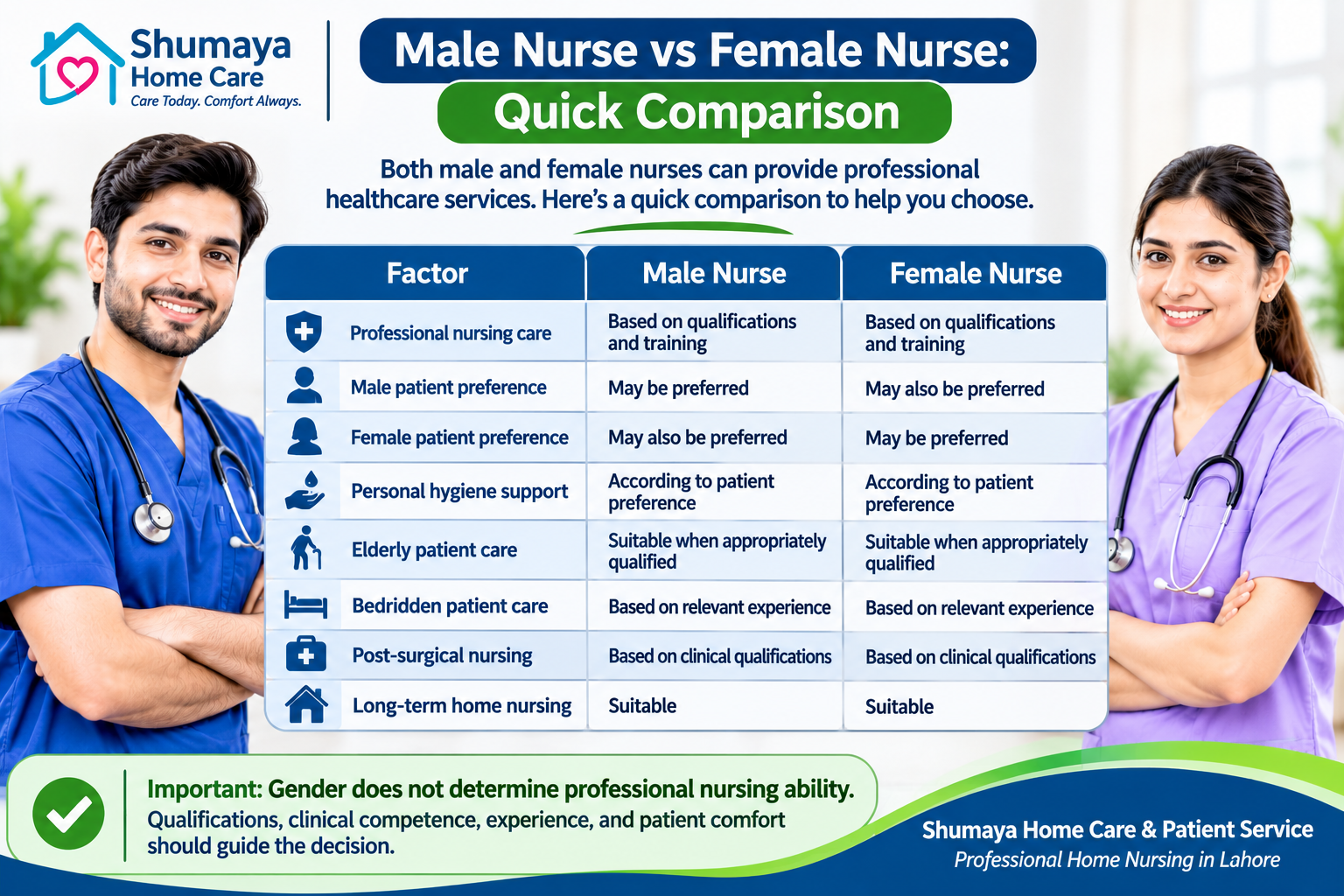
Male Nurse vs Female Nurse: Quick Comparison
Both male and female nurses can provide professional healthcare services. The following comparison highlights the factors families may consider when choosing between them.
| Factor | Male Nurse | Female Nurse |
|---|---|---|
| Professional nursing care | Based on qualifications and training | Based on qualifications and training |
| Male patient preference | May be preferred | May also be preferred |
| Female patient preference | May also be preferred | May be preferred |
| Personal hygiene support | According to patient preference | According to patient preference |
| Elderly patient care | Suitable when appropriately qualified | Suitable when appropriately qualified |
| Bedridden patient care | Based on relevant experience | Based on relevant experience |
| Post-surgical nursing | Based on clinical qualifications | Based on clinical qualifications |
| Long-term home nursing | Suitable | Suitable |
Important: Gender does not determine professional nursing ability. Qualifications, clinical competence, experience, and patient comfort should guide the decision.
What Qualifications Should a Male or Female Home Nurse Have?
Before hiring a male or female home nurse, families should check professional qualifications and relevant clinical experience.
A nurse’s gender should never replace the need to verify professional credentials.
Consider the following factors:
1. Nursing Education and Professional Registration
Check the nurse’s nursing education, qualifications, and applicable professional registration.
In Pakistan, families can verify relevant nursing registration and credentials through the Pakistan Nursing and Midwifery Council (PNMC).
2. Relevant Clinical Experience
Different patients require different types of nursing support.
For example:
Post-surgical patients may need nurses experienced in post-operative care.
Bedridden patients may need support with positioning and ongoing monitoring.
Elderly patients may need experience with age-related health conditions.
Patients with complex medical conditions may require specialized clinical experience.
Choose a nurse whose experience matches the patient’s condition.
3. Infection Prevention and Control
A professional home nurse should understand proper hand hygiene, safe use of protective equipment, appropriate waste disposal, and infection-prevention practices.
These measures are particularly important for elderly, bedridden, and post-surgical patients.
4. Communication Skills
A home nurse should communicate clearly with patients, family members, and healthcare professionals.
Good communication helps families understand the patient’s care requirements and recognize changes that may need medical attention.
5. Professional Conduct and Patient Privacy
A suitable nurse should respect patient confidentiality, consent, personal boundaries, and cultural preferences.
Families should also establish clear responsibilities and reporting arrangements before nursing care begins.
How to Choose the Right Home Nurse for Your Patient
Choosing between a male nurse and a female nurse should involve more than personal preference.
Follow these practical steps before arranging home nursing services.
Step 1: Understand the Patient’s Medical Condition
Identify whether the patient needs routine nursing support, post-surgical care, chronic disease monitoring, or long-term assistance.
Step 2: Identify the Required Nursing Skills
Determine whether the patient needs specialized clinical experience, wound care, mobility support, or regular monitoring.
Step 3: Discuss Gender Preference
Ask the patient whether they prefer a male or female nurse, particularly if personal hygiene and privacy are involved.
Step 4: Verify Qualifications and Experience
Check professional credentials, applicable registration, relevant training, and experience.
Step 5: Confirm Working Hours
Discuss whether the patient needs daytime, nighttime, 12-hour, or 24-hour nursing arrangements.
Step 6: Discuss Responsibilities
Clearly establish the nurse’s duties, clinical responsibilities, reporting process, and communication with the treating doctor.
Step 7: Review the Quality of Care
After nursing care begins, monitor whether the patient’s needs are being met and whether the arrangement remains comfortable and appropriate.
Can a Male Nurse Care for a Female Patient?
Yes. A male nurse can provide professional nursing care to a female patient when appropriately qualified and when the arrangement respects the patient’s consent, privacy, and preferences.
Similarly, a female nurse can provide nursing care to a male patient.
There is no universal requirement that a patient must always receive care from a nurse of the same gender.
However, families should discuss personal preferences before arranging home nursing services.
For intimate personal care, patients may prefer a same-gender healthcare professional. Their wishes should be respected wherever possible.
Can a Female Nurse Care for a Male Patient?
Yes. A female nurse can provide professional nursing care to male patients.
For example, a male patient recovering after surgery may receive nursing assistance from a female nurse if the patient is comfortable with the arrangement.
The nurse should have the appropriate qualifications and experience for the required care.
Patient consent, privacy, dignity, and professional conduct should always remain important considerations.
Home Nurse vs Patient Attendant: Which One Do You Need?
A home nurse and a patient attendant have different responsibilities. Understanding this difference helps families arrange appropriate support.
Home Nurse
A qualified home nurse provides professional nursing care according to their education, competence, and professional scope.
Responsibilities may include:
Nursing assessments and clinical monitoring.
Monitoring vital signs.
Wound care and dressing changes when qualified.
Post-operative nursing support.
Supporting prescribed clinical treatment.
Reporting changes in the patient’s condition.
Patient Attendant
A patient attendant mainly helps patients with daily activities, personal care, and comfort.
Responsibilities may include:
Assistance with bathing and personal hygiene.
Helping with dressing and grooming.
Feeding assistance.
Supporting safe movement and mobility.
Toileting assistance.
Repositioning according to the care plan.
Companionship and general patient support.
A patient attendant does not replace a qualified nurse and should not independently perform clinical nursing procedures.
Some patients may require both nursing and attendant support, depending on their medical condition and level of independence.
For more information, read our detailed guide: Staff Nurse vs Patient Attendant.
Male and Female Home Nursing Services in Lahore
Families in Lahore may have different requirements when arranging professional healthcare at home.
Some need a male nurse for an elderly father, while others prefer a female nurse for their mother or another female family member.
Patients recovering after surgery, living with chronic illnesses, or experiencing limited mobility may also require regular nursing assistance.
Shumaya Home Care & Patient Service provides gender-specific home-care staffing options, including male and female nursing staff and patient attendants, according to patient requirements and service availability.
Our home nursing services in Lahore are intended to help families arrange appropriate professional support for patients who need care at home.
Whether you need a male nurse, female nurse, or trained patient attendant, we can help you identify a suitable care arrangement based on:
The patient’s medical condition.
Required nursing or personal-care responsibilities.
Staff qualifications and relevant experience.
Patient’s gender preference and comfort.
Required working hours and care arrangements.
Families seeking home patient services in Lahore, Pakistan, can discuss their requirements with our team.
We also support families looking for elderly patient care at home in Lahore, Pakistan, including nursing and daily personal-care assistance according to individual needs.
Frequently Asked Questions
1. Is a male nurse better than a female nurse?
Neither is automatically better. Both male and female nurses can provide professional nursing care. Qualifications, clinical experience, training, and patient comfort are more important than gender.
2. Can a male nurse provide care to a female patient?
Yes. A qualified male nurse can provide professional care to a female patient when the arrangement respects her consent, privacy, and preferences.
3. Can a female nurse provide care to a male patient?
Yes. Female nurses can provide professional nursing care to male patients according to their qualifications and the patient’s care requirements.
4. What qualifications should a home nurse have in Pakistan?
Families should check nursing education, relevant professional credentials, applicable PNMC registration, clinical experience, and training appropriate to the patient’s condition.
5. Should I hire a nurse or a patient attendant?
Hire a qualified nurse when the patient requires clinical nursing care. A patient attendant is generally more suitable for daily personal assistance, feeding, bathing, dressing, mobility, and companionship.
6. Is a male nurse suitable for an elderly father?
Yes. A male nurse may be suitable for an elderly male patient who needs professional nursing support, provided the nurse has the relevant qualifications and experience.
7. Can I request a female nurse for my mother at home?
Yes. Families can request female nursing staff when arranging home nursing services, subject to suitable staff availability and the patient’s requirements.
8. Can I arrange a male or female home nurse in Lahore?
Yes. Families can contact home healthcare providers in Lahore to discuss their requirements and request suitably qualified male or female nursing staff.
Choose the Right Home Nursing Support With Shumaya
Choosing between a male nurse and a female nurse is a personal decision that should consider the patient’s medical condition, comfort, privacy, and family preferences.
Both male and female nurses can provide professional nursing care when they have the appropriate qualifications, training, and experience.
If your family needs a male or female home nurse in Lahore, Shumaya Home Care & Patient Service can help arrange suitable home-care support according to the patient’s requirements and staff availability.
We provide home nursing services and patient attendant support for elderly patients, bedridden individuals, post-surgical patients, and people who need assistance with daily care.
Contact Shumaya Home Care & Patient Service today to discuss your requirements and arrange suitable male or female home-care staff for your loved one.
Website: https://www.shumayahomecare.pk/