
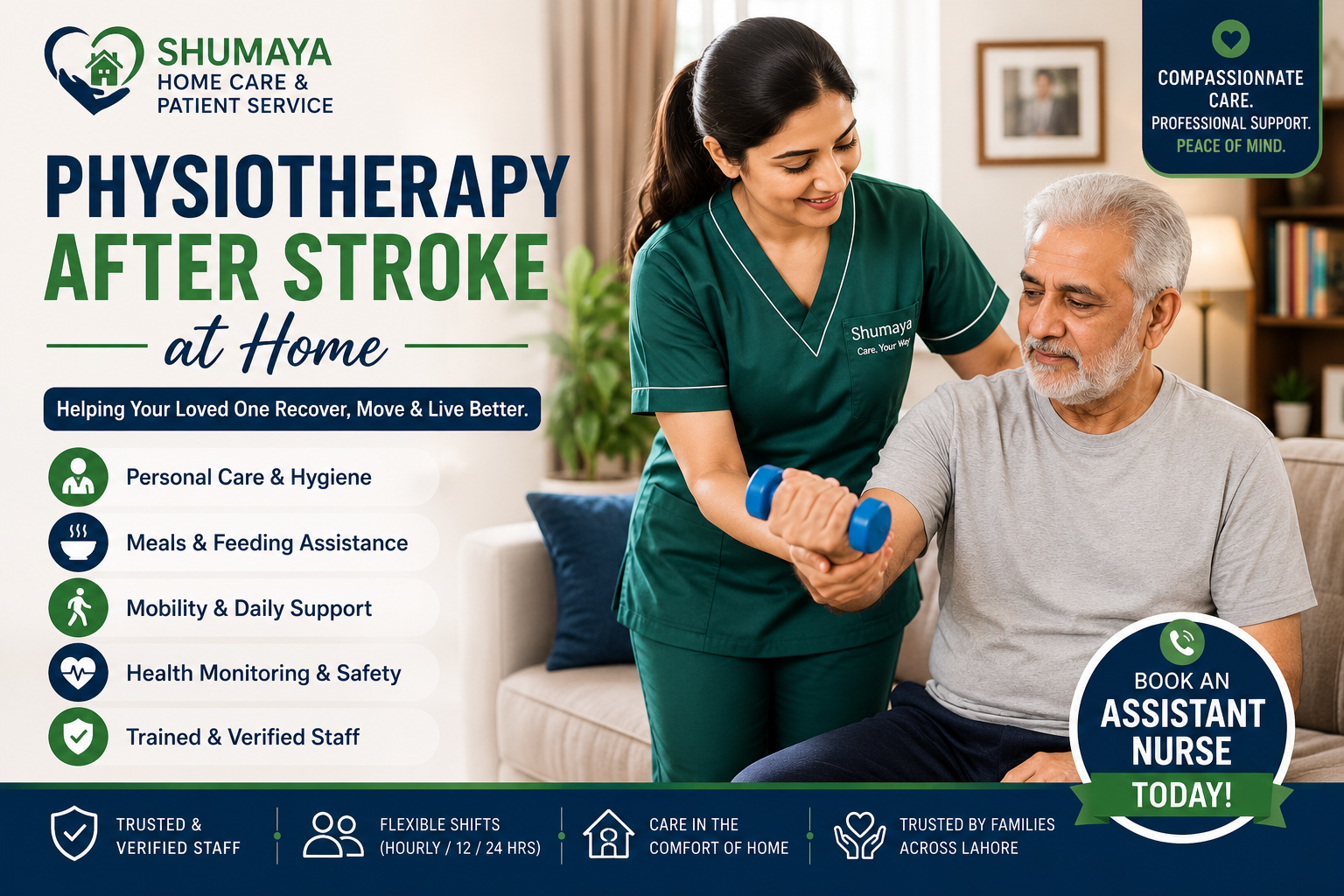
A stroke can change everyday life in an instant. Here's how families in Lahore can support safe, guided rehabilitation at home — from first exercises to knowing when to call for help.
Physiotherapy after a stroke is a form of rehabilitation that helps a patient improve movement and physical function. A stroke can affect one side of the body, making an arm or leg weak. Some patients also have problems with balance, coordination, walking, or muscle stiffness.
A physiotherapist assesses the patient's condition and develops exercises based on their specific needs. Treatment may focus on:
- Improving muscle strength
- Maintaining joint movement
- Improving balance and coordination
- Practicing safe standing and walking
- Improving the use of an affected arm or leg
- Training everyday movements
- Reducing the risk of falls
- Building confidence with physical activity
Recovery is different for every stroke survivor. The exercises that are safe and useful for one patient may not be suitable for another. Repeated, guided practice can help the patient relearn movements and become more capable of performing everyday activities.
Home-based physiotherapy allows rehabilitation to take place in the environment where the patient spends most of their time. This can be especially helpful when travelling to a clinic is difficult because of weakness, mobility problems, transportation issues, or the need for family assistance.
Patients Can Practice Real-Life Movements
The Patient Stays in a Familiar Environment
Some stroke survivors feel anxious or tired when travelling for treatment. Receiving physiotherapy at home removes some of that difficulty and allows the patient to work in a familiar space.
Family Caregivers Can Learn How to Help
Home sessions give caregivers a chance to understand how to support the patient safely. A physiotherapist can show family members how to assist with movements, positioning, transfers, and walking — without taking over tasks the patient can still do independently.
It Can Make Regular Therapy Easier
Stroke rehabilitation often involves repeated practice. Having therapy at home may make it easier for some families to maintain a regular routine. For families arranging physiotherapy at home in Lahore, the patient's mobility, safety, medical condition, and rehabilitation needs should all be considered when choosing the right type of support.
The timing of physiotherapy depends on the patient's medical condition and the advice of their healthcare team. Rehabilitation may begin during the hospital stay once the patient is medically stable. After discharge, therapy may continue at a rehabilitation center or at home.
There is no single starting point or recovery schedule for every stroke survivor. The severity and location of the stroke, the patient's strength and balance, other health conditions, and their response to treatment can all affect the rehabilitation plan.
Family members should follow the recommendations of the patient's doctor and physiotherapist rather than starting difficult exercises on their own.
Stroke exercises should be selected according to the patient's abilities. A physiotherapist should demonstrate the appropriate exercises and explain how often they should be performed.
Range-of-Motion Exercises
Gentle movements can help maintain joint flexibility and reduce stiffness. Depending on the patient's condition, therapy may include carefully moving the arm, wrist, fingers, leg, or ankle through a comfortable range of movement. If the patient cannot move a limb independently, a caregiver may sometimes be taught how to assist — only as instructed by the physiotherapist.
Strengthening Exercises
Stroke can cause weakness in an arm, leg, or one side of the body. A physiotherapist may introduce simple strengthening exercises when appropriate, involving controlled body movements, resistance, or weight-bearing activities. More exercise is not always better, especially when the patient becomes tired or loses control of the movement.
Balance Training
- Sitting with good control
- Standing safely
- Shifting weight from one side to another
- Maintaining a stable position
- Moving between sitting and standing
Gait and Walking Training
Some stroke survivors need to relearn how to walk. Walking therapy may involve practicing proper foot placement, weight shifting, standing control, and safe steps. A patient may need a walking aid such as a cane or walker — the appropriate device and level of support should be decided by a qualified professional. Family members should not pull or force a patient to walk if they are unable to maintain safe control.
Hand and Finger Exercises
A stroke can affect grip, finger movement, and the ability to use the affected hand. A physiotherapist may recommend repeated hand and finger movements to work on control and coordination — skills that can later connect to daily activities like holding a cup, using a spoon, buttoning clothing, or picking up light objects when safe.
Family support can make a big difference, but caregivers should think of themselves as supporters rather than replacing the physiotherapist. Here are practical ways to help.
- Create a simple routine — follow the exercise schedule provided by the physiotherapist, without adding extra exercises just because the patient appears to be improving.
- Keep the exercise area safe — remove loose rugs, clutter and wires, ensure enough space, and use any walker, cane, or grab rail as instructed.
- Encourage independence — if the patient can safely perform part of an activity, let them try, rather than doing the entire task for them.
- Watch for fatigue — follow recommended exercise duration and rest, and stop if the patient becomes unusually tired, dizzy, or unwell.
- Celebrate small improvements — longer sitting, a moving finger, or a few safer steps all matter, and encouragement helps without adding pressure.
Family members usually want to help as much as possible, but some approaches can make rehabilitation harder or less safe.
Pushing too hard
Trying to force more exercises than recommended can lead to fatigue, frustration, or unsafe movement. Follow the rehabilitation plan instead.
Skipping professional guidance
Not every exercise found online is suitable after a stroke. Use only exercises recommended or demonstrated by the patient's physiotherapist.
Doing everything for the patient
Constantly helping can unintentionally reduce chances to practice movement. Let the patient participate whenever it's safe.
Ignoring pain or unusual symptoms
Exercise should never push through unexplained pain or a sudden change in condition. Stop and contact a healthcare professional.
Allowing unsafe walking
A patient who seems stronger may still have poor balance. Don't assume independent walking is safe after just a few therapy steps — follow guidance on supervision and walking aids.
A safe home environment is an important part of stroke recovery. Families can review the patient's usual walking areas and remove common fall risks. Helpful steps may include:
- Keeping floors and walkways clear
- Removing loose rugs
- Improving lighting in hallways and bathrooms
- Keeping frequently used items within safe reach
- Using recommended handrails or grab bars
- Keeping mobility aids nearby
- Avoiding unnecessary furniture in walking paths
The exact changes needed depend on the patient's mobility and the layout of the home. A physiotherapist can also identify movement-related safety problems during a home visit.
⚠️ When to Stop Exercise and Seek Medical Help
Physiotherapy is generally planned around the patient's medical condition, but new symptoms should never be ignored. Stop the exercise session and seek medical advice if the patient develops:
- Sudden or worsening weakness or numbness
- New difficulty speaking or understanding speech
- Severe or sudden headache
- Chest pain
- Difficulty breathing
- Loss of consciousness
- Severe dizziness
- A fall that may have caused an injury
If symptoms could indicate another stroke, seek emergency medical care immediately.
Home physiotherapy may be useful when a stroke survivor has difficulty travelling to a clinic or needs rehabilitation focused on everyday activities at home. It may also help patients who need assistance with walking and transfers, balance training, mobility exercises, positioning, strength and movement exercises, using recommended walking aids, or creating a safe movement routine.
For families in Lahore, professional home physiotherapy services can provide structured rehabilitation while allowing the patient to remain at home.
Some stroke survivors also need help with bathing, dressing, mobility, medication reminders, or other daily activities. When these needs are difficult for family members to manage alone, professional home nursing or patient care support may work alongside the physiotherapy plan. The right combination of services depends on the patient's condition and the recommendations of their healthcare team.
How soon after a stroke can physiotherapy start?
Physiotherapy may begin during the hospital stay once the patient is medically stable. The timing and type of therapy depend on the severity of the stroke, the patient's condition, and the rehabilitation team's assessment.
How long does stroke recovery take?
There is no fixed recovery timeline. Some patients make noticeable improvements within weeks, while others continue rehabilitation for months or longer. Recovery can be affected by the type and severity of the stroke, overall health, age, therapy, and other individual factors.
Can family members help with stroke physiotherapy exercises?
Yes. Family support can be very helpful, but caregivers should follow exercises and instructions provided by the patient's physiotherapist. They should not introduce difficult exercises without professional guidance.
Is home physiotherapy suitable for every stroke patient?
Not necessarily. Home physiotherapy can be appropriate for many patients, particularly when travelling is difficult or rehabilitation needs to focus on everyday activities at home. However, the best setting depends on the patient's medical and rehabilitation needs.
How often should a stroke patient do physiotherapy exercises at home?
The frequency depends on the patient's rehabilitation plan. Some patients may have exercises to practice between professional sessions, while others may need more supervision. Follow the schedule provided by the physiotherapist rather than using a general exercise schedule.
Can physiotherapy help a stroke patient walk again?
Physiotherapy can help some stroke survivors improve strength, balance, coordination, and walking ability. However, the amount of recovery varies from person to person. A physiotherapist can assess the patient's walking ability and create an appropriate training plan.
Stroke recovery is a process, and progress may come in small steps. For some patients, improvement may mean standing with less support. For others, it may mean walking a few more steps, using an affected hand during a daily task, or moving around the home with greater confidence.
Physiotherapy after stroke at home gives patients an opportunity to practice these skills in the environment where they live. With a safe exercise plan, regular practice, professional guidance, and patient family support, rehabilitation can become part of everyday life.
Family caregivers do not need to do everything themselves. When professional physiotherapy or additional home care is needed, the right support can make daily recovery safer and more manageable while keeping the patient's individual needs at the center of care.
Need Guided Stroke Physiotherapy at Home?
Talk to Shumaya Home Care for a free consultation and a rehabilitation plan built around your loved one's needs.
Learn more about our team on the About Us page.